
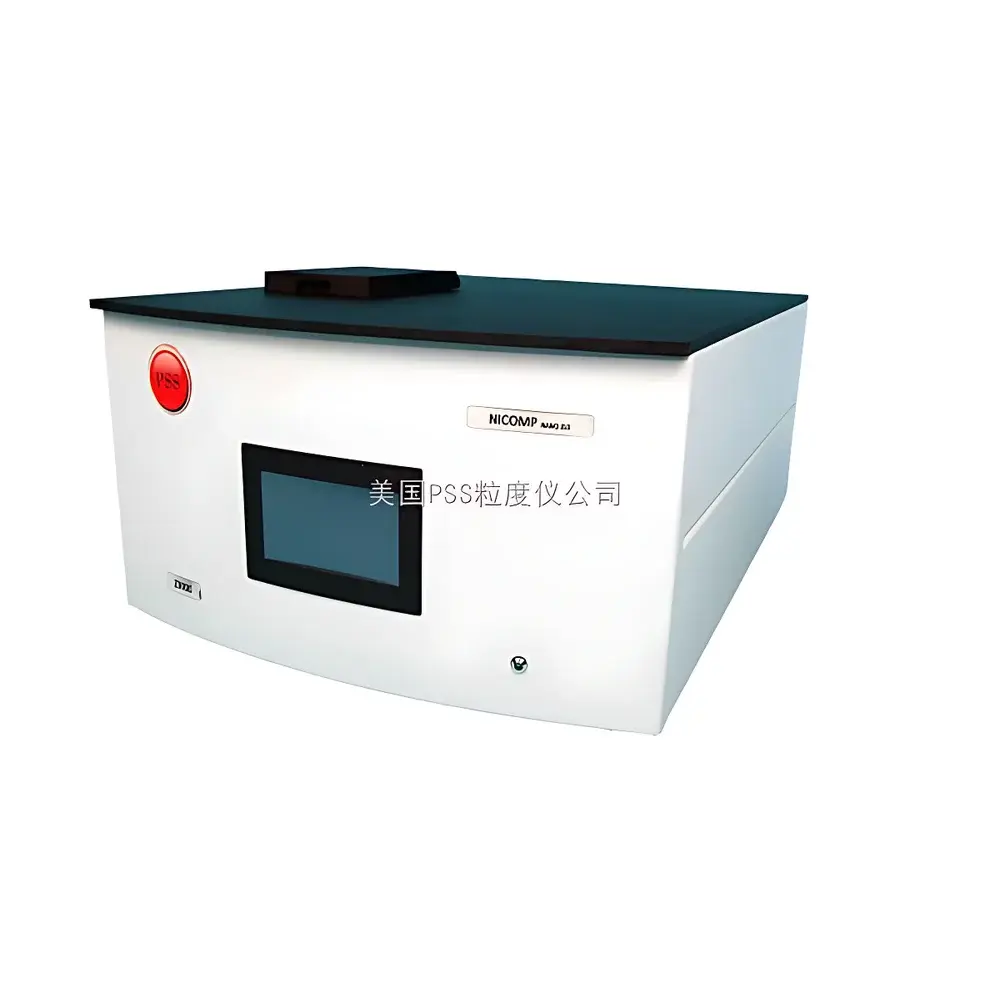
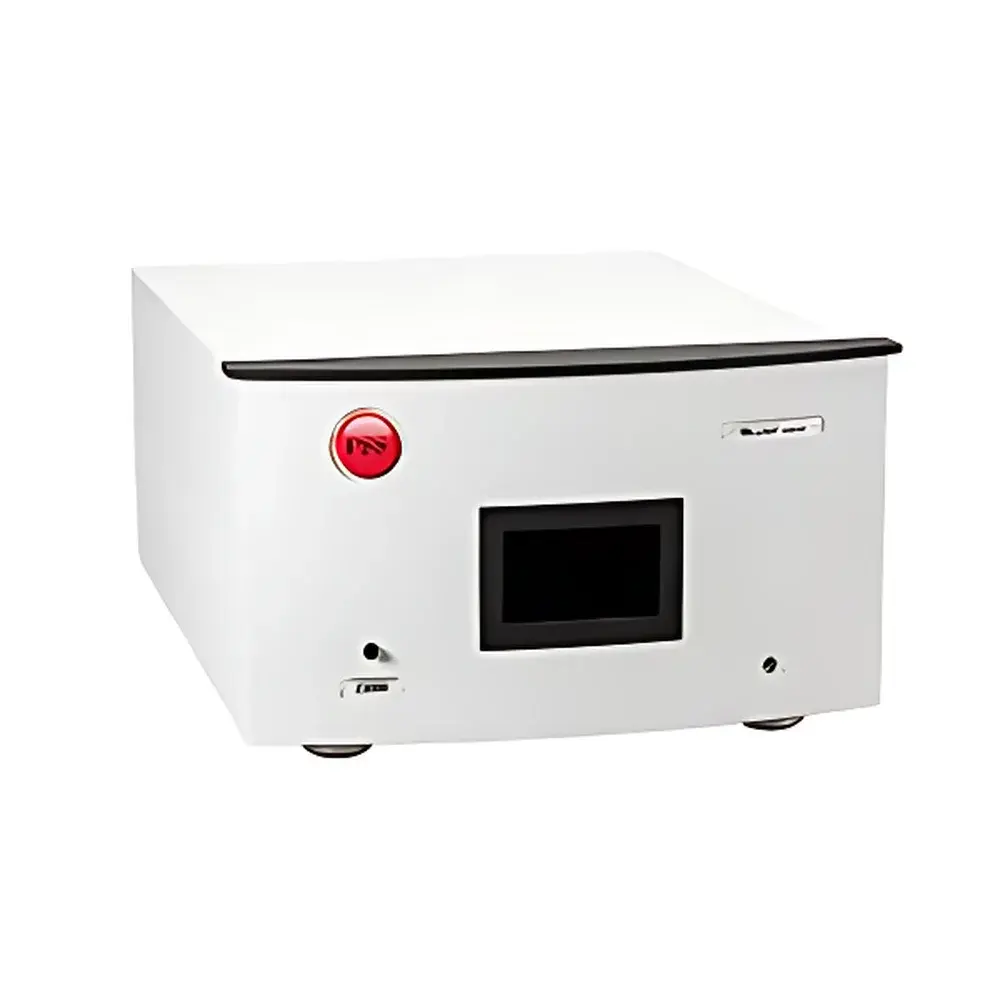
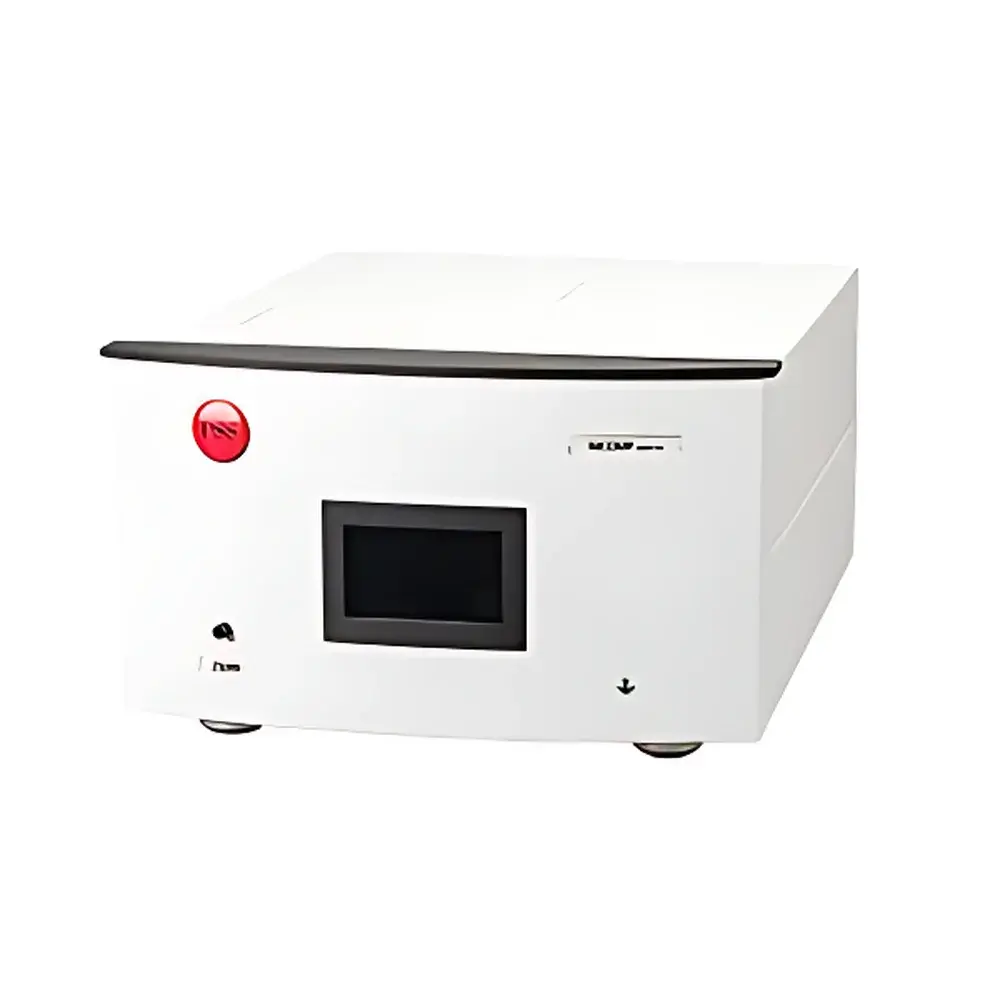
PSS Nicomp N3000 Basic Dynamic Light Scattering (DLS) Nanoparticle Size Analyzer
| Brand | Particle Sizing Systems (PSS), USA |
|---|---|
| Origin | USA |
| Model | Nicomp N3000 Basic |
| Measurement Principle | Dynamic Light Scattering (DLS) |
| Size Range | 0.3 nm – 6 μm |
| Dispersion Method | Wet & Dry |
| Instrument Type | Benchtop Laboratory DLS Analyzer |
| Repeatability | <1% |
| Analysis Time | 10–15 seconds |
| Laser Source | ≥35 mW, 635 nm red diode |
| Detection Angle | Multi-angle (10°–175°, 0.7° step, including 90°) |
| Detector | APD-LDC (Avalanche Photodiode with 7–10× gain vs. PMT) |
| Temperature Control | 0–90 °C (±0.1 °C stability) |
| pH Range | 1–14 |
| Sample Volume | 10 µL (min, with 1 mL cuvette) to 4 mL |
| Compliance | USP <729>, EP 2.9.31, FDA 21 CFR Part 11 (software optional), GLP/GMP-ready |
Overview
The PSS Nicomp N3000 Basic is a high-performance benchtop nanoparticle size analyzer engineered for precision characterization of colloidal dispersions and macromolecular systems using Dynamic Light Scattering (DLS). Unlike conventional single-algorithm DLS instruments, the Nicomp N3000 implements a dual-mode analysis architecture—simultaneously supporting Gaussian monomodal distribution fitting and the proprietary Nicomp multimodal algorithm—to resolve complex, polydisperse samples with physiologically or industrially relevant heterogeneity. Its operational principle relies on quantifying temporal fluctuations in scattered laser intensity arising from Brownian motion, converting autocorrelation decay into diffusion coefficients via the Stokes-Einstein equation, and ultimately deriving hydrodynamic diameter distributions without calibration standards. Designed for rigorous laboratory environments, the system delivers sub-nanometer resolution across a validated range of 0.3 nm to 6 μm—covering proteins, micelles, liposomes, polymer nanoparticles, and inorganic colloids—with exceptional sensitivity enabled by an APD-LDC detector and multi-angle optical configuration.
Key Features
- Proprietary Nicomp multimodal algorithm: Resolves true particle population structure in polydisperse systems (e.g., HDL/LDL/VLDL in serum), distinguishing components differing in size by as little as 1:2 intensity ratio.
- APD-LDC detector: Avalanche photodiode with 7–10× higher quantum efficiency than standard PMTs, enabling reliable detection of low-scattering species (e.g., proteins at <1 mg/mL, surfactant micelles, weakly refractive polymers).
- Multi-angle detection (10°–175°, 0.7° resolution): Optimizes signal-to-noise for particles >100 nm where angular dependence of scattering intensity becomes significant; eliminates angle-dependent bias in broad PSDs.
- Modular architecture: Supports field-upgradable options including automated dilution module (handles up to 40% w/v stock solutions), motorized multi-angle goniometer, and optional autosampler (60-position capacity).
- High-power tunable laser platform: Configurable 35–100 mW 635 nm red diodes ensure sufficient photon flux for ultra-low-concentration or low-refractive-index samples while maintaining thermal stability and beam coherence.
- No calibration required: Absolute sizing traceability maintained through fundamental physical constants (Boltzmann constant, solvent viscosity, temperature), eliminating reliance on reference standards.
Sample Compatibility & Compliance
The Nicomp N3000 Basic accommodates aqueous and most organic solvents—including DMSO, THF, chloroform, and ethanol—within pH 1–14 and temperature range 0–90 °C (±0.1 °C control). Standard quartz or high-transmission plastic cuvettes (1 mL and 4 mL formats) support both routine QC and research-grade measurements. The system meets regulatory requirements for pharmaceutical development and quality control: software modules comply with FDA 21 CFR Part 11 (electronic records/signatures), support audit trails, user access controls, and electronic signature workflows. Analytical methods align with USP (Particle Size Distribution of Liposomal Products), European Pharmacopoeia EP 2.9.31 (Light Scattering Methods), and ISO 22412:2017 (DLS general principles). All hardware and firmware are designed for GLP and GMP environments, with documented IQ/OQ protocols available upon request.
Software & Data Management
The included Nicomp Software Suite provides full control over instrument parameters, real-time correlation function monitoring, and advanced post-processing. Users can toggle between Gaussian and Nicomp multimodal fitting within a single measurement session, compare residuals, overlay historical datasets, and export data in CSV, PDF, or XML formats compatible with LIMS integration. The software supports automated batch processing, customizable report templates (including SOP-compliant headers), and raw data archiving with timestamped metadata (temperature, viscosity, refractive index, laser power). Optional 21 CFR Part 11-compliant version includes role-based permissions, electronic signatures, and immutable audit logs for regulated laboratories. All algorithms are fully transparent—users may inspect intermediate correlation decay curves, baseline correction parameters, and regularization settings to ensure method robustness and scientific reproducibility.
Applications
The Nicomp N3000 Basic serves critical roles across pharmaceutical R&D (nanocarrier characterization, protein aggregation monitoring, liposome batch release testing), materials science (CMP slurry uniformity, ceramic precursor dispersion stability, pigment dispersion optimization), and industrial QC (inkjet ink particle integrity, cosmetic emulsion homogeneity, food-grade colloidal stabilizer performance). It enables direct assessment of micelle CMC transitions, viral vector aggregation states, antibody-drug conjugate (ADC) stability, and nanosuspension shelf-life prediction—without chromatographic separation. In semiconductor manufacturing, it verifies silica/alumina slurry particle integrity pre-CMP; in biologics development, it detects subvisible aggregates below the resolution limit of light obscuration. Its ability to resolve multimodal distributions makes it indispensable for formulations where functional performance depends on discrete subpopulations—not just mean size.
FAQ
What distinguishes Nicomp multimodal analysis from conventional DLS software?
Nicomp’s algorithm applies constrained non-negative least-squares deconvolution to the autocorrelation function, resolving independent particle populations without assuming Gaussian shape—unlike standard cumulant or CONTIN methods that force unimodal fits.
Can the N3000 Basic analyze highly concentrated or turbid samples?
Yes—when equipped with the optional automatic dilution module, it handles stock concentrations up to 40% w/v and performs on-the-fly dilution to optimal scattering conditions, minimizing manual intervention and concentration-related artifacts.
Is temperature control precise enough for thermodynamic studies?
The Peltier-controlled cuvette holder maintains ±0.1 °C stability across 0–90 °C, enabling Arrhenius-based activation energy calculations and reversible thermal denaturation profiling.
Does the system support Zeta potential measurements?
Zeta potential capability requires the optional electrophoretic light scattering (ELS) module and compatible cell; the N3000 Basic platform is DLS-only but shares mechanical and software architecture with ELS-capable models.
How does the APD-LDC detector improve sensitivity over PMT-based systems?
APD-LDC achieves 7–10× higher internal gain with lower dark current and superior quantum efficiency at 635 nm, delivering measurable signal from samples with scattering cross-sections orders of magnitude smaller than those detectable by PMT.
Related Products



