
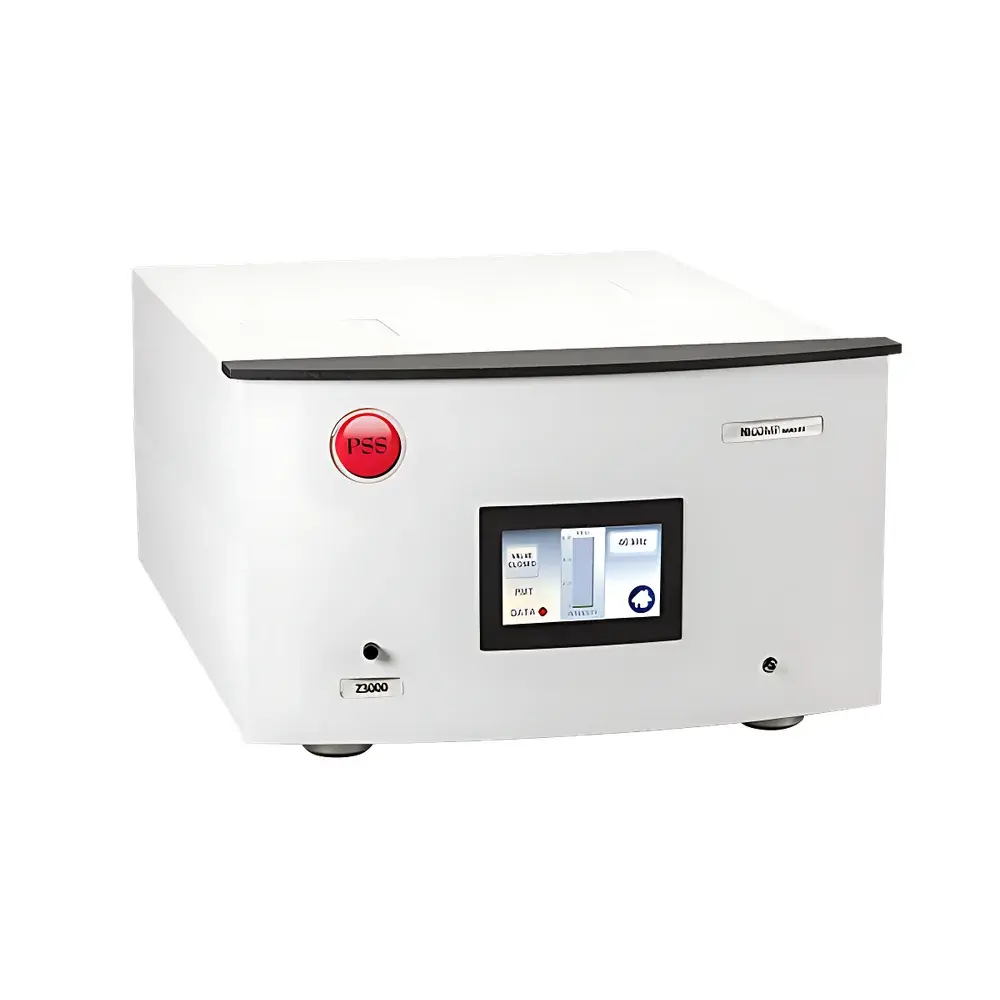
PSS Nicomp N3000 Basic Nanoparticle Size Analyzer
| Brand | Particle Sizing Systems (PSS), USA |
|---|---|
| Origin | USA |
| Manufacturer Type | Authorized Distributor |
| Product Category | Imported Instrument |
| Model | PSS Nicomp N3000 Standard |
| Dispersion Method | Wet Dispersion |
| Instrument Type | Laboratory Laser Particle Size Analyzer |
| Measurement Range | 0.3 nm – 10 µm |
| Repeatability | ±99% |
| Measurement Time | 1–10 min |
| Temperature Control Accuracy | ±0.1 °C (0–90 °C) |
| pH Range | 1–14 |
| Laser Power Options | 15–100 mW (635 nm or 514.4 nm) |
| Detection Angles | 10°–175° (0.7° step, including 90°) |
| Detector | APD-LDC Avalanche Photodiode (7–10× gain vs. PMT) |
| Sample Volumes | 10 µL (microcell) to 4 mL (standard quartz cuvette) |
| Solvent Compatibility | Aqueous and most organic media |
| Software Compliance | 21 CFR Part 11-ready, GLP/GMP audit trail enabled |
| Optional Modules | Auto-dilution system (up to 50% w/v input), multi-angle detector (3000/MA), high-power laser (3000/HPLD), automated syringe pump titration (for zeta potential), 60-position autosampler |
Overview
The PSS Nicomp N3000 Basic Nanoparticle Size Analyzer is a laboratory-grade dynamic light scattering (DLS) instrument engineered for high-fidelity particle size distribution (PSD) analysis of colloidal and macromolecular systems in liquid dispersion. Operating on the physical principle of Brownian motion-induced intensity fluctuations in scattered laser light, the system computes hydrodynamic diameter via the Stokes–Einstein equation. Its validated measurement range spans 0.3 nm to 10 µm—encompassing proteins, liposomes, polymeric micelles, surfactant aggregates, viral vectors, and submicron ceramic or metallic dispersions. Unlike conventional DLS platforms that assume monodisperse Gaussian distributions, the Nicomp N3000 implements a proprietary multimodal resolution algorithm capable of resolving true polydispersity without prior assumptions about sample composition. This capability is critical for quality control in pharmaceutical nanocarrier development, biologics formulation, CMP slurry certification, and advanced materials R&D where accurate deconvolution of coexisting populations (e.g., monomer/aggregates, HDL/LDL/VLDL) directly impacts process understanding and regulatory filing.
Key Features
- APD-LDC avalanche photodiode detector with 7–10× higher quantum efficiency than standard PMTs—essential for low-scattering samples including proteins (<1 mg/mL), non-ionic surfactants, and low-refractive-index polymers.
- Multi-angle detection architecture (10°–175°, 0.7° incremental resolution) enabling angular-dependent scattering analysis to improve sizing accuracy for particles >100 nm and mitigate orientation bias in anisotropic systems.
- Dual-algorithm software engine: seamless switching between classical Gaussian fitting (ISO 22412 compliant) and Nicomp multimodal distribution analysis—validated for resolution of 1:2 intensity-ratio bimodal standards (e.g., 93 nm + 150 nm latex).
- Integrated temperature-controlled cuvette holder (0–90 °C, ±0.1 °C stability) with condensation suppression—critical for thermosensitive biologics and kinetic aggregation studies.
- Modular hardware design supporting field-upgradable options: auto-dilution module (handles up to 50% w/v stock suspensions), high-power laser variants (35–100 mW), and 60-position autosampler for unattended QC workflows.
- No routine calibration required; traceable to NIST-traceable polystyrene and silica reference materials across full dynamic range.
Sample Compatibility & Compliance
The Nicomp N3000 accommodates aqueous buffers (pH 1–14), polar organics (e.g., ethanol, acetone, DMF), and low-viscosity oils—compatible with ISO 13321 (DLS), USP (liposome size), and EP 2.9.31 (nanomedicine characterization). Its robust optical path tolerates turbid samples up to 40% w/v solids when paired with multi-angle acquisition. The system meets analytical data integrity requirements per FDA 21 CFR Part 11 through electronic signature support, audit trail logging, and role-based user access controls. All firmware and software versions are documented per ICH Q5C and Q5E guidelines for biotechnology product characterization, and raw correlation data files (.cor) retain full traceability for GLP/GMP audits.
Software & Data Management
Nicomp’s proprietary software suite provides real-time autocorrelation function fitting, baseline correction, and noise-filtered cumulant analysis. It exports PSD results in multiple formats (CSV, PDF, XML) with embedded metadata (temperature, viscosity, refractive index, laser wavelength). Batch processing supports statistical trending across hundreds of runs, while report templates comply with internal SOPs and external regulatory submissions (e.g., IND/IMPD dossiers). The platform supports LIMS integration via ASTM E1578-compliant drivers and includes built-in validation documentation packages (IQ/OQ/PQ protocols) for laboratory accreditation (ISO/IEC 17025).
Applications
- Pharmaceutical Nanomedicine: Quantification of liposomal doxorubicin PDI, PEGylated nanoparticle aggregation onset, and mRNA-LNP encapsulation efficiency via size-stability correlation.
- Biologics Characterization: Detection of subvisible protein aggregates (≥0.3 nm) under accelerated stress conditions—aligned with ICH Q5C guidance on higher-order structure assessment.
- Materials Science: Monitoring silica sol-gel nucleation kinetics, ceria nanoparticle sintering behavior, and TiO₂ nanotube self-assembly dynamics.
- Electronics Manufacturing: Certification of CMP slurry particle uniformity (D90 < 80 nm) per SEMI F25 standards to prevent wafer scratching during planarization.
- Food & Cosmetics: Emulsion droplet sizing in plant-based dairy alternatives (target D[4,3] < 200 nm for oral bioavailability) and sunscreen nanoparticle dispersion verification (TiO₂/ZnO < 100 nm).
FAQ
What distinguishes Nicomp multimodal analysis from standard DLS software?
Nicomp’s algorithm does not force data into a single Gaussian peak. Instead, it iteratively resolves independent scattering populations using constrained regularization—enabling quantification of distinct species (e.g., 7 nm HDL, 29 nm LDL, 217 nm VLDL in native plasma) without chromatographic separation.
Can the N3000 analyze concentrated industrial slurries without dilution?
Yes—the optional auto-dilution module processes undiluted feedstocks up to 50% w/v, delivering statistically robust results at optimal scattering angles while eliminating manual pipetting error and operator variability.
Is temperature control sufficient for protein thermal denaturation studies?
With ±0.1 °C stability over 0–90 °C and programmable ramp rates (0.1–5 °C/min), the system supports Arrhenius-based aggregation kinetics modeling and cold-chain stability assessment per ICH Q5C Annex 2.
How is data integrity ensured for regulated environments?
All analyses generate immutable .cor files with embedded timestamps, user IDs, instrument serial numbers, and environmental logs—fully compliant with 21 CFR Part 11 electronic record requirements and ALCOA+ principles.
Does the system support zeta potential measurements?
Zeta analysis requires electrophoretic light scattering (ELS); the N3000 Basic model is DLS-only. However, the N3000 Zeta configuration integrates with optional titration modules (e.g., Metrohm Titrando) for automated pH/zeta mapping per ISO 13099.



