
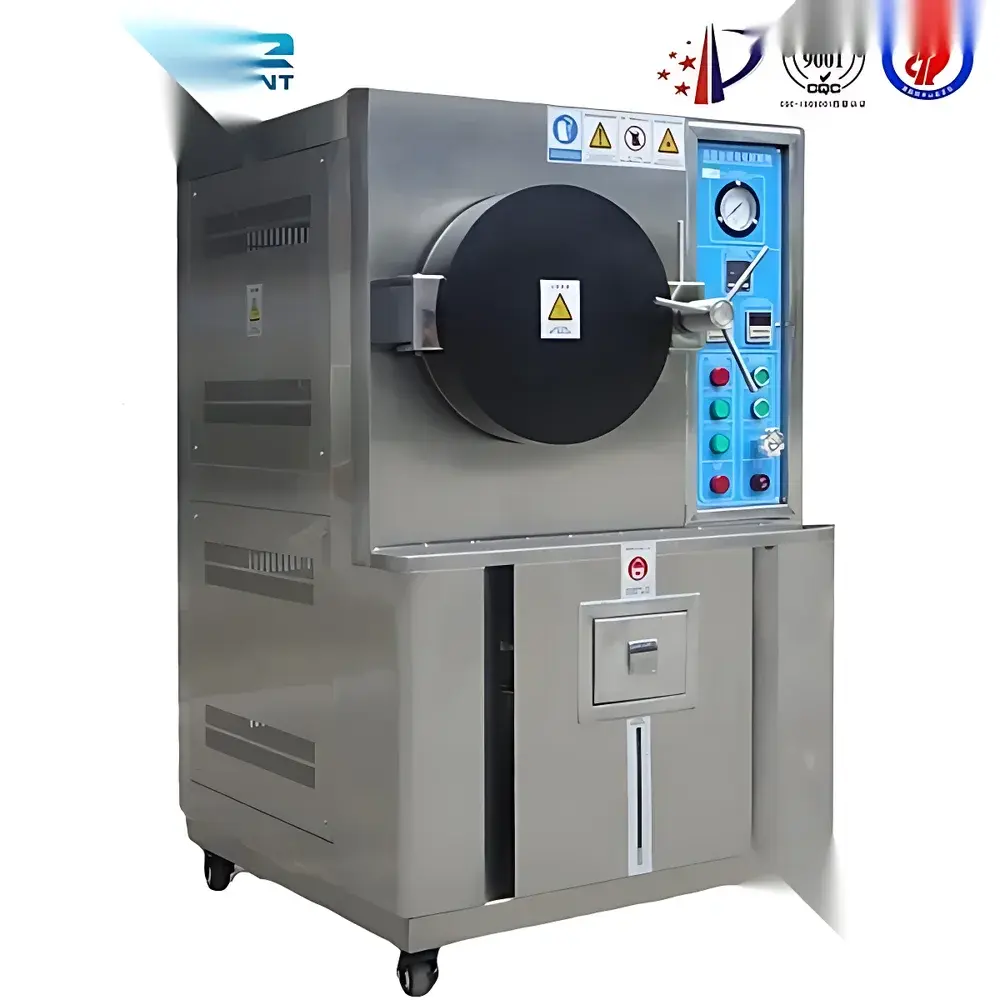
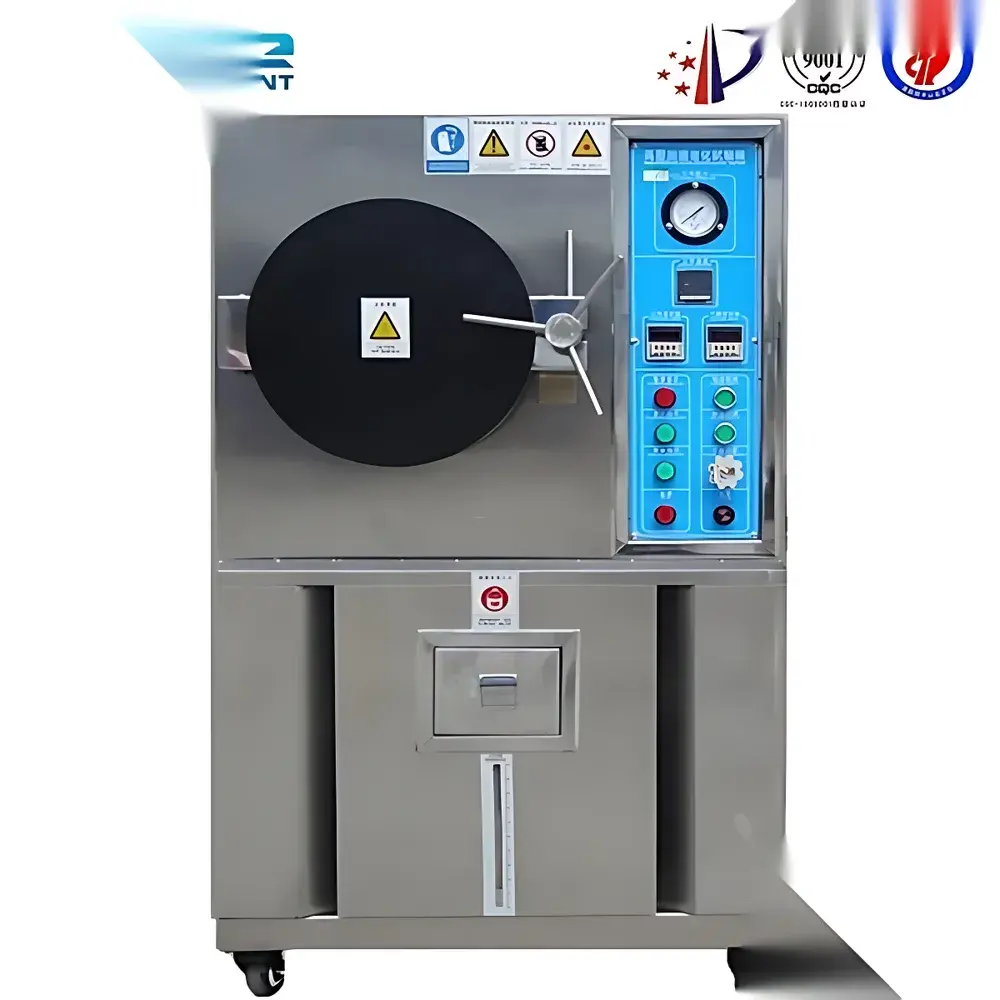
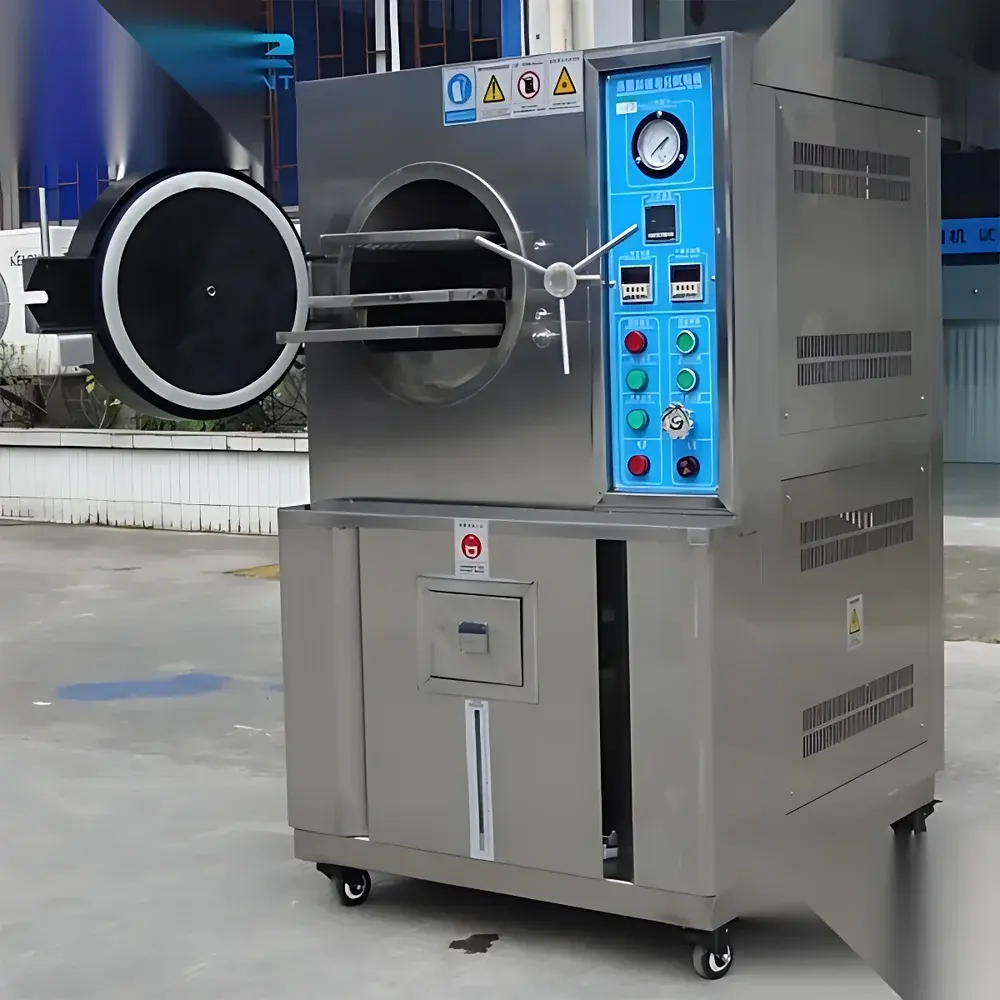
PTC-25 / PTC-35 High-Pressure Accelerated Aging Test Chamber
| Key Features | Internal Chamber Diameter × Depth: ∅250×450 mm (PTC-25) or ∅350×500 mm (PTC-35) |
|---|---|
| Temperature Range | RT+10°C to 132°C |
| Humidity Range | 100% RH |
| Pressure Range | 0.0–2.8 kg/cm² (gauge), max safe capacity 4.0 kg/cm² |
| Temp. Uniformity | ±1.5°C |
| Temp. Control Accuracy | ±0.5°C |
| Temp. Resolution | 0.1°C |
| Pressurization Time (0→2.0 kg/cm²) | ~30 min |
| Inner Chamber Material | SUS304 stainless steel |
| Outer Casing | SECC steel with electrostatic powder coating |
| Compliance | ASTM, DIN, BS, IEC, NACE, UL, CNS, ISO, JIS, MIL |
Overview
The PTC-25 and PTC-35 High-Pressure Accelerated Aging Test Chambers are engineered for controlled stress testing of electronic components, packaging materials, PCBs, semiconductor devices, and medical device enclosures under elevated temperature, saturated steam humidity, and regulated overpressure conditions. These chambers operate on the principle of pressurized saturated steam aging—leveraging the thermodynamic properties of water vapor at subcritical conditions to accelerate moisture diffusion into materials, thereby simulating years of field exposure in days or weeks. Unlike conventional humidity chambers, the PTC series maintains a fully saturated environment (100% RH) at temperatures up to 132°C and pressures up to 2.8 kg/cm² (gauge), enabling rigorous qualification per JEDEC JESD22-A102 (HAST), JESD22-A110 (uHAST), and IPC-9702 standards. The cylindrical horizontal chamber design minimizes thermal stratification and eliminates direct steam jetting toward operators, supporting both reliability screening and failure mechanism analysis in R&D and QA/QC laboratories.
Key Features
- Cylindrical horizontal internal chamber geometry (∅250×450 mm for PTC-25; ∅350×500 mm for PTC-35) optimized for uniform steam distribution and ergonomic sample loading/unloading
- Microprocessor-based PID + SSR control system with LED digital display for precise saturation temperature regulation
- High-stability platinum resistance temperature sensors (Pt100) and insulated high-voltage heating elements ensure ±0.5°C temperature control accuracy and 0.1°C resolution
- Dual-stage pressure monitoring: analog precision pressure gauge for real-time readout and integrated safety transducer for automatic interlock response
- Motor-driven magnetic-coupled fan system enables natural convection circulation of saturated steam—no forced air turbulence that could disturb condensation dynamics
- Robust construction: SUS304 stainless steel inner chamber (cryogenic- and steam-resistant); SECC outer casing with corrosion-inhibiting electrostatic powder coating
- Integrated vacuum-assisted air purge cycle prior to test initiation—removes ambient oxygen and particulates to ensure reproducible steam purity and eliminate oxidation artifacts
Sample Compatibility & Compliance
The PTC chambers accommodate a wide range of non-volatile, non-explosive solid specimens—including IC packages (QFP, BGA, CSP), conformal-coated assemblies, plastic housings, adhesive-bonded joints, and sterilizable medical device trays. All models comply with international test method requirements for accelerated moisture resistance evaluation, including ASTM F1659 (moisture barrier integrity), IEC 60068-2-66 (damp heat, steady state, high pressure), ISO 11357-5 (thermal analysis of polymers under humidity), and MIL-STD-883 Method 1030 (moisture resistance). Safety architecture meets EN 61000-6-2/6-4 (EMC), EN 61010-1 (electrical safety), and ASME BPVC Section VIII Div. 1 (pressure vessel design). The door-locking mechanism is pressure-activated: mechanical interlocking engages only when internal pressure exceeds atmospheric—preventing accidental opening during operation.
Software & Data Management
While the base configuration utilizes standalone microcontroller-based operation with analog pressure indication and LED temperature display, optional RS-485/Modbus RTU interface enables integration with laboratory-wide data acquisition systems (e.g., LabVIEW, Ignition SCADA, or custom MES platforms). Real-time logging of temperature, pressure, and elapsed time supports 21 CFR Part 11-compliant audit trails when paired with validated third-party software. All control logic includes built-in event logging—recording start/stop timestamps, safety shutdown triggers (e.g., overtemperature, overpressure, door breach), and automatic recovery sequences. Calibration records and maintenance logs can be exported in CSV format for GLP/GMP documentation workflows.
Applications
- JEDEC-compliant Highly Accelerated Stress Testing (HAST) and Unbiased HAST (uHAST) for semiconductor package qualification
- Moisture sensitivity level (MSL) determination per J-STD-020
- Evaluation of conformal coating adhesion and delamination kinetics under thermal-hygric stress
- Accelerated life testing of polymer-based medical device housings and drug delivery systems
- Validation of hermetic seal integrity in MEMS and optoelectronic modules
- Corrosion susceptibility assessment of printed circuit board finishes (ENIG, OSP, immersion silver)
FAQ
What is the maximum allowable test duration without manual intervention?
Standard configuration supports continuous operation for up to 100 hours per water fill cycle. Optional auto-refill kits enable unattended multi-day testing with programmable top-up scheduling.
Does the chamber support vacuum pre-conditioning as part of the test sequence?
Yes—the integrated vacuum pump removes ambient air prior to steam generation, reducing oxygen content and minimizing oxidative degradation during high-temperature exposure.
How is temperature and pressure uniformity verified across the working volume?
Uniformity is validated per IEC 60068-3-5 using calibrated PT100 probes at nine predefined locations (center + eight corners); results demonstrate ≤±1.5°C spatial deviation and ≤±0.5°C temporal stability over 24-hour dwell periods.
Can the PTC series be used for testing lithium-ion battery cells?
No—this equipment is not certified for flammable, volatile, or pressurized electrochemical cells. Battery testing requires specialized explosion-proof environmental chambers compliant with UN 38.3 and IEC 62133.
Is third-party calibration and IQ/OQ/PQ documentation available?
Yes—factory-certified calibration certificates traceable to NIST standards are provided. Installation Qualification (IQ), Operational Qualification (OQ), and Performance Qualification (PQ) protocols can be supplied upon request for GxP-regulated environments.



