
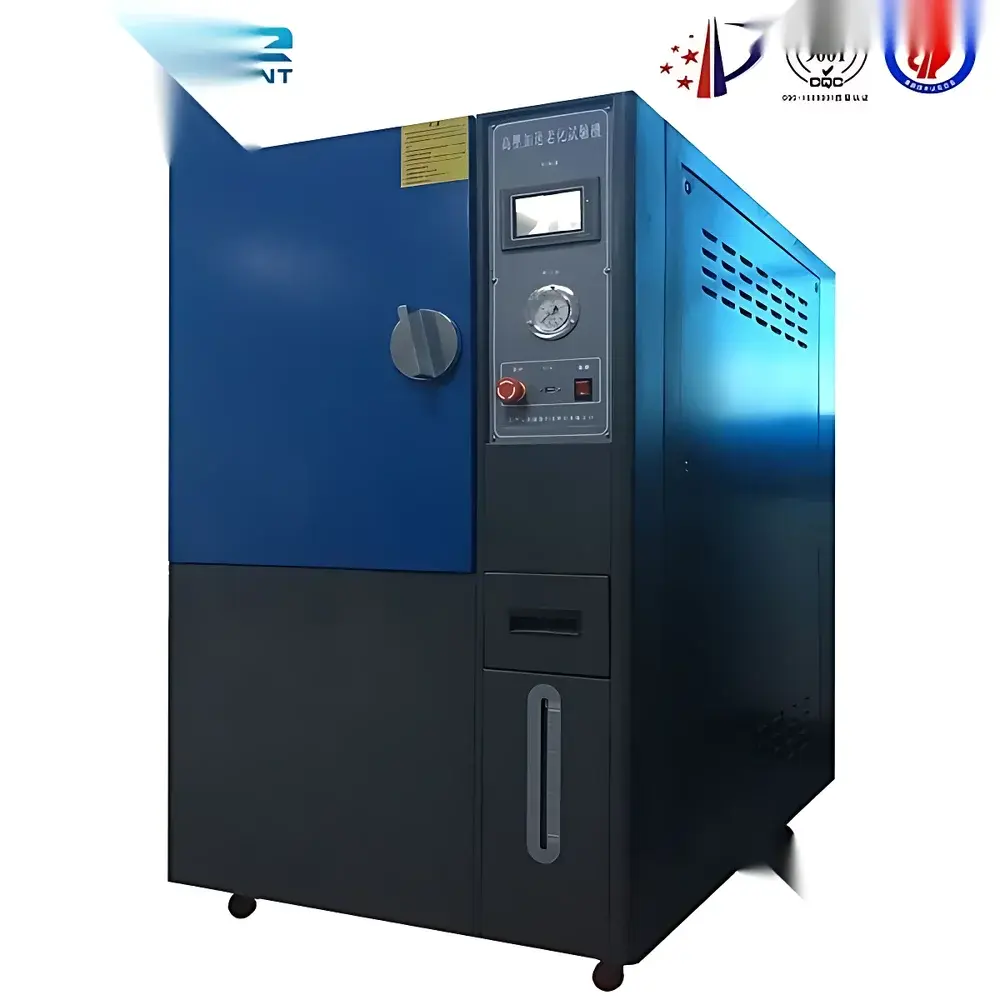
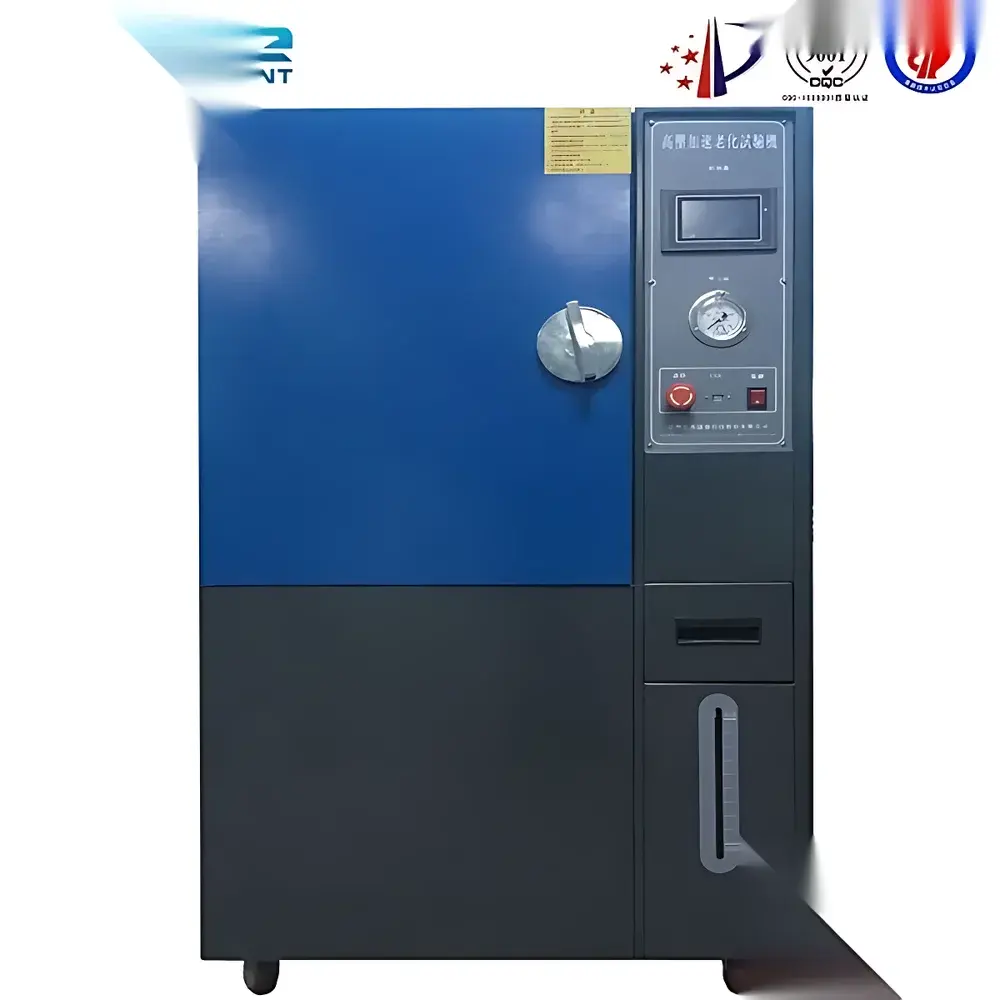
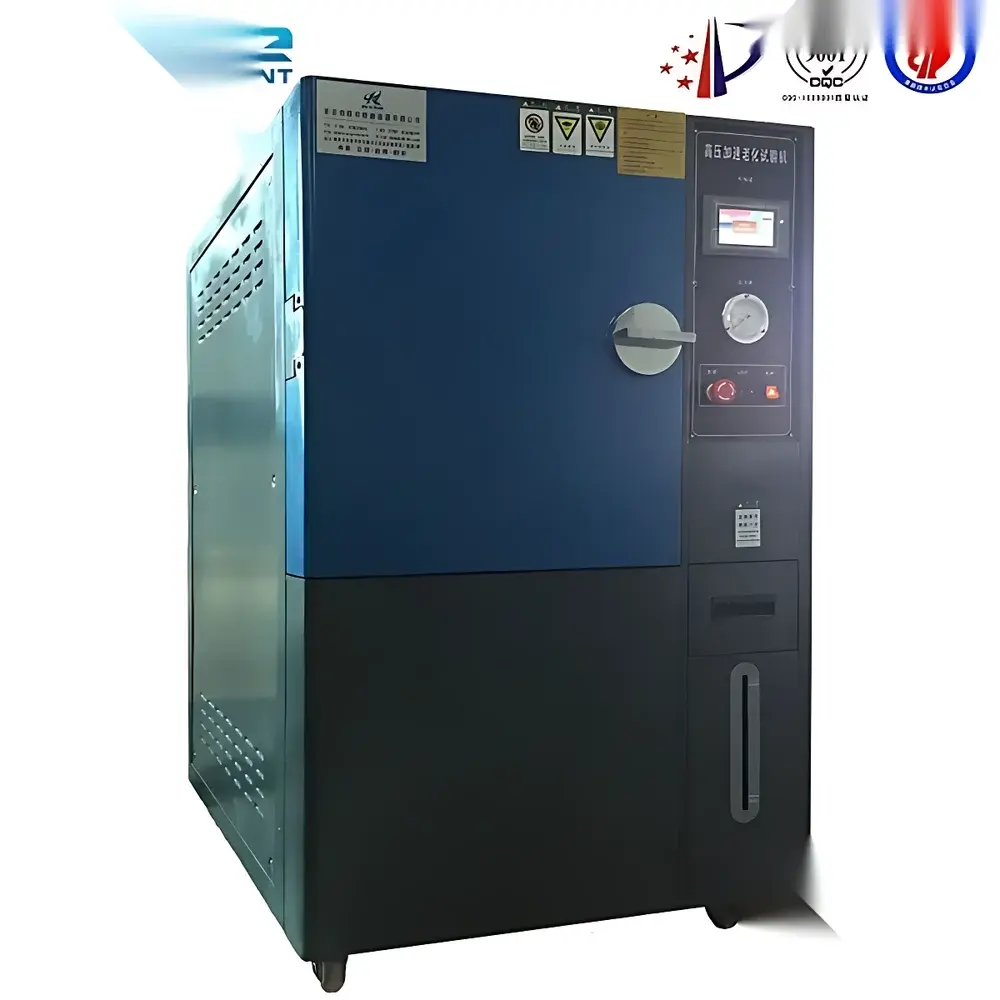
PTC Aging Test Chamber
| Key Features | Temperature Range: RT+10°C to 132°C |
|---|---|
| Humidity Range | 100% RH (saturated steam) |
| Pressure Range | 0–2.8 kg/cm²(g) (relative gauge pressure) |
| max vessel rating | 4.0 kg/cm²(g) |
| Internal Chamber Dimensions | ∅250×450 mm, ∅350×500 mm (customizable) |
| Temperature Uniformity | ±1.5°C |
| Temperature Control Accuracy | ±0.5°C |
| Temperature Resolution | 0.1°C |
| Heating Method | Insulated stainless-steel sheathed heaters with PID + SSR control |
| Humidity & Pressure Generation | Saturated steam via electrically heated water reservoir |
| Circulation | Natural convection of saturated steam |
| Chamber Material | SUS304 stainless steel (interior), SECC steel with electrostatic powder coating (exterior) |
| Compliance | ASTM D3045, DIN 53479, ISO 2231, IEC 60068-2-13, JIS C 0021, UL 746B, MIL-STD-810H, NACE TM0177, BS EN 60068-2-30 |
| Safety Systems | Automatic pressure relief, vacuum break, door interlock with pressure-dependent mechanical sealing, low-water auto-refill, real-time fault diagnostics |
Overview
The PTC Aging Test Chamber is an engineered environmental stress chamber designed for accelerated life testing of polymeric, electronic, and composite materials under precisely controlled high-temperature, high-humidity, and elevated-pressure saturated steam conditions. It operates on the principle of pressurized saturated steam aging—where test specimens are exposed to 100% relative humidity at temperatures up to 132°C and gauge pressures up to 2.8 kg/cm²(g), significantly accelerating hydrolytic degradation mechanisms such as chain scission in polyesters (e.g., PET, PBT), polyimides, and thermoplastic elastomers. Unlike conventional humidity chambers, this system maintains true saturation equilibrium by generating and sustaining pure, non-superheated steam within a sealed stainless-steel pressure vessel, enabling reproducible exposure profiles required for qualification per international material reliability standards.
Key Features
- Robust chamber architecture featuring seamless SUS304 interior lining and electropolished surface finish—resistant to condensate corrosion and facilitating cleaning and residue-free operation.
- Dual-mode safety interlock: Mechanical door seal reinforced by internal positive pressure; door remains physically locked until chamber pressure returns to atmospheric level—eliminating risk of accidental opening during pressurized operation.
- Integrated microprocessor-based PID controller with SSR output driving precision temperature regulation; coupled with Pt100 platinum resistance sensors (IEC 60751 Class A) for traceable thermal measurement.
- Self-regulating saturated steam generation system with automatic water replenishment—capable of uninterrupted 100-hour continuous operation without manual intervention.
- Natural-convection steam circulation ensures uniform thermal and humidity distribution (±1.5°C spatial uniformity) without turbulent airflow that could disturb specimen placement or induce localized cooling.
- Real-time monitoring suite including digital LED displays for chamber temperature, absolute pressure, and elapsed test time—with configurable alarm thresholds for over-temperature, over-pressure, low-water, and sensor failure conditions.
- Vacuum-assisted air purge cycle prior to steam pressurization removes ambient oxygen and particulates, minimizing oxidative side reactions and ensuring purity of the aging environment—critical for evaluating oxidation-sensitive polymers and encapsulated electronics.
Sample Compatibility & Compliance
This chamber accommodates diverse sample geometries—including molded plastic housings, PCB assemblies, wire insulation, gaskets, medical device components, and automotive under-hood modules—within its horizontal cylindrical test cavity (standard configurations: ∅250×450 mm and ∅350×500 mm). The design supports both static and dynamic loading configurations, with optional fixtures for strain-controlled aging. All operational parameters align with test method requirements specified in ASTM D3045 (Standard Practice for Heat Aging of Plastics), ISO 2231 (Plastics — Determination of Effect of Thermal Ageing), IEC 60068-2-13 (Damp Heat, Accelerated, Steady State), and UL 746B (Polymeric Materials — Long Term Property Evaluations). Data integrity complies with GLP principles and supports FDA 21 CFR Part 11–ready audit trails when integrated with validated software platforms.
Software & Data Management
While the base configuration employs a standalone LED controller, optional Ethernet-enabled data acquisition modules provide real-time logging of temperature, pressure, and runtime at user-defined intervals (1–60 sec resolution). Export formats include CSV and XML for integration into LIMS or statistical process control (SPC) environments. Calibration records—including sensor verification reports and pressure transducer linearity checks—are stored internally with timestamped metadata. System firmware supports password-protected parameter locking to prevent unauthorized changes during qualification runs—a requirement under ISO/IEC 17025-accredited laboratories.
Applications
- Accelerated hydrolysis testing of engineering thermoplastics (e.g., PCT, PBT, PA66) used in automotive connectors and medical fluid-handling components.
- Qualification of conformal coatings and potting compounds for aerospace avionics subjected to tropical operational environments.
- Failure mode analysis of silicone elastomer seals and diaphragms in pharmaceutical single-use bioreactors.
- Evaluation of delamination resistance in multilayer flexible printed circuits exposed to humid heat cycling.
- Material screening for military-grade enclosures per MIL-STD-810H Method 507.6 (Humidity).
FAQ
What is the maximum allowable operating pressure and how is overpressure protection implemented?
The chamber is rated for a maximum working pressure of 2.8 kg/cm²(g), with a certified burst pressure of ≥4.0 kg/cm²(g). Dual redundant safety mechanisms include a spring-loaded pressure relief valve set at 3.0 kg/cm²(g) and an independent electronic pressure cutoff that halts heating if the measured value exceeds 2.9 kg/cm²(g).
Does the system meet requirements for regulatory submission testing?
Yes—when operated with documented calibration certificates, maintenance logs, and validated procedures, the chamber satisfies evidence requirements for ISO 13485, IATF 16949, and FDA QSR audits. Optional IQ/OQ documentation packages are available upon request.
Can the chamber operate without external water supply?
It includes an internal reservoir with auto-refill capability; however, for extended unattended runs (>100 h), connection to a continuous deionized water feed line is recommended and supported via optional solenoid valve integration.
How is steam quality verified and maintained during testing?
A dedicated steam purging cycle evacuates non-condensable gases before pressurization. A continuously monitored condensate drain line removes sub-saturated vapor, ensuring only dry saturated steam contacts test specimens—verified by thermodynamic consistency between measured temperature and corresponding saturation pressure per the IAPWS-IF97 standard.
Related Products



