
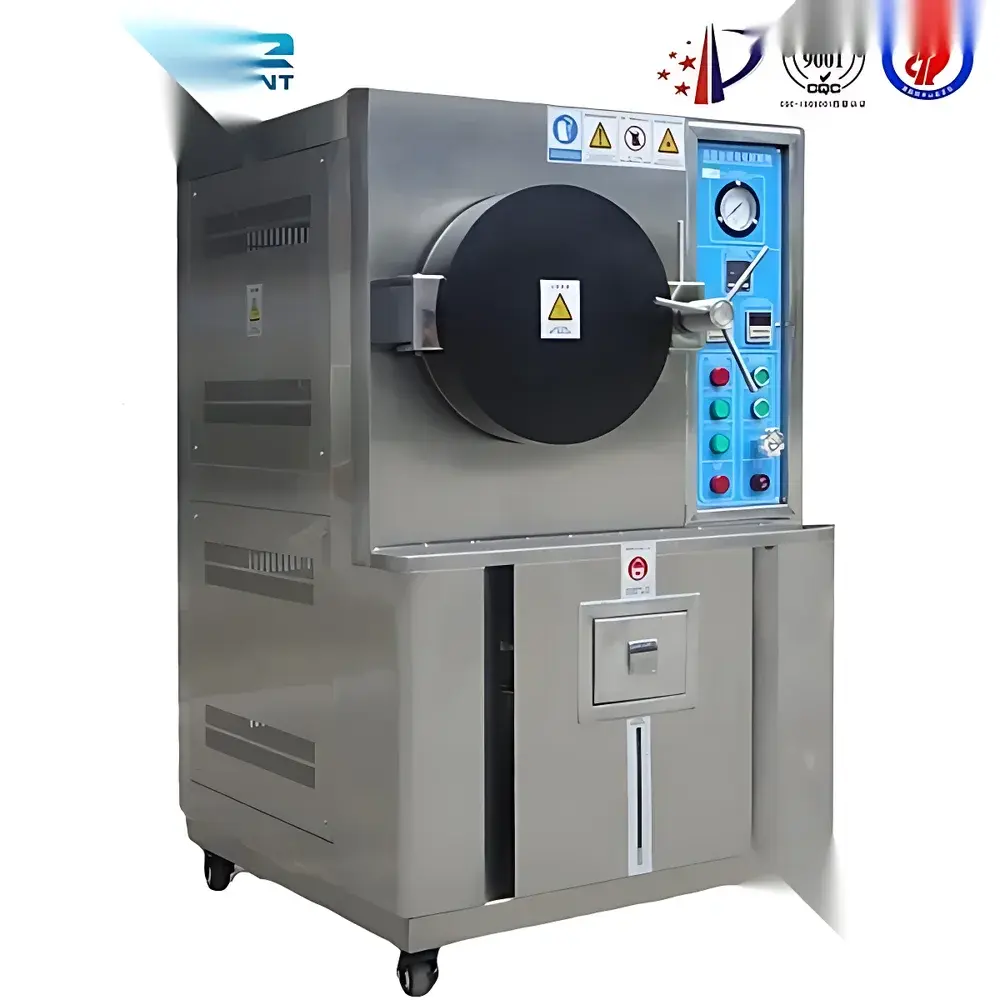
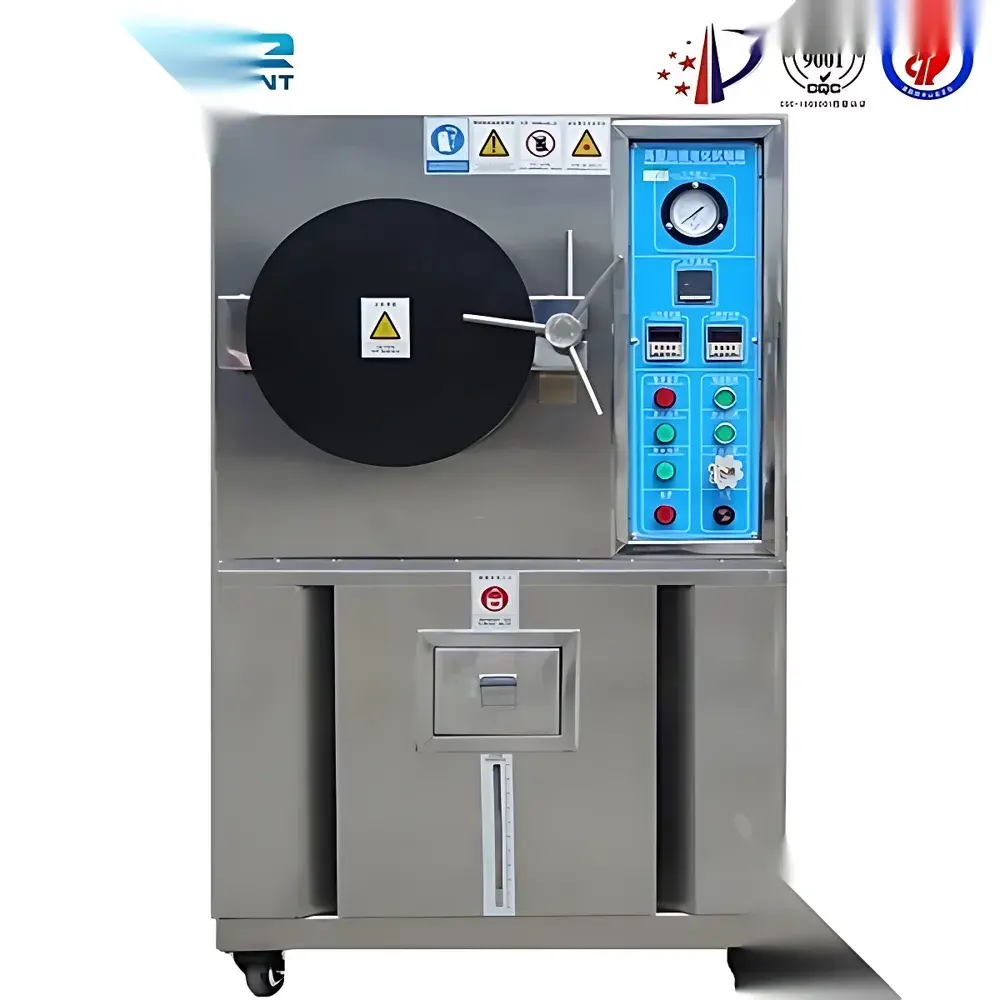
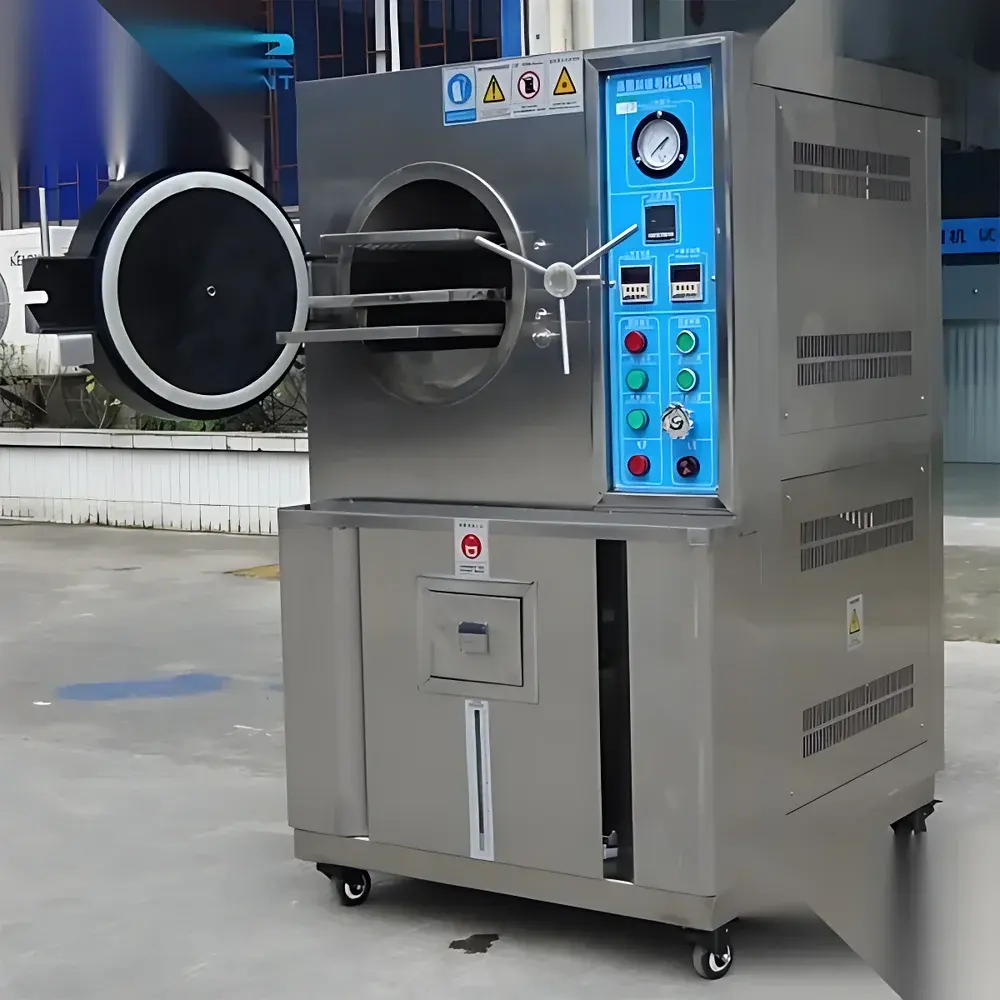
OK-PTC Series PCT (Pressure Cooker Test) Accelerated Aging Chamber
| Brand | OK |
|---|---|
| Model | OK-PTC-25 / OK-PTC-35 |
| Chamber Dimensions | ∅250×450 mm (OK-PTC-25) or ∅350×500 mm (OK-PTC-35) |
| Temperature Range | RT+10°C to 132°C |
| Humidity Range | 100% RH |
| Pressure Range | 0.0–2.8 kg/cm² (gauge), max working pressure 3.0 kg/cm² (absolute: 1 atm + 3.0 kg/cm²) |
| Temp. Uniformity | ±1.5°C |
| Temp. Control Accuracy | ±0.5°C |
| Temp. Resolution | 0.1°C |
| Pressurization Time (0→2.0 kg/cm²) | ~30 min |
| Inner Chamber Material | SUS304 stainless steel |
| Outer Casing | SECC steel with electrostatic powder coating |
| Compliance | ASTM D2247, DIN 50017, ISO 6270-2, IEC 60068-2-66, JIS C 0068, UL 746B, NACE TM0177, MIL-STD-810H |
Overview
The OK-PTC Series PCT (Pressure Cooker Test) Accelerated Aging Chamber is an engineered environmental stress test system designed for high-reliability evaluation of moisture-sensitive electronic components, polymer encapsulants, PCB laminates, and packaging materials under combined elevated temperature, saturated steam humidity, and controlled hydrostatic pressure. Operating on the principle of accelerated hydrolytic degradation—where water vapor diffuses into polymeric interfaces under thermodynamic driving force—the chamber replicates years of field-level moisture ingress and delamination risk in days or weeks. Unlike standard humidity chambers, the OK-PTC applies positive gauge pressure (up to 2.8 kg/cm²) to increase the partial pressure of water vapor, thereby elevating its chemical activity and accelerating moisture-induced failure mechanisms such as wire bond corrosion, popcorning, and interfacial delamination. Its cylindrical horizontal chamber geometry ensures ergonomic sample loading while minimizing condensate pooling and thermal shock exposure during door operation.
Key Features
- Cylindrical horizontal test chamber design with seamless SUS304 interior—optimized for uniform steam distribution, reduced condensation, and safe operator access under pressurized conditions
- Microprocessor-based PID + SSR control system with LED display, enabling precise regulation of saturated steam temperature (RT+10°C to 132°C) and real-time pressure tracking via calibrated analog pressure gauge
- Integrated platinum resistance temperature sensor (Pt100) and insulated high-wattage heating elements ensure stable thermal response and long-term calibration stability
- Magnetic-drive centrifugal fan system enables passive steam convection without mechanical seals—eliminating lubricant contamination and maintaining 100% RH integrity across the working volume
- Multi-layer safety architecture: dual redundant pressure sensors, automatic pressure relief valve, vacuum-assisted air purge cycle (pre-test), and interlocked door mechanism that physically reinforces sealing under internal pressure
- Self-sustaining water supply system supports continuous operation up to 100 hours per fill; optional fully automated make-up water module available for unattended multi-day testing
Sample Compatibility & Compliance
The OK-PTC chamber accommodates a broad range of non-volatile, non-explosive test specimens—including IC packages (QFP, BGA, CSP), molded plastic housings, conformal coatings, adhesives, and composite substrates—without requiring specialized fixtures. Its internal geometry allows for standardized tray stacking or rack-mounted configuration per JEDEC J-STD-020 and JESD22-A102 guidelines. The system meets essential requirements for qualification testing under multiple international standards: ASTM D2247 (water immersion aging), ISO 6270-2 (condensation test with pressure), IEC 60068-2-66 (damp heat, steady state, accelerated), JIS C 0068 (humidity resistance), and UL 746B (polymeric materials). It supports traceable validation protocols required for GLP-compliant reliability labs and satisfies prerequisite conditions for AEC-Q200 stress screening of automotive electronics.
Software & Data Management
While the base model features a stand-alone LED controller, optional RS-485/Modbus RTU interface enables integration with centralized lab data acquisition systems (e.g., LabVIEW, SCADA, or custom MES platforms). All operational parameters—including chamber temperature, absolute pressure, elapsed test time, and cycle status—are logged at user-defined intervals (1–60 sec resolution) with timestamped CSV export capability. The control firmware implements audit-trail functionality compliant with FDA 21 CFR Part 11 preconditions: operator login authentication, parameter change logging, and immutable event history. Calibration records (temperature and pressure) can be digitally archived alongside test reports to support ISO/IEC 17025 accreditation requirements.
Applications
- Moisture sensitivity level (MSL) classification per JEDEC J-STD-020
- Preconditioning prior to reflow simulation or solderability testing
- Qualification of mold compound adhesion and die attach integrity
- Accelerated life testing of conformal coatings and potting compounds
- Evaluation of corrosion resistance in metallized interconnects (e.g., Cu-Al wire bonds)
- Reliability screening for aerospace-grade PCBAs subjected to tropical operational environments
FAQ
What is the maximum allowable test duration without manual intervention?
With standard water reservoir capacity, the chamber supports uninterrupted operation for up to 100 hours. Optional auto-refill modules extend this to indefinite runtime under monitored conditions.
Does the system comply with JEDEC JESD22-A102 for pressure cooker testing?
Yes—the OK-PTC achieves the required temperature (130°C ± 2°C), pressure (15 psig ≈ 1.03 kg/cm² gauge), and humidity (100% RH) conditions specified in JESD22-A102, with verified thermal uniformity and pressure ramp profiles.
Can the chamber be validated for IQ/OQ/PQ protocols?
Yes. Full validation documentation packages—including sensor calibration certificates (NIST-traceable), mapping reports (temperature/pressure uniformity), and alarm response verification—are available upon request.
Is vacuum pre-purge mandatory before each test cycle?
Vacuum evacuation is recommended prior to pressurization to remove ambient oxygen and minimize oxidative side reactions, especially for copper-based metallization. The integrated vacuum pump and HEPA-filtered air reintroduction sequence is configurable via manual or timed automation.



