
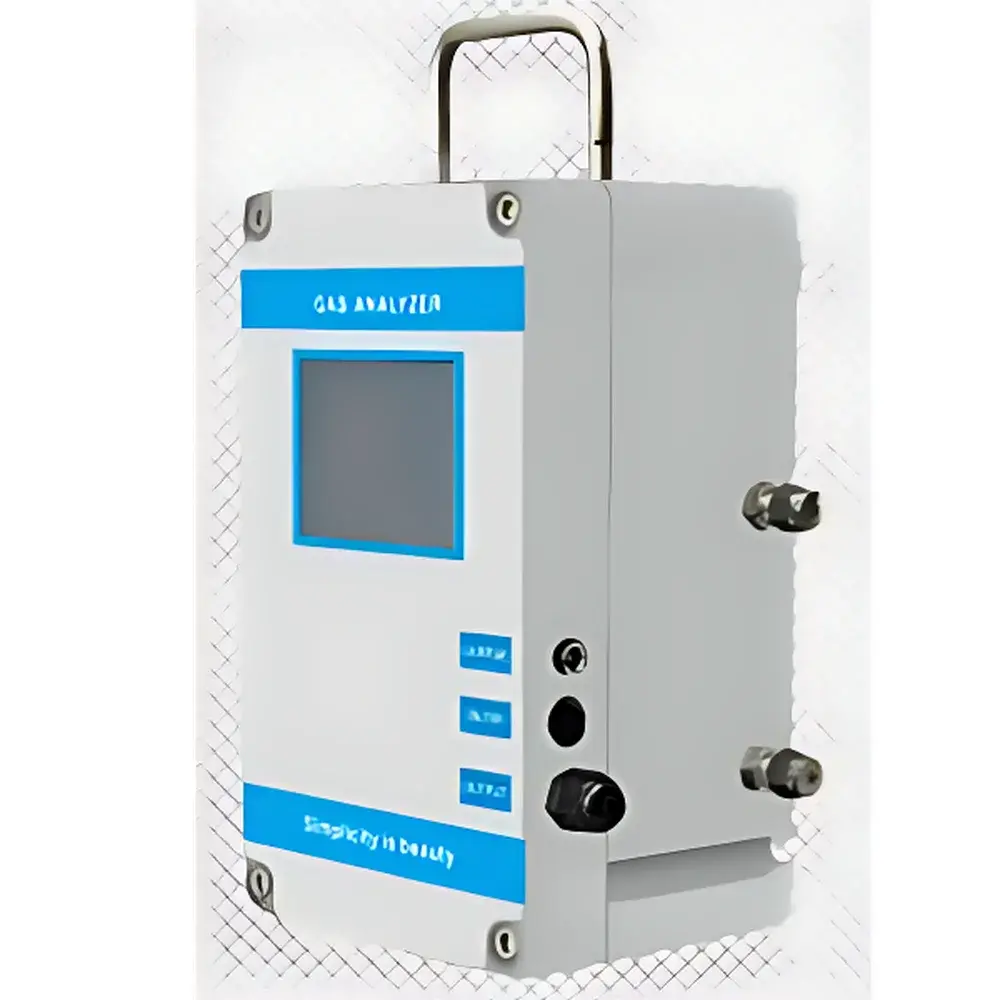
PTI OMD-780 Portable Thermal Conductivity Hydrogen Purity Analyzer
| Brand | PTI (USA) |
|---|---|
| Origin | USA |
| Manufacturer Type | Authorized Distributor |
| Origin Category | Imported |
| Model | OMD-780 |
| Measurement Principle | Thermal Conductivity Detection |
| H₂ Range Options | 0–1% |
| Accuracy | ±1% FS (air matrix), ±0.5% FS (CO₂ matrix), ±0.1% FS (CO₂ concentration mode) |
| Response Time | ≤10 s |
| Operating Pressure | 0–1.0 MPa |
| Ambient Temperature Range | −30 °C to +60 °C |
| Storage Temperature | −40 °C to +70 °C |
| Display | 800×480 true-color TFT touchscreen |
| Power Supply | 220 VAC ±10%, 50 Hz / Rechargeable Li-ion battery (≥8 h continuous operation) |
| Data Logging | 128 entries with timestamp, local storage & export capability |
| Calibration | Field-executable zero/span calibration |
Overview
The PTI OMD-780 Portable Thermal Conductivity Hydrogen Purity Analyzer is a field-deployable, laboratory-grade gas analysis instrument engineered for precise, real-time quantification of hydrogen concentration across diverse gas matrices—including air, nitrogen, argon, and carbon dioxide. It operates on the fundamental principle of thermal conductivity differential measurement: hydrogen exhibits significantly higher thermal conductivity (~7x that of air and ~14x that of CO₂), enabling selective detection without chemical reaction or consumables. Unlike electrochemical or catalytic bead sensors, the OMD-780 employs a temperature-stabilized dual-sensor bridge configuration with active thermal compensation, ensuring minimal drift under ambient fluctuations. Its modular range configuration—supporting five user-selectable spans (0–1%, 0–2%, 0–5%, 0–100%, or 90–100% H₂)—allows optimization for applications ranging from trace leak detection in inert atmospheres to high-purity verification in electrolyzer off-gas or PEM fuel cell feed streams. The device meets the functional requirements of ISO 8573-1 (compressed air purity), ASTM D1946 (analysis of hydrogen in gases), and supports method validation under GLP-compliant workflows.
Key Features
- Temperature-compensated constant-temperature thermal conductivity sensor with <1% full-scale drift over 30-day stability testing at 25 °C ambient
- Integrated gas conditioning system: particulate filter (0.5 µm rating) and precision pressure regulator (0–1.0 MPa operating range, ±0.02 MPa regulation tolerance)
- True-color 5-inch TFT LCD touchscreen (800×480 resolution) with intuitive bilingual (English/Chinese) GUI, supporting gesture-based navigation and context-sensitive help
- Onboard rechargeable lithium-ion battery pack delivering ≥8 hours of continuous operation at 25 °C; automatic overcharge protection and state-of-charge indicator
- Field-calibratable architecture: user-accessible zero and span calibration routines using certified standard gases (NIST-traceable H₂/N₂ or H₂/CO₂ blends)
- Non-volatile memory storing up to 128 measurement records with UTC timestamp, gas matrix identifier, operator ID, and calibration history
- Dual power input support: universal AC adapter (220 VAC ±10%, 50 Hz) and DC input (12–24 V) for vehicle or portable power station integration
Sample Compatibility & Compliance
The OMD-780 is validated for use with dry, non-corrosive gas streams containing no condensable vapors or particulates exceeding filtration capacity. It is suitable for hydrogen purity assessment in PEM electrolysis output, transformer oil degassing headspace, semiconductor purge lines, and inert blanketing environments. While not intrinsically safe certified, it complies with IEC 61000-6-3 (EMC emission limits) and IEC 61000-6-2 (immunity to electrostatic discharge, RF fields, and fast transients). For regulated environments, data logging supports audit trails compliant with FDA 21 CFR Part 11 when paired with PTI’s optional PC-based configuration software (v3.2+), including electronic signature capture and change-control logs.
Software & Data Management
The analyzer includes embedded firmware v2.4 with USB-C interface for direct data export in CSV format. Optional PTI DataLink Desktop Software (Windows 10/11) enables advanced functions: automated calibration report generation per ISO/IEC 17025 Annex A.3, trend analysis with configurable alarm thresholds (LO/HI, rate-of-change), and batch export to LIMS via ODBC driver. All stored records include metadata—date/time, sensor temperature, bridge voltage differential, and calibration gas lot number—facilitating traceability in QA/QC documentation.
Applications
- Hydrogen production facilities: real-time monitoring of electrolyzer stack outlet purity prior to compression and storage
- Power transformer maintenance: dissolved gas analysis (DGA) headspace screening for fault-generated H₂
- Fuel cell R&D labs: feed gas qualification for proton exchange membrane systems requiring ≥99.99% H₂
- Electronics manufacturing: verification of hydrogen-nitrogen forming gas mixtures used in reflow soldering
- Research laboratories: kinetic studies of hydrogenation reactions where rapid, matrix-independent H₂ tracking is essential
- Industrial safety: periodic sweep testing for H₂ accumulation in battery rooms or hydrogen refueling station enclosures
FAQ
Does the OMD-780 require periodic sensor replacement?
No—the thermal conductivity sensor is solid-state and rated for >5 years of continuous operation under specified environmental conditions. Only routine zero/span verification every 30 days is recommended for critical applications.
Can it measure hydrogen in wet gas streams?
Not directly. Condensed moisture causes thermal loading errors and may damage the sensor. Use an inline chilled mirror or permeation dryer upstream if sample dew point exceeds −20 °C.
Is NIST-traceable calibration gas required for field calibration?
Yes. Accurate span calibration mandates certified reference materials with documented uncertainty (e.g., ±0.1% H₂ in N₂, certified by an ISO/IEC 17025-accredited provider).
What communication protocols does it support?
USB-C virtual COM port only. Modbus RTU or Ethernet interfaces are not supported in this model variant.
How is data integrity ensured during battery-powered operation?
All measurements are written to non-volatile flash memory immediately upon acquisition; power loss during logging does not corrupt existing records.
Related Products







