
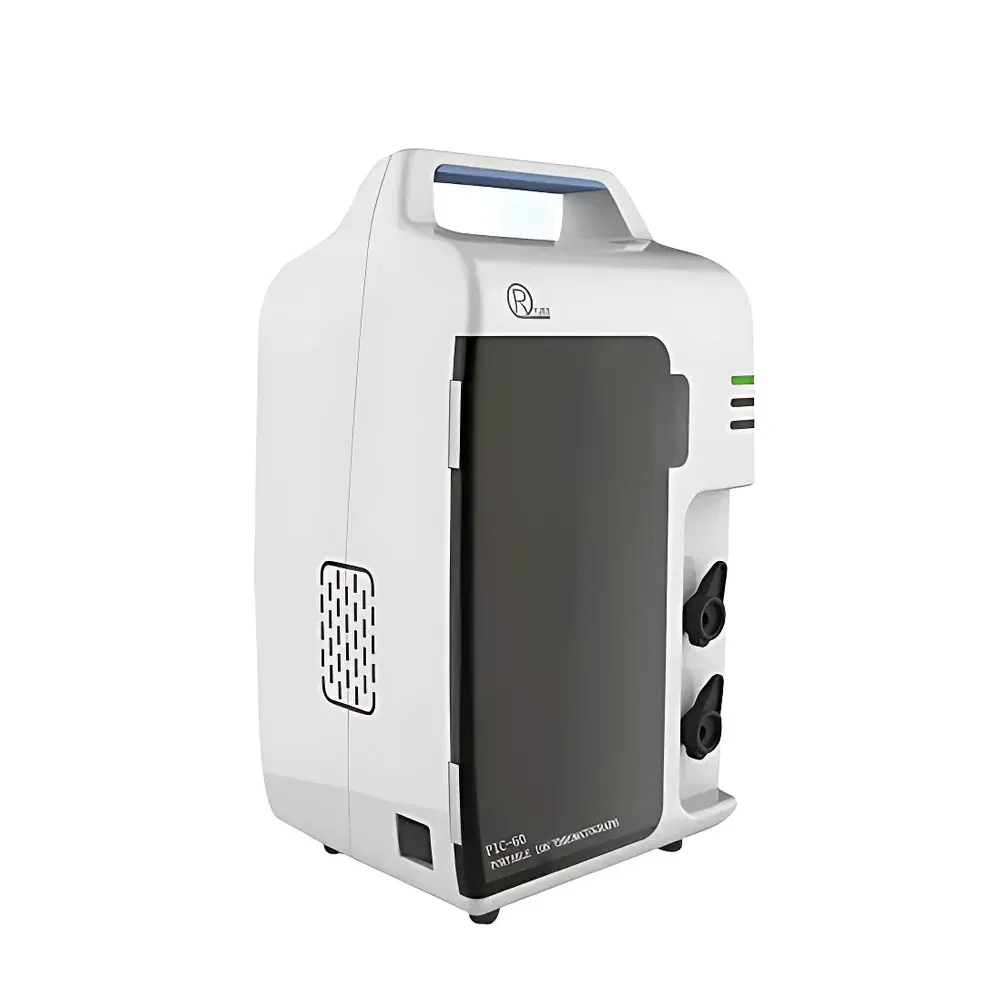
PUREN PIC-60 Dual-System Portable Ion Chromatograph
| Brand | PUREN |
|---|---|
| Origin | Shandong, China |
| Manufacturer Type | Direct Manufacturer |
| Instrument Type | Portable Ion Chromatograph |
| Model | PIC-60 |
| Pump Pressure Rating | 42 MPa |
| Flow Rate Range | 0.001–9.999 mL/min |
| Eluent Flow Rate Range | 0.001–9.999 mL/min |
| Maximum Operating Pressure | 42 MPa |
| Operating Temperature Range | 0–65 °C |
| Temperature Reproducibility | ±0.01 °C |
| Eluent Concentration Range | 0–80 mmol/L |
Overview
The PUREN PIC-60 Dual-System Portable Ion Chromatograph is a field-deployable analytical instrument engineered for simultaneous quantitative determination of anions and cations in complex matrices using suppressed conductivity detection. Based on high-pressure ion exchange chromatography principles, the system employs two independent high-pressure liquid chromatography (HPLC)-grade fluidic paths—each with dedicated dual-plunger reciprocating pumps, injection valves, separation columns, suppressors, and conductivity detectors—to enable true parallel analysis of both ionic species within a single run. Its compact, battery-powered architecture integrates all critical modules—including temperature-controlled column oven, eluent delivery, and detector electronics—into a unified chassis weighing under 12 kg. Designed for mission-critical environments where laboratory infrastructure is unavailable, the PIC-60 meets the operational demands of emergency response teams, environmental monitoring units, forensic laboratories, and offshore platforms requiring rapid, on-site ion profiling without compromise to analytical integrity.
Key Features
- Dual independent chromatographic systems operating in parallel: enables concurrent anion and cation analysis with no cross-contamination or method switching delay.
- High-precision dual-plunger piston pumps delivering flow stability ≤0.1% RSD across 0.001–9.999 mL/min, rated to 42 MPa maximum pressure.
- Electrically isolated eluent storage: proprietary bag-based eluent reservoirs physically separated from power supply and control circuitry to eliminate electrical hazards during field use.
- Integrated thermally stabilized column compartment maintaining 0–65 °C operation with ±0.01 °C reproducibility—critical for retention time stability in variable ambient conditions.
- Onboard rechargeable ultra-thin lithium polymer battery supporting ≥4 hours of continuous operation at typical flow rates (1.0 mL/min) and detector gain settings.
- Embedded dual-mode connectivity: IEEE 802.11 b/g/n Wi-Fi and USB 2.0 host interface for real-time data streaming and remote instrument control.
Sample Compatibility & Compliance
The PIC-60 accommodates aqueous samples containing common inorganic ions—including F⁻, Cl⁻, NO₂⁻, Br⁻, NO₃⁻, PO₄³⁻, SO₄²⁻, Li⁺, Na⁺, NH₄⁺, K⁺, Mg²⁺, and Ca²⁺—with detection limits typically ranging from 0.1–5 µg/L depending on matrix complexity and column configuration. It supports standard IC-compatible sample introduction methods: direct injection (10–100 µL loop), inline filtration (0.22 µm PTFE), and optional autosampler integration (external). The system complies with ISO/IEC 17025:2017 requirements for testing laboratory competence and aligns with ASTM D4327 (anion analysis in water), ASTM D6919 (cation analysis), and EPA Method 300.1 for drinking water compliance monitoring. All firmware and software components support audit-trail generation per FDA 21 CFR Part 11 for regulated environments.
Software & Data Management
The PIC-60 operates with PUREN IC-Studio v3.x, a cross-platform application supporting Windows 8/10/11 and Android 9.0+ devices. The software provides full instrument control, real-time chromatogram visualization, peak integration using tangent skim and Gaussian deconvolution algorithms, calibration curve generation (linear, quadratic, or weighted), and customizable report templates exportable as PDF, CSV, or XML. Raw data files are stored in vendor-neutral .icd format compliant with ASTM E1381-99 standards. Internal 32 GB eMMC flash memory retains ≥50,000 chromatograms with metadata (operator ID, location tag, GPS timestamp if enabled, method version). Wireless synchronization enables secure cloud backup via TLS 1.2–encrypted endpoints and role-based access control for multi-user deployments.
Applications
- Environmental emergency response: rapid screening of surface water, groundwater, and soil leachates for regulatory ions following chemical spills or industrial accidents.
- Maritime and offshore operations: on-vessel monitoring of boiler feedwater, cooling system fluids, and ballast water treatment efficacy.
- Forensic toxicology labs: quantification of inorganic electrolytes in biological fluids for postmortem analysis or poisoning investigations.
- Petroleum refinery QA/QC: chloride and sulfate monitoring in crude oil desalting effluents and hydroprocessing streams.
- Field-based educational outreach: mobile teaching platform for university-level analytical chemistry curricula emphasizing separation science fundamentals.
FAQ
Can the PIC-60 perform gradient elution?
Yes—the dual-pump architecture supports isocratic and binary gradient elution using compatible eluent combinations (e.g., KOH/NaOH or MSA/HNO₃), programmable via IC-Studio with up to 20 segment gradients.
Is method validation documentation provided?
Each instrument ships with a Factory Performance Qualification (PQ) report, including retention time precision, peak area repeatability (n=6 injections), and baseline noise specifications measured per ISO 13882:2020 Annex B.
What column chemistries are supported?
The system accepts standard 4 mm × 150 mm or 2 mm × 150 mm IC columns with 5–10 µm particle size, including AS23/AG23 (anion), CS19/CG19 (cation), and specialized columns for organic acid or transition metal analysis.
Does it meet GLP/GMP data integrity requirements?
Yes—IC-Studio enforces electronic signatures, user authentication, automated audit trails, and immutable raw data archiving consistent with ALCOA+ principles and EU Annex 11 guidance.
How is calibration maintained during extended field deployment?
The integrated column oven and pressure-compensated flow control minimize drift; daily bracketing with certified reference materials (CRM) is recommended, and built-in auto-calibration routines verify detector zero and span at user-defined intervals.





