
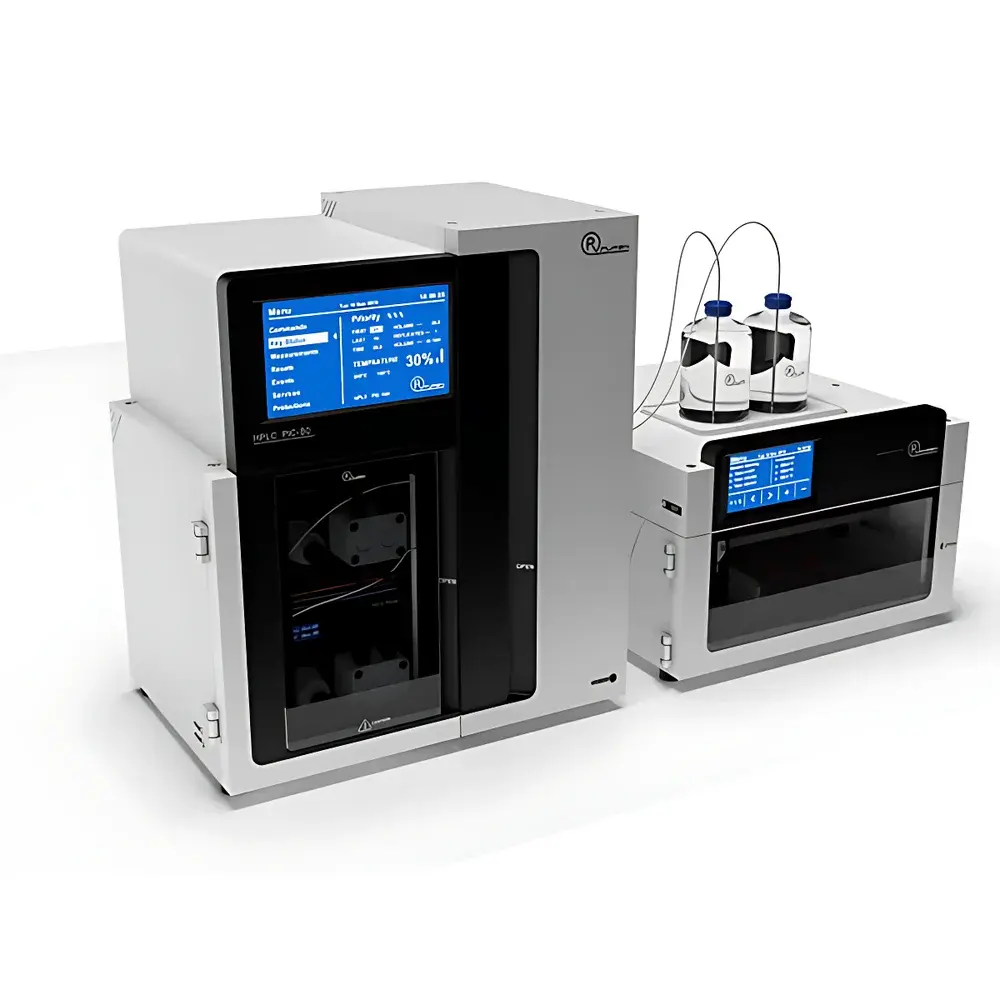
PUREN PIC-80B Ion Chromatograph
| Brand | PUREN |
|---|---|
| Origin | Shandong, China |
| Manufacturer Type | Manufacturer |
| Origin Category | Domestic |
| Model | PIC-80B |
| Instrument Type | Laboratory |
| Application Scope | General-purpose |
| Pump Pressure Rating | 0–42.0 MPa (stainless steel), 0–36 MPa (PEEK) |
| Flow Rate Range | 0.001–9.999 mL/min |
| Eluent Flow Rate | 0.7–1.5 mL/min |
| Max Operating Pressure | 10 MPa |
| Operating Temperature Range | 5–65 °C |
| Temperature Reproducibility | ±0.004 °C |
| Eluent Concentration Range | 1.92–4.8 mM |
Overview
The PUREN PIC-80B Ion Chromatograph is a high-integration, laboratory-grade analytical instrument engineered for precise, reproducible separation and quantification of inorganic anions and cations in aqueous matrices. Based on suppressed conductivity detection coupled with high-performance ion-exchange chromatography, the system delivers robust baseline stability, low detection limits, and excellent retention time reproducibility. Its modular architecture supports both single-system (anion-only or cation-only) configurations and optional dual-channel operation, enabling flexible deployment across environmental monitoring, pharmaceutical quality control, food safety testing, and industrial process water analysis. The instrument employs a non-metallic fluidic path constructed entirely from PEEK, PTFE, and polypropylene components to eliminate metal ion leaching—critical for trace-level analysis and compatibility with aggressive eluents including carbonate/bicarbonate, methanesulfonic acid (MSA), and hydroxide-based gradients.
Key Features
- Integrated high-brightness LCD touchscreen interface with intuitive navigation and real-time system status monitoring.
- Onboard automated sample preparation: integrated auto-dilutor and auto-standard preparer enable unattended calibration curve generation and high-concentration sample dilution (manual or programmable dilution factors).
- Full-system thermostatic control: column, suppressor, conductivity cell, and six-port valve housed within a single temperature-stabilized chamber; includes pre-heating of eluent to minimize thermal dispersion and improve peak shape.
- Non-metallic flow path: PEEK high-pressure pump head, Rheodyne PEEK injection valve, and chemically resistant tubing/fittings ensure compatibility with acidic, basic, and organic-modified eluents while preventing contamination from metallic impurities.
- Dual data redundancy architecture: local high-capacity storage combined with secure cloud synchronization enables automatic backup, remote access, and audit-compliant data retrieval from any internet-connected device.
- Modular detector compatibility: supports conductivity detection as standard; configurable for optional UV/Vis, amperometric, or mass spectrometric detection interfaces per application-specific requirements.
Sample Compatibility & Compliance
The PIC-80B is validated for analysis of common inorganic ions—including F⁻, Cl⁻, NO₂⁻, Br⁻, NO₃⁻, PO₄³⁻, SO₄²⁻, Li⁺, Na⁺, NH₄⁺, K⁺, Mg²⁺, and Ca²⁺—in drinking water, wastewater, soil extracts, pharmaceutical excipients, and semiconductor rinse waters. Its eluent concentration range (1.92–4.8 mM) and stable flow delivery (0.001–9.999 mL/min, ±0.1% RSD) support compliance with ISO 10304-1:2012, ASTM D4327, EPA Method 300.0 and 317.0, and USP . The system’s temperature reproducibility (±0.004 °C) and pressure stability meet GLP/GMP environmental control criteria; full electronic audit trail, user authentication, and 21 CFR Part 11–compliant software modules are available upon configuration.
Software & Data Management
The embedded chromatography data system (CDS) provides real-time instrument control, peak integration, quantitative reporting, and customizable report generation in native Word (.docx) and Excel (.xlsx) formats. Raw data files adhere to open-standard formats (e.g., .cdf) for third-party processing. Cloud synchronization uses TLS 1.2–encrypted transmission and role-based access control (RBAC), supporting multi-site collaboration and centralized data governance. All acquisition parameters, calibration history, and maintenance logs are timestamped and digitally signed—enabling full traceability required under ISO/IEC 17025 and FDA inspection protocols.
Applications
- Environmental labs: routine monitoring of regulated anions in surface water, groundwater, and wastewater per EU Directive 2000/60/EC and U.S. Clean Water Act.
- Pharmaceutical QC: residual chloride, sulfate, and ammonium testing in active pharmaceutical ingredients (APIs) and purified water (PW/WFI) per USP and EP 2.2.38.
- Food & beverage: nitrate/nitrite quantification in processed meats, dairy, and infant formula in alignment with Codex Alimentarius standards.
- Electronics manufacturing: ultra-trace halide analysis in ultrapure water used in wafer cleaning processes (ASTM D5127).
- Academic research: method development for novel ion-pairing reagents, gradient elution optimization, and coupling with IC-ICP-MS hyphenated techniques.
FAQ
What eluent types are compatible with the PIC-80B?
The system supports carbonate/bicarbonate, methanesulfonic acid (MSA), and potassium hydroxide (KOH) eluents—delivered via PEEK-compatible pumps and valves. Organic modifiers (e.g., acetone, methanol) up to 25% v/v may be used with appropriate column selection.
Does the instrument support 21 CFR Part 11 compliance?
Yes—when configured with the optional Secure CDS package, it provides electronic signatures, audit trails, user permission tiers, and data integrity controls meeting FDA requirements for regulated environments.
Can the PIC-80B operate without an external degasser?
Yes—the integrated online vacuum degassing module eliminates the need for standalone degassers, reducing footprint and improving long-term eluent stability.
What is the maximum column oven temperature?
The thermostatic chamber maintains temperatures from 5 °C to 65 °C with ±0.004 °C reproducibility, suitable for high-efficiency capillary and microbore columns requiring precise thermal management.
Is remote system monitoring supported?
Yes—via encrypted HTTPS web interface and mobile-responsive dashboard, users can monitor run status, view real-time chromatograms, receive alarm notifications, and initiate shutdown sequences remotely.
Related Products




