
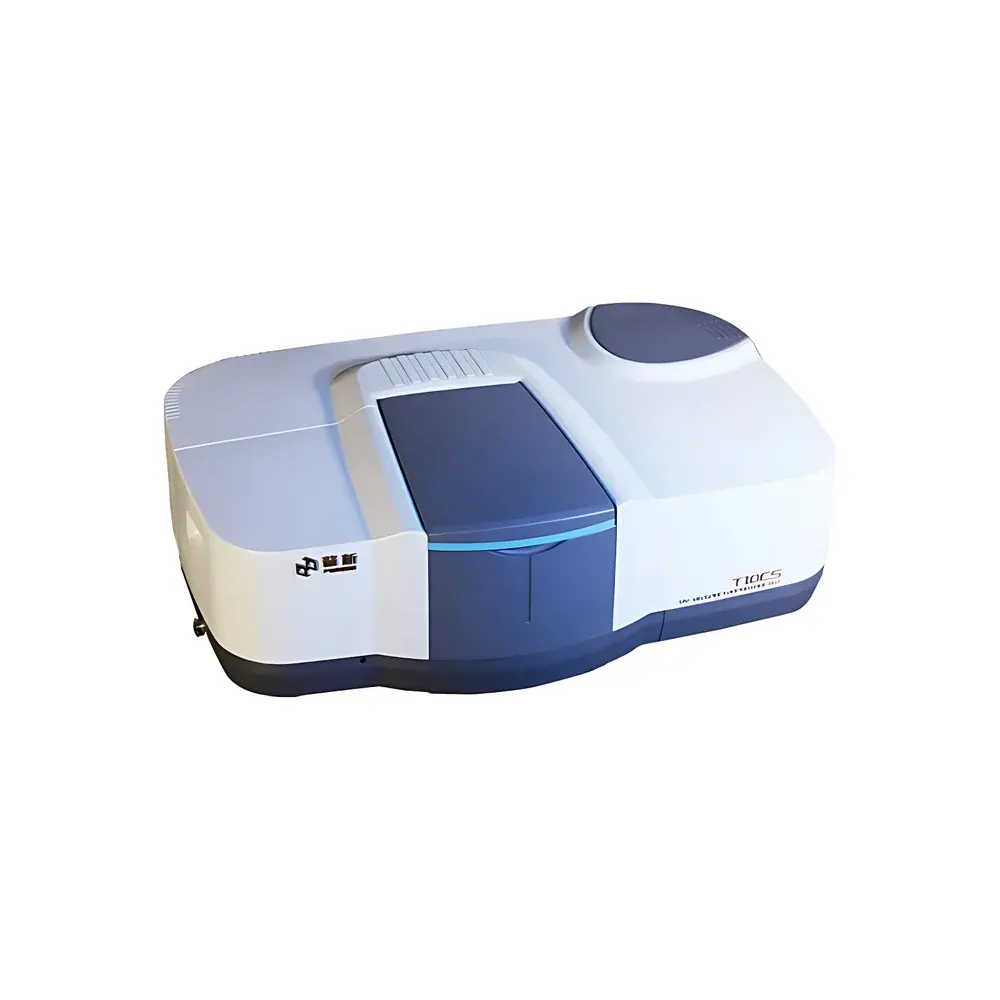
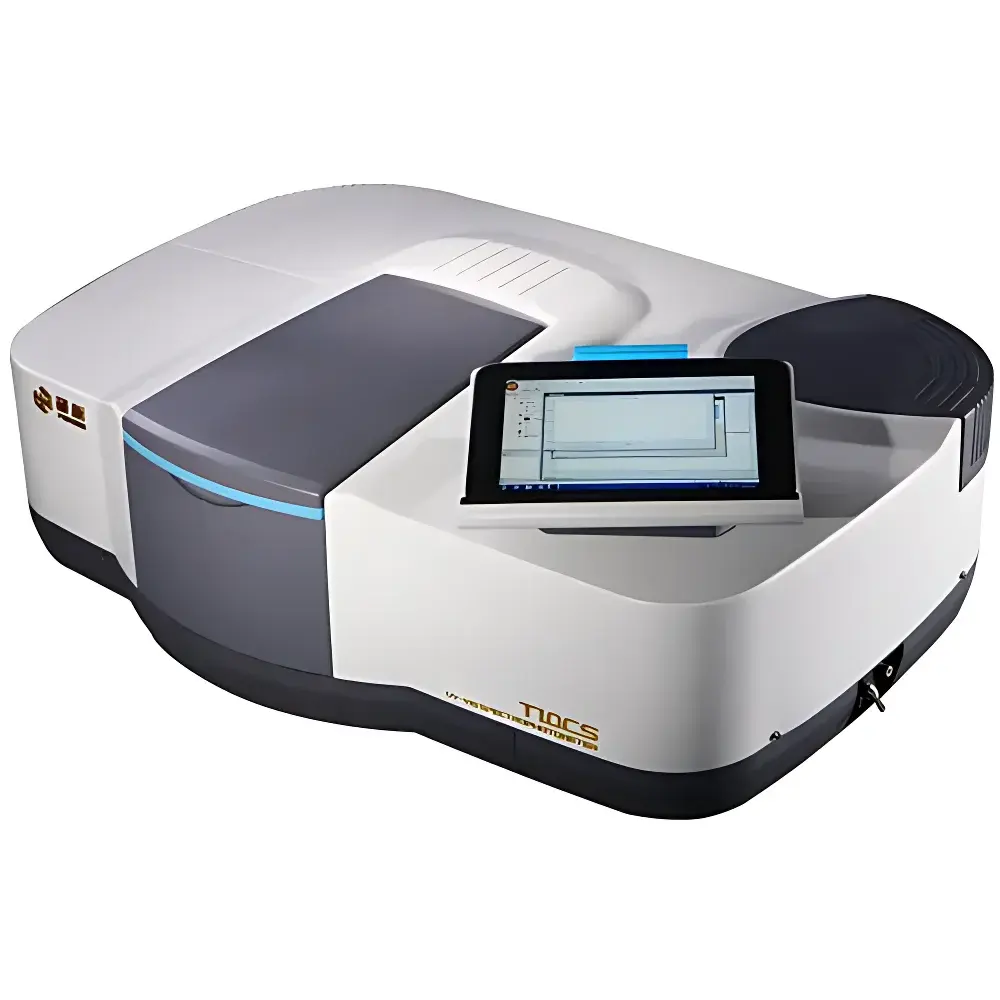
Purkinje T10CS Dual-Beam Ultraviolet-Visible Spectrophotometer
| Brand | Purkinje |
|---|---|
| Origin | Beijing, China |
| Manufacturer Type | Direct Manufacturer |
| Instrument Architecture | Dual-Beam |
| Detector Type | Photomultiplier Tube (PMT) |
| Wavelength Range | 185–900 nm |
| Wavelength Accuracy | ±0.1 nm (at D₂ line, 656.1 nm) |
| Wavelength Repeatability | ≤0.05 nm (at D₂ line, 656.1 nm) |
| Spectral Bandwidth | Continuously Adjustable from 0.1 to 5.0 nm |
| Stray Light | ≤0.00004%T (NaI, 220 nm) |
| Stray Light | ≤0.00002%T (NaNO₂, 360 nm) |
| Photometric Range | –8 to +8 Abs |
| Baseline Flatness | ±0.0005 Abs |
| Photometric Accuracy | ±0.002 Abs (0–0.5 Abs), ±0.004 Abs (0.5–1.0 Abs), ±0.3%T (>1.0 Abs) |
| Photometric Repeatability | ≤0.001 Abs (0–0.5 Abs), ≤0.002 Abs (0.5–1.0 Abs), ≤0.1%T (>1.0 Abs) |
| Drift | ≤0.1%T/h |
Overview
The Purkinje T10CS Dual-Beam Ultraviolet-Visible Spectrophotometer is a research-grade analytical instrument engineered for high-fidelity quantitative and qualitative absorption spectroscopy across the deep-UV to near-IR spectrum (185–900 nm). It employs a hybrid Czerny–Turner double monochromator optical architecture—comprising two cascaded dispersion stages with specially coated high-reflectivity mirrors and precision-aligned gratings—to achieve exceptional stray light suppression and spectral resolution. The dual-beam design actively compensates for source intensity fluctuations and detector drift in real time, enabling stable baseline performance over extended acquisition periods. Coupled with a low-noise photomultiplier tube (PMT) detector and thermally stabilized optics, the system delivers a photometric range of –8 to +8 Abs, supporting highly concentrated samples without dilution or signal saturation. Its triple-lamp configuration (deuterium, tungsten, and mercury) enables automated wavelength calibration and seamless spectral continuity across UV and visible regions—critical for regulatory-compliant method validation and long-term instrument traceability.
Key Features
- Hybrid C-T double monochromator system with optimized optical coatings, achieving stray light levels of ≤0.00004%T at 220 nm (NaI) and ≤0.00002%T at 360 nm (NaNO₂), as verified per national metrological type evaluation protocols.
- Continuously variable spectral bandwidth from 0.1 nm to 5.0 nm (in 0.1 nm increments), implemented via a discrete three-slit assembly with motorized slit control—enabling automatic bandwidth optimization based on sample absorption maxima.
- Integrated wavelength calibration source (Hg lamp) alongside primary D₂ and W lamps, supporting in situ verification of wavelength accuracy per ISO 17025 and ASTM E275–22 requirements.
- Modular open-platform architecture with standardized electrical and mechanical interfaces, facilitating third-party accessory integration and custom firmware development for specialized applications such as dissolution testing or reflectance quantification.
- Thermally stabilized optical bench and vibration-damped chassis ensure baseline flatness of ±0.0005 Abs and photometric drift ≤0.1%T/h—meeting stringent GLP and GMP environmental stability criteria.
Sample Compatibility & Compliance
The T10CS accommodates diverse sample formats—including cuvettes (10 mm to 100 mm pathlength), solid reflectance accessories (e.g., 60 mm and 150 mm integrating spheres), temperature-controlled multi-cell holders (5- and 8-position), microvolume cells (down to 2 µL), and flow-through configurations via optional peristaltic pump modules. All accessories maintain optical alignment fidelity and are mechanically registered to the instrument’s optical axis. The system complies with key international standards including ISO 6425 (spectrophotometer performance verification), ASTM E275–22 (description of ultraviolet and visible spectrophotometers), and USP (UV-Vis spectrophotometry). Its software architecture supports audit trails, electronic signatures, and 21 CFR Part 11–compliant data integrity controls when deployed in regulated QC/QA environments.
Software & Data Management
UVWin software provides a Windows-based graphical interface with full instrument control, spectral acquisition, kinetic scanning, multi-wavelength quantitation, and derivative analysis. It supports user-defined method templates, batch processing workflows, and export to CSV, XML, and PDF formats compliant with LIMS integration. Raw absorbance and transmittance data are stored with embedded metadata—including lamp status, slit width, date/time stamps, operator ID, and calibration history—ensuring full traceability. Optional software modules enable compliance with pharmacopeial monographs (e.g., USP , EP 2.2.25), dissolution profile comparison (f₁/f₂), and multivariate curve resolution (MCR) for complex mixture analysis.
Applications
The T10CS serves as a foundational tool in academic research laboratories for kinetics studies, equilibrium constant determination, and ligand-binding assays. In public health and environmental labs, it supports EPA Method 365.3 (phosphate), ISO 10523 (pH of aqueous extracts), and WHO-recommended heavy metal speciation protocols. Industrial users apply it for raw material identity verification (IR/UV fingerprint matching), cleaning validation residue detection (e.g., residual solvents at ppm levels), and polymer degradation monitoring via carbonyl index calculation. Metrology institutes utilize its certified wavelength accuracy and low stray light for reference material characterization and inter-laboratory comparison exercises under ISO/IEC 17043.
FAQ
What wavelength calibration standards are supported?
The built-in Hg lamp enables automated peak identification at 253.7 nm, 296.7 nm, 365.0 nm, 404.7 nm, 435.8 nm, and 546.1 nm—fully traceable to NIST SRM 2034 and ISO 6425 Annex B.
Can the T10CS be integrated into an automated lab workflow?
Yes—via RS-232, USB, and optional Ethernet interfaces, the instrument supports SCPI command sets and LabVIEW drivers for integration with robotic liquid handlers and centralized data management systems.
Is the optical system vacuum-purged for deep-UV operation?
No; the 185 nm lower limit is achieved using high-transmission fused silica optics and nitrogen-purged optical paths (optional accessory), eliminating the need for full vacuum enclosures while maintaining signal-to-noise integrity below 190 nm.
How is photometric accuracy validated during routine use?
Certified neutral density filters (NIST-traceable, e.g., Schott NG11) and potassium dichromate solutions (USP Reference Standard) are used for daily verification per ASTM E927–21 Section 7.3.
Does the system support Good Manufacturing Practice (GMP) documentation requirements?
When configured with UVWin Pro Edition, the instrument generates ALCOA+ compliant records—including electronic signatures, change logs, and immutable audit trails—validated for FDA and EMA inspections.
Related Products






