
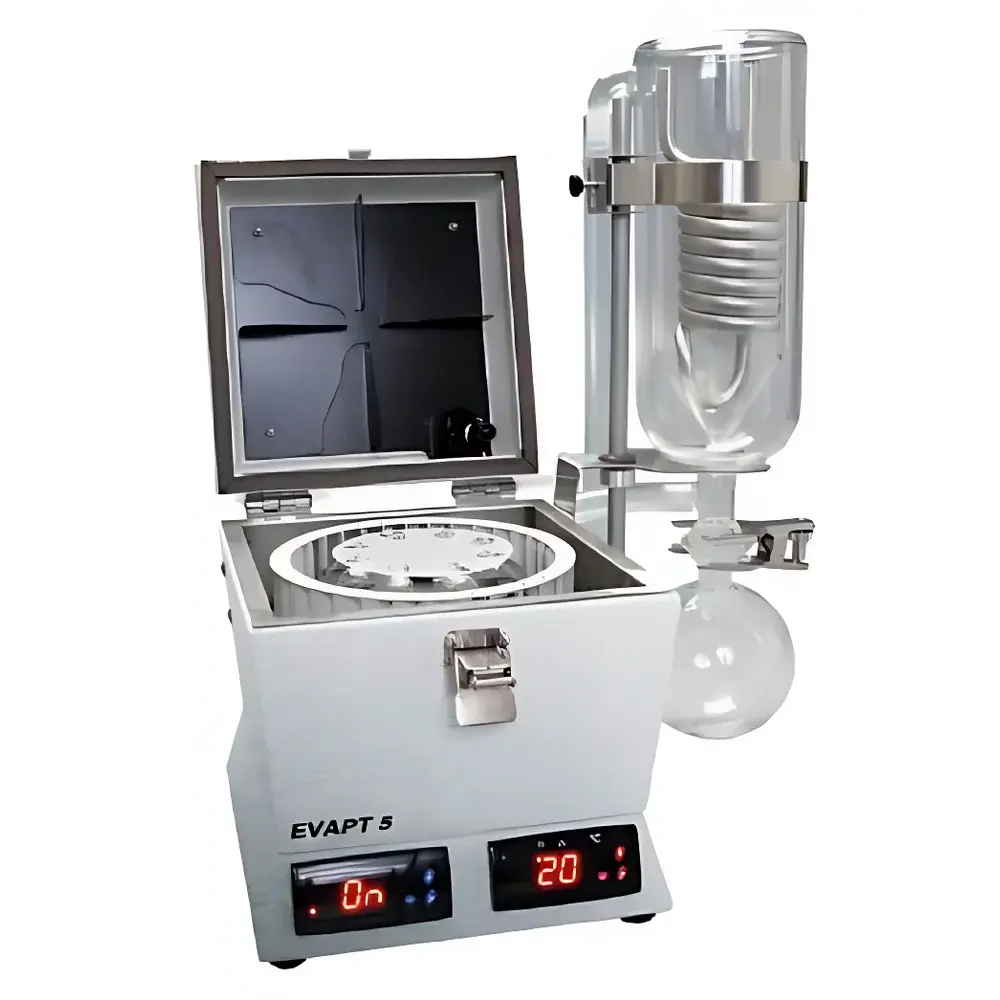
PYNN EVAPT 5 Vacuum-Free Centrifugal Evaporator
| Brand | PYNN |
|---|---|
| Origin | USA |
| Model | EVAPT 5 |
| Instrument Type | Vacuum-Free Centrifugal Concentrator |
| Key Patents | US 8,061,056 B2 (Self-Generated Blow-Down Technology) |
| Operating Temperature Range | 0–55 °C |
| Timer Range | 0–1000 min |
| Dimensions | 20.3 cm × 30.5 cm × 45.7 cm (W×D×H) |
| Sample Capacity Options | 6×20 mL scintillation vials |
Overview
The PYNN EVAPT 5 is a vacuum-free centrifugal evaporator engineered for high-fidelity sample concentration, drying, and solvent removal without reliance on external vacuum pumps or low-pressure environments. Unlike conventional rotary evaporators or vacuum centrifugal concentrators, the EVAPT 5 employs a patented self-generated blow-down mechanism (US Patent 8,061,056 B2) that establishes controlled vapor-phase mass transfer through synchronized thermal and cryogenic dual-loop circulation. This principle leverages differential vapor pressure gradients induced by simultaneous sample heating and condensate capture—enabling rapid, gentle, and fully enclosed solvent recovery. The system operates at ambient pressure, eliminating risks of bumping, foaming, or cross-contamination associated with vacuum-induced boiling instability. Its sealed architecture ensures full containment of volatile, toxic, or radio-labeled compounds, making it suitable for GLP-compliant laboratories handling hazardous analytes in life science, pharmaceutical, and nuclear research applications.
Key Features
- Vacuum-free operation: Eliminates need for vacuum pumps, oil traps, or vented exhaust lines—reducing infrastructure requirements and maintenance overhead.
- Self-generated blow-down technology: Proprietary airflow induction driven by thermal-cryogenic coupling ensures continuous, laminar vapor transport from rotating samples to an integrated standby cold trap.
- Dual-loop thermal management: Independent heating (0–55 °C, ±0.5 °C accuracy) and cryogenic condensation (−30 °C typical trap surface temperature) operate synchronously to maximize solvent capture efficiency (>98% recovery for common organics including ethanol, acetonitrile, and ethyl acetate).
- Quiet, low-energy design: Acoustic emission <45 dBA; power consumption ≤250 W during active evaporation—compatible with standard benchtop electrical outlets.
- Compact footprint: 20.3 cm × 30.5 cm base area and 45.7 cm height enable placement inside radiation-shielded enclosures, fume hoods, or open lab benches without ducting.
- One-touch programmable interface: Intuitive touchscreen allows presetting time (0–1000 min), temperature profile, and automatic endpoint detection to prevent over-drying or sample degradation.
Sample Compatibility & Compliance
The EVAPT 5 accommodates diverse vessel formats—including scintillation vials (6×20 mL, 6×30 mL, 4×40 mL), microcentrifuge tubes (8×1.6 mL), HPLC vials (10×1.5 mL), and custom rotors for specialized geometries. Its fully sealed vapor path meets ISO 15195:2019 requirements for containment of volatile hazardous substances and supports compliance with OSHA 29 CFR 1910.120 (HAZWOPER) and IAEA Safety Standards Series No. SSG-24 for radioactive material handling. All wetted surfaces are constructed from chemically inert 316 stainless steel and PTFE-coated aluminum, ensuring resistance to aggressive solvents and minimizing adsorption artifacts. The system supports audit-ready operation under FDA 21 CFR Part 11 when paired with validated software modules (see Software & Data Management section).
Software & Data Management
The EVAPT 5 Control Suite (v3.2+) provides local touchscreen operation and optional Ethernet/USB connectivity for remote monitoring and data logging. Each run generates a timestamped record containing setpoints (temperature, duration), real-time sensor readings (condenser surface temp, chamber ambient temp), and system status flags (e.g., “cold trap saturation,” “rotor imbalance”). Export formats include CSV and PDF reports compatible with LIMS integration. For regulated environments, optional 21 CFR Part 11-compliant firmware enables electronic signatures, role-based access control, and immutable audit trails—fully traceable to ALCOA+ principles (Attributable, Legible, Contemporaneous, Original, Accurate, Complete, Consistent, Enduring, Available).
Applications
The EVAPT 5 delivers reproducible performance across demanding workflows requiring solvent removal under non-vacuum conditions: RNA/DNA clean-up following phenol-chloroform extraction; concentration of radiolabeled tracers (e.g., 3H-thymidine, 14C-glucose) prior to scintillation counting; post-synthesis workup of air/moisture-sensitive intermediates in medicinal chemistry; lyophilization-preparatory drying of monoclonal antibody formulations; and preparative-scale concentration of HPLC fractions containing thermolabile natural products. Its absence of vacuum-induced shear stress preserves protein tertiary structure integrity—validated via CD spectroscopy and SEC-MALS analysis across multiple independent studies.
FAQ
Does the EVAPT 5 require a vacuum pump or external cooling water supply?
No. It operates entirely without vacuum infrastructure or chilled water connections—the integrated Peltier-based cold trap and resistive heating elements function autonomously.
Can the EVAPT 5 handle highly volatile solvents such as diethyl ether or pentane?
Yes, provided appropriate rotor sealing and cold trap temperature settings are selected; solvent-specific recovery efficiency data sheets are available upon request.
Is rotor customization supported for non-standard tube formats?
Yes—PYNN offers engineering consultation and CNC-machined rotor fabrication for proprietary vessel geometries, subject to mechanical compatibility review.
How is calibration verified and maintained?
Temperature sensors are NIST-traceable and support user-performed verification using certified reference thermometers; annual factory recalibration services are available under extended warranty plans.
What safety certifications does the EVAPT 5 hold?
It complies with UL 61010-1:2012, IEC 61010-1:2010, and CE marking per Directive 2014/30/EU (EMC) and 2014/35/EU (LVD).



