
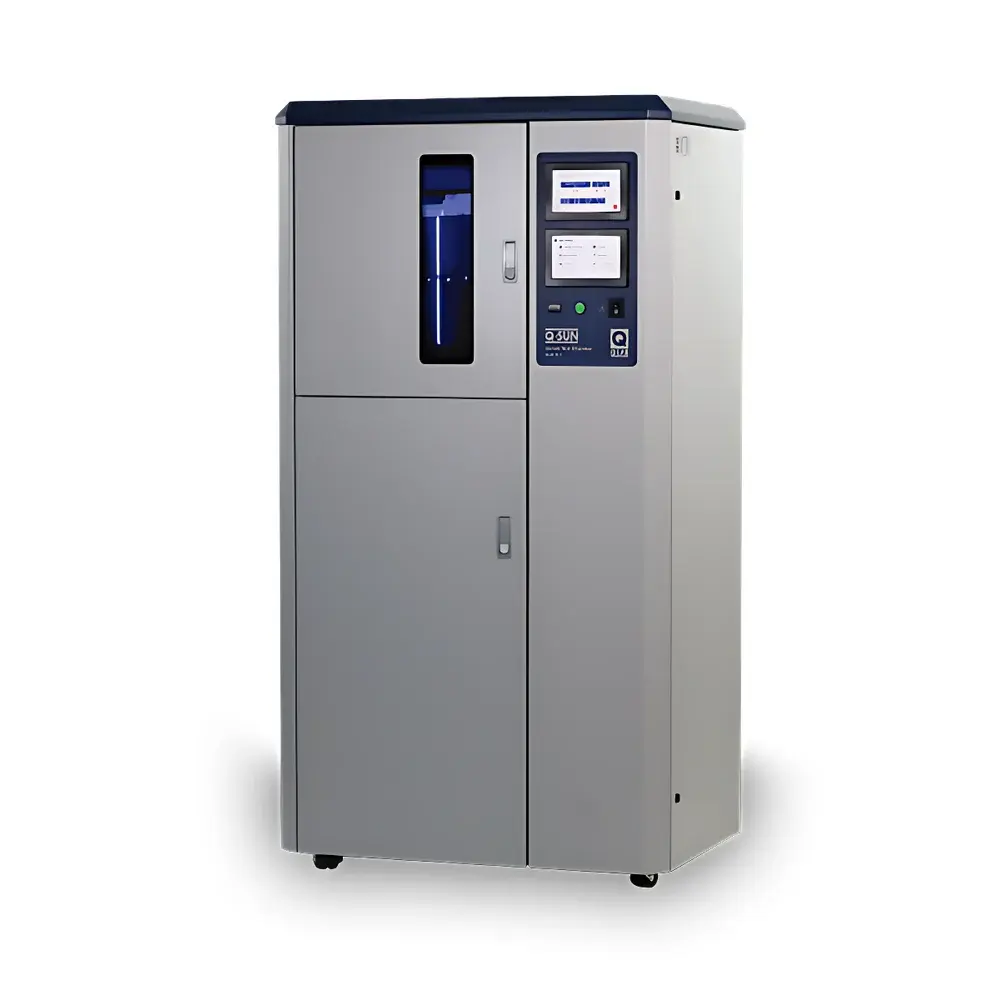

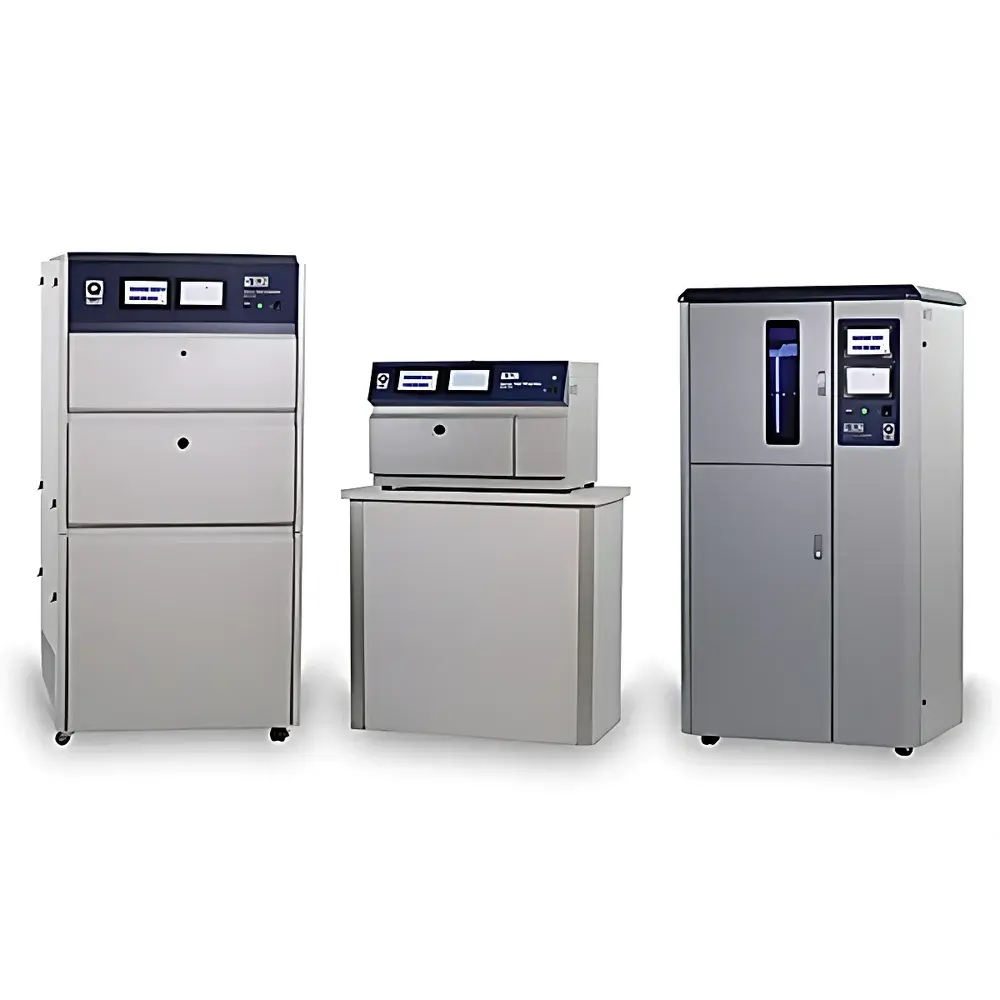
Q-LAB Q-SUN Xe-2 Xenon Arc Weathering Tester for Color Fastness Testing
| Brand | Q-LAB |
|---|---|
| Origin | USA |
| Model | Q-SUN Xe-2 |
| Light Source | 1800 W Air-Cooled Xenon Lamp |
| Spectral Range | Full-spectrum Solar Simulation (UV, Visible, NIR) |
| Irradiance Control | Solar Eye® Closed-Loop Radiometer System |
| Temperature Control | Black Panel Temperature (35–105 °C), Chamber Air Temperature |
| Humidity Control | Standard Relative Humidity (RH) Regulation (Requires Deionized Water) |
| Optional Feature | Water Spray Function (Operates in Light/Dark Cycles) |
| Sample Capacity | 31 Specimens (46 mm × 122 mm) |
| Compliance | ISO 4892-2, ASTM G155, AATCC TM16, ISO 105-B02/B04/B06, GB/T 8427, JIS L0843, SAE J2527, PV 1303, VDA 675242, and >30 Other International Standards |
| Calibration Traceability | NIST-Traceable, ISO/IEC 17025 Accredited Laboratory |
| Connectivity | Built-in Ethernet, Remote Monitoring & Data Logging Support |
| User Interface | Multilingual Controller (EN/FR/ES/IT/DE), Self-Diagnostic Alerts, Virtual Bar Chart Software Integration |
Overview
The Q-LAB Q-SUN Xe-2 Xenon Arc Weathering Tester is an engineered solution for accelerated color fastness and photostability evaluation of textiles, dyes, automotive interior materials, and coated substrates. It employs a single 1800 W air-cooled xenon arc lamp to replicate the full solar spectrum—including ultraviolet (290–400 nm), visible (400–700 nm), and near-infrared (700–1100 nm) radiation—enabling physiologically relevant degradation mechanisms under controlled laboratory conditions. Unlike outdoor exposure, where specimens receive only intermittent peak-intensity irradiation, the Q-SUN Xe-2 delivers continuous, calibrated noon-sun-equivalent irradiance for 24 hours per day, significantly accelerating aging kinetics while preserving spectral fidelity. Its design adheres to fundamental principles of photochemical kinetics and thermal-photonic coupling, ensuring that degradation pathways (e.g., dye bond cleavage, polymer chain scission, pigment fading) align with real-world service life expectations.
Key Features
- Full-spectrum xenon lamp system with spectral output matching natural sunlight, configurable via interchangeable optical filters to meet ISO 4892-2, ASTM G155, AATCC TM16, and automotive OEM specifications (e.g., SAE J2527, PV 1303)
- Solar Eye® closed-loop irradiance control continuously monitors and adjusts lamp output to maintain ±5% irradiance stability across UV and visible bands, ensuring test repeatability and inter-laboratory reproducibility
- Independent black panel temperature (BPT) and chamber air temperature regulation, with BPT range from 35 °C to 105 °C—critical for simulating thermal acceleration effects on photooxidation rates
- Standard relative humidity (RH) control (10–95% RH), requiring deionized water to prevent mineral deposition and sensor drift; RH and temperature are logged synchronously with irradiance
- Optional water spray function, mounted at the chamber ceiling, operates during both light and dark cycles to simulate dew, rain, or condensation-induced stress—particularly relevant for textile swelling, hydrolytic dye loss, and coating delamination
- Large-capacity rotating drum sample holder accommodating 31 specimens (46 mm × 122 mm), compatible with ISO 105-B02 frame mounts, AATCC TM16 specimen holders, and standard textile swatch formats
- Embedded Ethernet interface enabling remote configuration, real-time parameter monitoring, automated data export, and audit-ready test condition reporting compliant with GLP and FDA 21 CFR Part 11 requirements
Sample Compatibility & Compliance
The Q-SUN Xe-2 supports rigid and flexible planar specimens up to 3 mm thickness, including woven/knitted fabrics, dyed leather, synthetic upholstery, plastic trim, printed labels, and coated metal substrates. Its mechanical design accommodates standardized mounting fixtures per ISO 105-B02 (blue wool scale reference), AATCC TM16 (multi-fiber fabric arrays), and JIS L0843 (Japanese textile color fastness protocols). The instrument meets or exceeds performance criteria defined in over 30 international standards—including ISO 4892-2 (xenon arc exposure methods), ASTM G155 (non-filtered xenon arc apparatus), GB/T 8427 (Chinese textile color fastness), and VDA 675242 (German automotive interior lightfastness)—ensuring regulatory acceptability for QC release, supplier qualification, and R&D benchmarking. All optical filter configurations are validated against CIE Publication No. 85 and ISO/TR 11477 spectral reference data.
Software & Data Management
The embedded controller features a multilingual (English, French, Spanish, Italian, German) touchscreen interface with intuitive navigation, real-time graphical display of irradiance, BPT, RH, and chamber temperature, and context-aware diagnostic alerts. Continuous parameter logging is stored internally and exportable via Ethernet to CSV or XML formats. The optional “Virtual Bar Chart” PC software enables automated synchronization of exposure profiles, generation of time-stamped compliance reports, and secure transmission of raw logs to Q-Lab technical support for root-cause analysis. Audit trails record all user actions, setpoint changes, calibration events, and system faults—fully traceable to NIST-traceable references and compliant with ISO/IEC 17025 documentation requirements for accredited testing laboratories.
Applications
This tester is routinely deployed in textile quality assurance labs to assess color migration, crocking resistance, and UV-induced hue shift in reactive-dyed cotton, disperse-dyed polyester, and pigment-printed blends. Automotive Tier 1 suppliers use it for validating dashboard material fade resistance per GMW 14867 and Ford CETP 00.00-L-467. Coating manufacturers apply it to evaluate gloss retention and chalking onset in acrylic and polyurethane topcoats under simulated window-filtered spectra (using Daylight-Q/B filter). Regulatory testing labs leverage its traceable calibration and documented uncertainty budgets for certification under ISO 105-B04 (continuous irradiation) and ISO 105-B06 (intermittent irradiation with moisture cycles). Research institutions utilize its programmable irradiance ramps and multi-parameter correlation capability to model Arrhenius-type photochemical activation energies.
FAQ
What spectral filters are included with the Q-SUN Xe-2, and how do they affect test validity?
The base configuration includes Daylight-Q and Window Glass-Q filters. Daylight-Q replicates unfiltered terrestrial sunlight (ISO 4892-2 Cycle 1); Window Glass-Q simulates indoor exposure through architectural glass (ISO 4892-2 Cycle 2). Filter selection directly determines UV cutoff, IR heating profile, and photodegradation mechanism dominance—thus governing test relevance to end-use environment.
Is the water spray function compatible with humidity control during the same test cycle?
Yes. The spray system operates independently of RH regulation and can be scheduled during light or dark phases. However, deionized water is mandatory for both systems to avoid scaling and sensor contamination.
How often must the black panel temperature sensor be calibrated, and what traceability does it provide?
Annual field calibration using the CT202 reference thermometer (matched to either insulated or non-insulated black panel type) is recommended. Q-Lab’s ISO/IEC 17025-accredited calibration lab provides NIST-traceable certificates with measurement uncertainty statements per ISO/IEC 17025 Clause 6.5.
Can the Q-SUN Xe-2 generate test reports compliant with FDA 21 CFR Part 11?
Yes—when used with Virtual Bar Chart software and configured with electronic signatures, audit trail logging, and role-based access control, the system supports Part 11-compliant electronic records for regulated pharmaceutical packaging or medical textile validation.
What maintenance intervals are specified for the xenon lamp and optical components?
The 1800 W air-cooled lamp requires replacement after ~1500 hours of operation. Quartz envelope cleaning and filter inspection are recommended every 500 hours. Full optical alignment verification is performed during lamp replacement using factory-provided alignment jigs and spectral validation protocols.





