
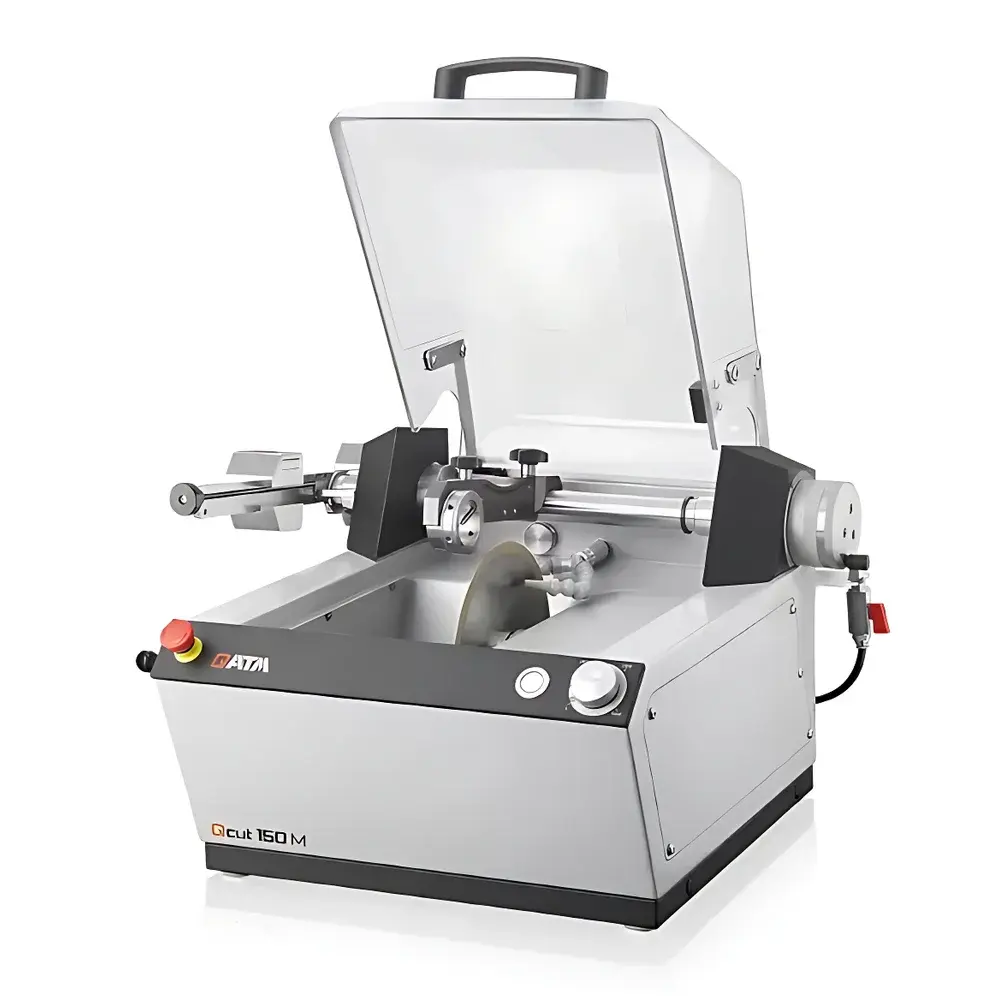
QATM Qcut 150 M Manual Precision Cutting Machine
| Brand | QATM |
|---|---|
| Origin | Germany |
| Model | Qcut 150 M |
| Instrument Type | Manual Precision Cutting Machine |
| Cutting Wheel Diameter | 75–203 mm (3"–8") |
| Adjustable Speed | 150–3000 rpm |
| Max Cutting Capacity | Ø 40 mm |
| Adjustable Cutting Force | 0–10 N |
| Y-Axis Feed (Vertical) | 120 mm (Manual) |
| Z-Axis Feed (Parallel to Wheel) | 25 mm (Manual) |
| Motor Power | 0.37 kW (S1) |
| Power Supply | 0.75 kVA |
| Dimensions (W×H×D) | 591 × 391 × 590 mm |
| Weight | ~45 kg |
| Cooling Systems | 4 configurable options |
| Frame Material | Powder-coated stainless steel |
Overview
The QATM Qcut 150 M is a manually operated, high-precision laboratory cutting machine engineered for reproducible cross-sectioning of metallic, ceramic, composite, and polymer specimens in metallographic and materials science laboratories. It operates on the principle of controlled abrasive wheel cutting under adjustable mechanical loading and variable rotational velocity—enabling optimal material removal rates while minimizing thermal damage, deformation, or edge chipping. Designed for routine sample preparation prior to mounting, grinding, polishing, and microscopic analysis, the Qcut 150 M delivers consistent cut geometry across diverse specimen geometries and hardness profiles. Its robust stainless-steel frame with powder-coated finish ensures long-term dimensional stability and resistance to coolant-induced corrosion—critical for compliance with ISO 14644 cleanroom-compatible lab environments and GLP-aligned sample traceability workflows.
Key Features
- Manually actuated dual-axis feed system: Y-axis (vertical, 120 mm travel) for specimen approach; Z-axis (parallel to wheel plane, 25 mm travel) for fine depth control during precision sectioning.
- Continuously adjustable cutting force (0–10 N) via calibrated rotary arm mechanism—enabling optimization for brittle ceramics (low-force mode) and high-strength alloys (higher-load configurations).
- Variable-speed motor (150–3000 rpm) compatible with cutting wheels from Ø 75 mm to Ø 203 mm (3″ to 8″), supporting both coarse deburring and final thin-sectioning protocols.
- Tool-free quick-change system for clamping arms, sample holders, and platform accessories—reducing setup time and mitigating operator-induced variability.
- Four selectable cooling delivery modes: flood, mist, drip, and dry—each configurable to match material-specific thermal sensitivity and lubrication requirements per ASTM E3-22 and ISO 15510 standards.
- Integrated LED-lit cutting chamber with buffered safety hood closure—ensuring visual monitoring without compromising operator protection or dust containment.
Sample Compatibility & Compliance
The Qcut 150 M accommodates cylindrical, rectangular, irregular, and mounted specimens up to Ø 40 mm diameter or equivalent cross-sectional area. It supports standard ISO 643-compliant metallographic blanks, ASTM E8/E8M tensile coupons, and EN 10360-certified reference blocks. Clamping solutions include V-blocks, parallel jaw fixtures, and custom-machined adapters—all compliant with ISO/IEC 17025 documentation requirements for sample identification and positional repeatability. The machine’s mechanical design conforms to EN 61000-6-2 (EMC immunity) and EN 61000-6-4 (EMC emission) standards; its guarded enclosure meets EN ISO 13857 safety clearance specifications. No electrical interlocks or software-based audit trails are included—consistent with its classification as a Class I manual preparation instrument under EU Machinery Directive 2006/42/EC.
Software & Data Management
As a fully manual cutting system, the Qcut 150 M does not incorporate embedded microcontrollers, digital interfaces, or data logging capabilities. All operational parameters—including rotational speed, applied load, feed rate, and cooling mode—are set and recorded externally via lab notebook entries or LIMS-integrated SOP templates. This architecture eliminates firmware validation overhead and aligns with FDA 21 CFR Part 11 “non-electronic record” exemptions for purely mechanical instruments used in GMP-compliant QC labs. Traceability is maintained through physical logbooks referencing specimen ID, operator initials, date/time, wheel type (e.g., SiC vs. diamond-bonded), and post-cut inspection notes per ISO 17025 clause 7.5.2.
Applications
- Routine metallographic sectioning of ferrous and non-ferrous alloys for grain structure evaluation per ASTM E112.
- Preparation of fracture surfaces for SEM/EDS analysis—minimizing artifact generation via low-speed, high-coolant protocols.
- Cutting of sintered ceramics and cemented carbides where thermal cracking must be avoided.
- Sectioning of coated components (e.g., thermal barrier coatings) to preserve interface integrity prior to cross-sectional microscopy.
- QC sampling in foundry and heat-treatment facilities requiring rapid, repeatable specimen extraction from production lots.
FAQ
Is the Qcut 150 M suitable for automated or programmable operation?
No. It is strictly a manual instrument with no motorized axes, digital controls, or external communication ports.
Can it accommodate diamond-impregnated cutting wheels?
Yes—provided the wheel arbor size matches the Ø 12.7 mm spindle and maximum outer diameter remains within 203 mm.
What maintenance intervals are recommended for the mechanical feed system?
Lubrication of Y/Z-axis lead screws and pivot points is advised every 200 operating hours or quarterly, whichever occurs first, using ISO VG 68 mineral oil.
Does QATM provide ISO 17025-compliant calibration certificates for this model?
No—calibration is not applicable to purely mechanical feed and force systems; however, traceable torque wrenches and tachometers may be used for periodic verification per internal SOPs.
Is the cutting chamber compatible with fume extraction ducting?
Yes—the rear panel includes a standardized Ø 100 mm port for integration with laboratory exhaust systems meeting EN 13122-2 airflow requirements.
Related Products



