
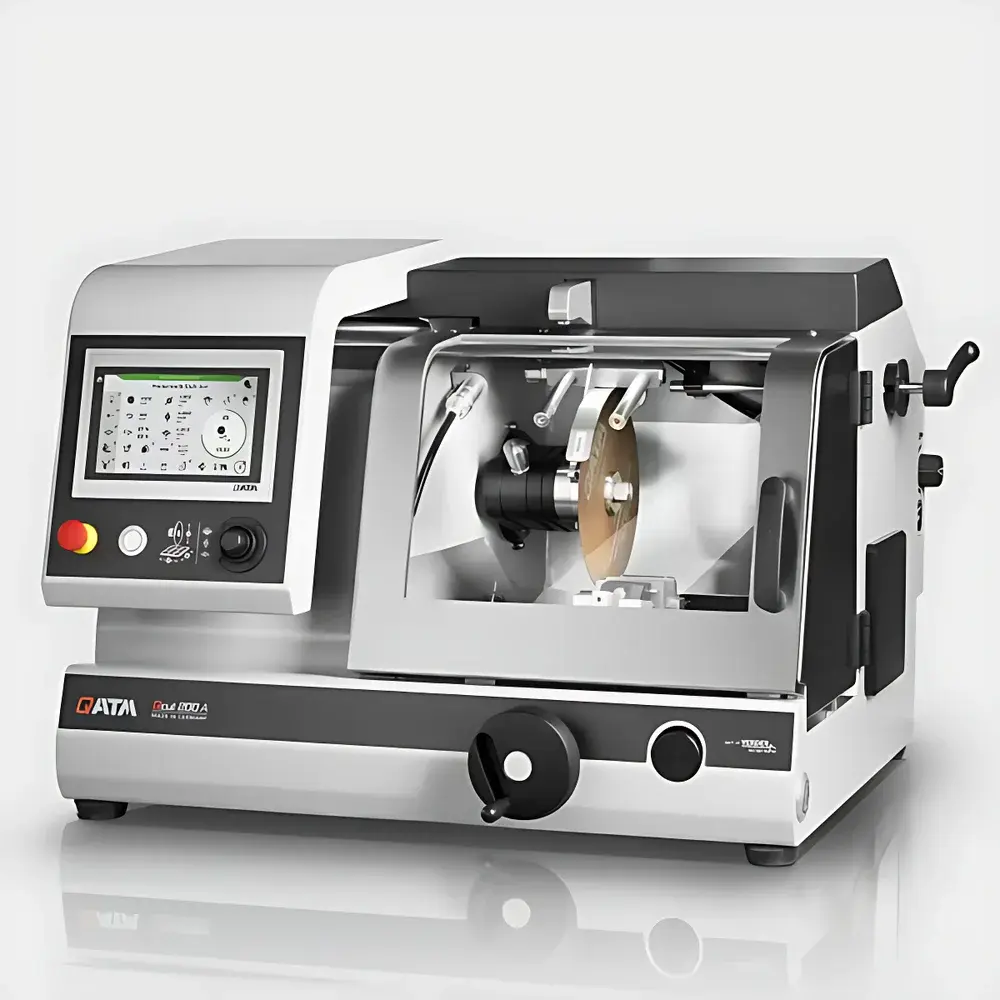
QATM Qcut 200 A (Brilliant 220 Successor) Desktop Precision Cut-Off Machine
| Brand | QATM |
|---|---|
| Origin | Germany |
| Model | Qcut 200 A |
| Cutting Wheel Max Diameter | Ø 203 mm (8") |
| Max Cutting Height | 75 mm (with Ø 200 mm wheel) |
| X-Axis Travel | 210 mm (manual/automatic) |
| Y-Axis Travel | 80 mm (automatic) |
| Z-Axis Travel (optional) | 80 mm (automatic) |
| Z-Axis Positioning Accuracy | 0.005 mm |
| T-Slot Width | 8 mm |
| Spindle Speed Range | 300–5000 rpm |
| Motor Power (S1 duty) | 0.75 kW |
| Input Power Rating | 2.2 kW |
| Dimensions (W×H×D) | 725 × 535 × 675 mm |
| Weight | ~82 kg |
Overview
The QATM Qcut 200 A is a fourth-generation desktop precision cut-off machine engineered for metallographic and materials science laboratories requiring reproducible, low-damage sectioning of metallic, ceramic, and composite specimens. Unlike conventional benchtop cutters constrained by mechanical rigidity or thermal instability, the Qcut 200 A implements a true multi-axis servo-controlled architecture—featuring fully automated X- and Y-axes, with optional high-resolution Z-axis motion—to deliver sub-micron positioning repeatability and programmable feed control across complex geometries. Its design philosophy centers on minimizing thermal distortion and mechanical vibration during cutting: the spindle employs a backlash-free precision bearing system, while an enhanced coolant delivery circuit achieves up to 25% higher flow rate versus comparable instruments—reducing abrasive wheel wear by approximately 15% and extending consumable service life. As the designated successor to the Brilliant 220 platform, the Qcut 200 A retains full backward compatibility with legacy fixtures and software modules while introducing modular adaptability for rotational sample holders and integrated cleaning sequences.
Key Features
- Three-axis motion control (X, Y, and optional Z), all driven by closed-loop servo motors with real-time position feedback
- Backlash-free high-precision spindle assembly with ISO 200-class dynamic balance and extended service intervals
- Optimized coolant distribution system delivering laminar, high-volume flow directly at the cut interface—critical for heat-sensitive alloys and brittle ceramics
- Automated wheel cleaning cycle triggered pre- and post-cut to prevent slurry buildup and maintain consistent kerf geometry
- Modular rotational adapter kit enabling controlled angular indexing for serial cross-sectioning of cylindrical or irregularly shaped samples
- Tool-free, quick-release wheel mounting mechanism compliant with EN 13218 and ISO 527-2 safety standards
- Integrated emergency stop, interlocked guard doors, and torque-limited axis homing for operator safety and GLP-compliant operation
Sample Compatibility & Compliance
The Qcut 200 A accommodates specimens up to 75 mm in height using standard Ø 200 mm cut-off wheels (max compatible diameter: Ø 203 mm). Its T-slot worktable (8 mm width) supports universal fixture integration—including custom vacuum chucks, multi-position vise arrays, and thermally isolated clamping plates—for ferrous/non-ferrous metals, sintered carbides, graphite, and fiber-reinforced polymers. All operational parameters—including spindle speed, feed rate, dwell time, and coolant activation—are programmable per specimen type and documented in audit-ready format. The system complies with IEC 61000-6-2 (EMC immunity), IEC 61000-6-4 (EMC emission), and meets essential requirements of the EU Machinery Directive 2006/42/EC. Optional firmware enables 21 CFR Part 11–compliant electronic signatures and audit trails for regulated environments.
Software & Data Management
Control is executed via QATM’s proprietary CutControl Suite—a Windows-based application supporting both manual jog-mode operation and fully automated batch protocols. Each cutting program stores metadata including user ID, timestamp, wheel serial number, coolant temperature log, and real-time motor load profiling. Export formats include CSV (for LIMS integration), XML (for traceable QA documentation), and PNG snapshots of active parameter graphs. Remote diagnostics and firmware updates are supported over Ethernet; local storage retains ≥10,000 protocol histories with automatic overwrite protection. Optional API access allows integration into laboratory automation frameworks (e.g., LabVantage, Thermo Fisher SampleManager).
Applications
- Precision sectioning of turbine blades, weld joints, and additive-manufactured components for subsequent SEM-EDS or EBSD analysis
- Low-stress preparation of aluminum-lithium alloys and titanium aluminides where recrystallization or phase transformation must be avoided
- Serial sectioning of battery electrode stacks and solid-state electrolyte billets for microstructural correlation studies
- Routine QC cutting of incoming raw materials (ingots, forgings, extrusions) in accordance with ASTM E3-22 and ISO 14489
- Preparation of embedded samples for automated polishing workflows—leveraging Z-axis depth control to achieve consistent final thickness
FAQ
What is the maximum recommended specimen height for optimal cut quality?
For nominal kerf width ≤ 0.35 mm and surface roughness Ra < 1.6 µm, the maximum recommended height is 75 mm when using a Ø 200 mm reinforced resin-bonded wheel at 3200 rpm with continuous coolant flow.
Can the Qcut 200 A be integrated into a fully automated sample prep line?
Yes—via RS-232, Modbus TCP, or digital I/O signals, the machine supports handshake protocols with robotic arms and conveyor systems for unattended batch processing.
Is ISO/IEC 17025 calibration support available for this instrument?
QATM provides factory calibration certificates traceable to PTB (Physikalisch-Technische Bundesanstalt); on-site verification services—including axis linearity, speed accuracy, and coolant flow rate validation—are offered under separate service agreement.
Does the system support variable-speed cutting for dissimilar material interfaces?
Yes—the spindle speed is continuously adjustable between 300 and 5000 rpm in 1-rpm increments, and feed rate profiles can be segmented per Z-depth layer to accommodate graded or layered structures.
What maintenance intervals are specified for the servo drive system?
Servo amplifiers require no scheduled maintenance; spindle bearings are rated for 15,000 operating hours under standard load conditions, with lubrication inspection recommended every 2,000 hours.



