
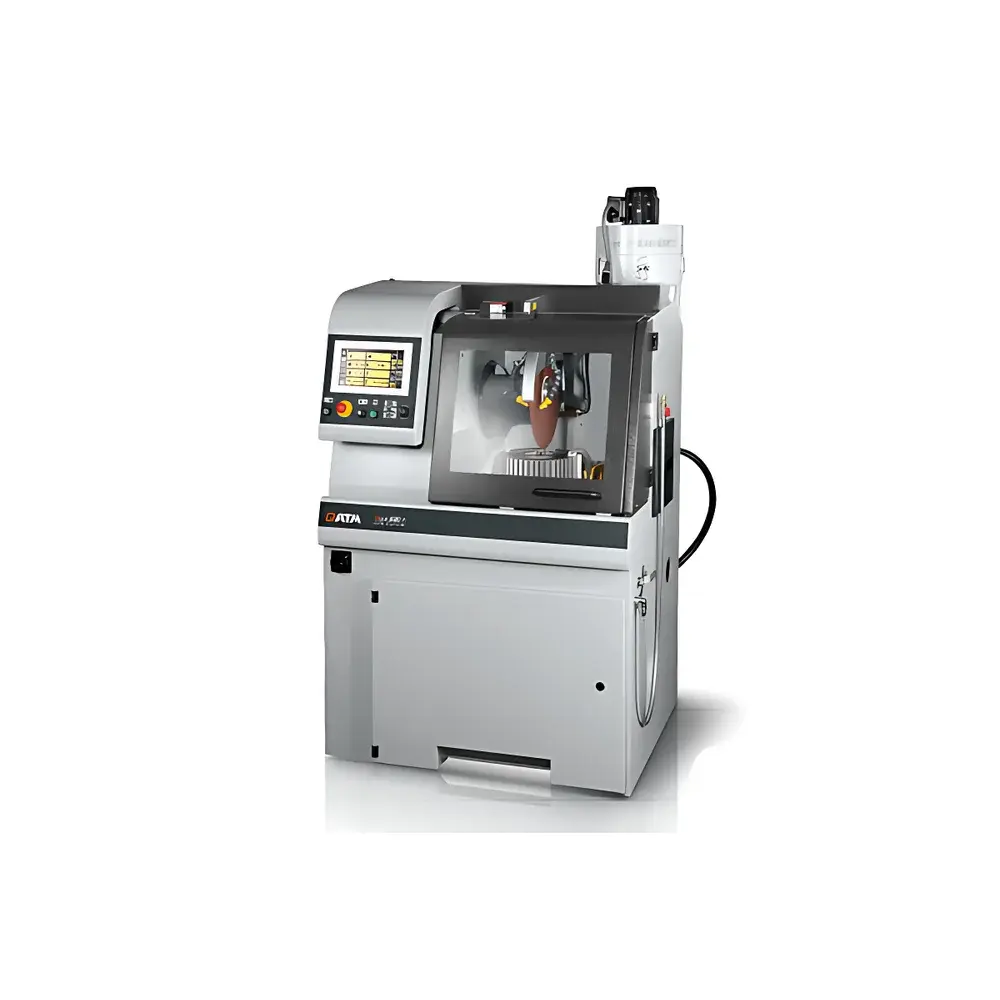
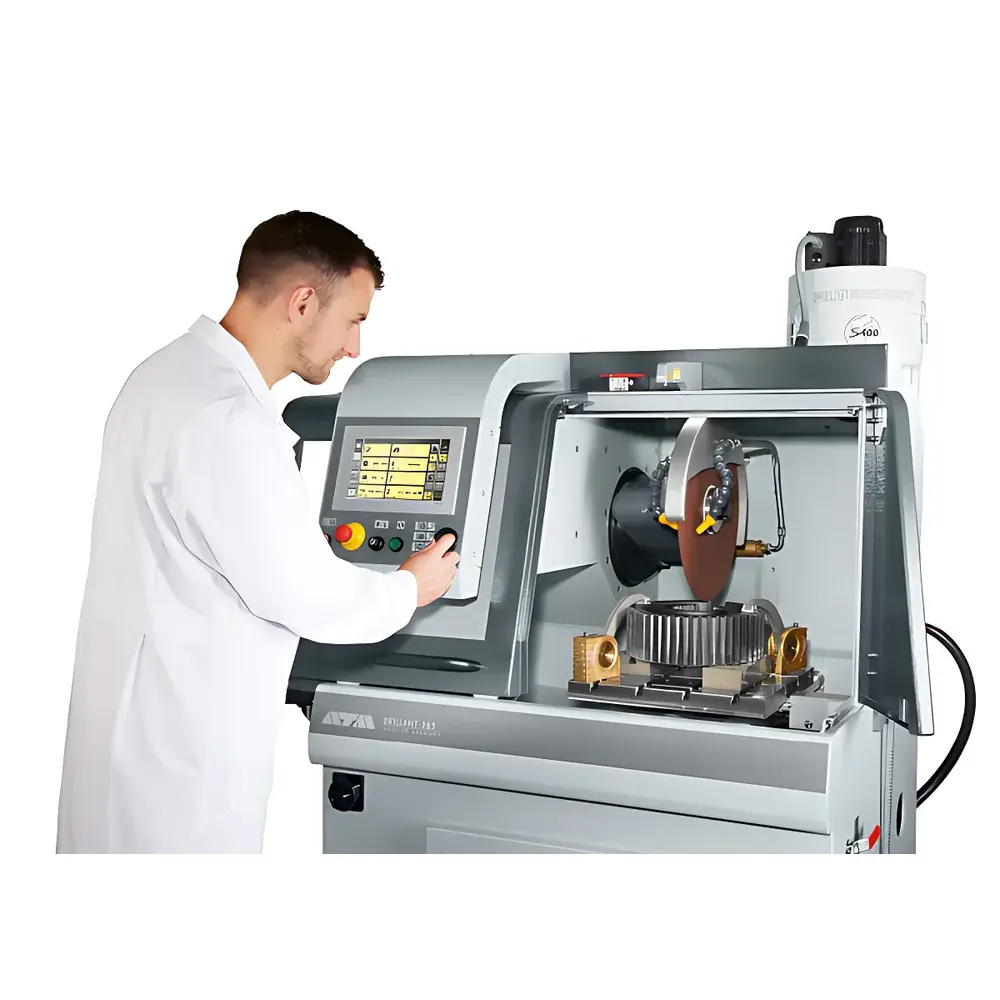
QATM Qcut 400A (formerly ATM Brillant 265) Fully Automatic Vertical Abrasive Cutting Machine
| Brand | QATM |
|---|---|
| Origin | Germany |
| Model | Qcut 400A (formerly ATM Brillant 265) |
| Cutting Wheel Diameter | Up to 406 mm (16") |
| Max. Cutting Capacity | Ø150 mm |
| X-Axis Travel | 345 mm |
| Y-Axis Travel | 200 mm |
| Z-Axis Travel | 150 mm (manual or optional motorized) |
| Z-Axis Positioning Accuracy | 0.1 mm |
| T-Slot Width | 12 mm |
| Power Supply | 17 kVA, 7 kW (S1 duty cycle) |
| Dimensions (W×H×D) | 1100 × 1610 × 930 mm |
| Weight | ~480 kg |
Overview
The QATM Qcut 400A — formerly the ATM Brillant 265 — is a fully automatic vertical abrasive cutting machine engineered for precision metallographic sample preparation in demanding laboratory and quality control environments. Designed and manufactured in Germany, it employs controlled abrasive wheel cutting under continuous coolant flow to produce planar, distortion-free cross-sections of metallic, ceramic, and composite specimens. Its vertical architecture enables optimal chip removal and consistent kerf geometry, while the integrated force-sensitive feed control ensures reproducible cut depth and minimal thermal damage — critical for subsequent mounting, grinding, and polishing steps in microstructural analysis per ASTM E3, ISO 14577, and EN 10360 standards.
Key Features
- Fully automated X- and Y-axis motion (345 mm × 200 mm travel) with sub-millimeter repeatability, enabling multi-position cutting sequences without manual repositioning.
- Motorized Z-axis (optional) with 0.1 mm positioning resolution and programmable downfeed profiles — supporting pulse, continuous, and adaptive-force cutting modes.
- Variable-speed spindle (adjustable RPM range optimized for SiC and diamond wheels up to 406 mm diameter) ensures optimal wheel life and surface integrity across diverse materials.
- Innovative quick-change wheel system reduces maintenance downtime and enhances operator safety during abrasive disc replacement.
- Integrated LED lighting (high-CRI, shadow-minimized) and large sliding safety door provide unobstructed visual access and ergonomic workflow during setup and operation.
- 10.1-inch capacitive touchscreen interface running QATM’s proprietary control software — featuring intuitive teach-in programming, real-time feed force monitoring, and on-screen diagnostics.
- Automatic clamping system accommodates specimen thicknesses from 5 mm to 130 mm, with full support for samples up to 20 mm thick and 150 mm in maximum diameter.
- Right-side open configuration allows longitudinal cutting of extended components (e.g., rods, tubes, extrusions) without disassembly.
Sample Compatibility & Compliance
The Qcut 400A prepares specimens for optical microscopy, SEM/EDS, hardness testing, and coating thickness analysis. It accepts ferrous and non-ferrous alloys, sintered metals, cemented carbides, technical ceramics, and fiber-reinforced composites. All mechanical and electrical subsystems comply with CE directives (2006/42/EC Machinery Directive, 2014/30/EU EMC Directive), and the coolant containment system meets ISO 14122-3 for safe access design. The control architecture supports audit-ready operation under GLP and GMP frameworks, with timestamped program logs, user-access levels, and optional electronic signature integration compatible with FDA 21 CFR Part 11 requirements.
Software & Data Management
QATM’s embedded software provides full sequence programmability: users define start/end coordinates, feed rate profiles, dwell times, and coolant activation per cut. Up to 200 custom programs can be stored locally with version-stamped metadata. The system supports USB export of cutting logs (CSV format) including date/time, operator ID, program name, actual feed force, wheel RPM, and positional error flags. Optional Ethernet connectivity enables remote diagnostics and centralized fleet management via QATM’s LabConnect platform — facilitating instrument calibration tracking, preventive maintenance scheduling, and SOP-driven workflow enforcement.
Applications
- Routine metallographic sectioning of castings, forgings, weldments, and heat-treated components for microstructure evaluation.
- Preparation of failure analysis specimens (fracture surfaces, fatigue zones, corrosion interfaces) requiring minimal artifact introduction.
- High-throughput QC sampling in foundries, aerospace OEMs, and automotive Tier-1 suppliers where dimensional consistency and edge integrity are validated against internal specifications.
- Cutting of coated systems (thermal barrier coatings, PVD/CVD layers) with controlled subsurface deformation for interfacial adhesion assessment.
- Sectioning of additively manufactured parts to examine layer bonding, porosity distribution, and residual stress morphology.
FAQ
What types of abrasive wheels are compatible with the Qcut 400A?
Standard configurations support resin-bonded SiC wheels (up to 406 mm) and diamond-impregnated wheels for hard ceramics and carbides. Wheel arbor size is standardized at 32 mm; optional adapters accommodate alternative hub geometries.
Is coolant management integrated into the system?
Yes — the machine includes a 30 L recirculating coolant tank with magnetic particle filter, level sensor, and temperature monitoring. Coolant delivery is synchronized with wheel rotation and feed engagement via solenoid valves.
Can the Qcut 400A be integrated into an automated lab workflow?
It supports digital I/O signals (24 V DC) for external start/stop and status feedback, and its Ethernet interface enables SCADA-level integration with LIMS or MES platforms using Modbus TCP or OPC UA protocols.
What safety certifications does the unit carry?
It bears CE marking per applicable EU harmonized standards, including EN ISO 13857 (safety distances), EN 60204-1 (electrical equipment), and EN 13218 (abrasive wheel machinery). Full risk assessment documentation is provided with delivery.
Does the system support traceable calibration records?
Positional axes are factory-calibrated using laser interferometry; calibration certificates (traceable to PTB) are included. Software logs all axis homing events and permits scheduled recalibration verification through built-in diagnostic routines.



