
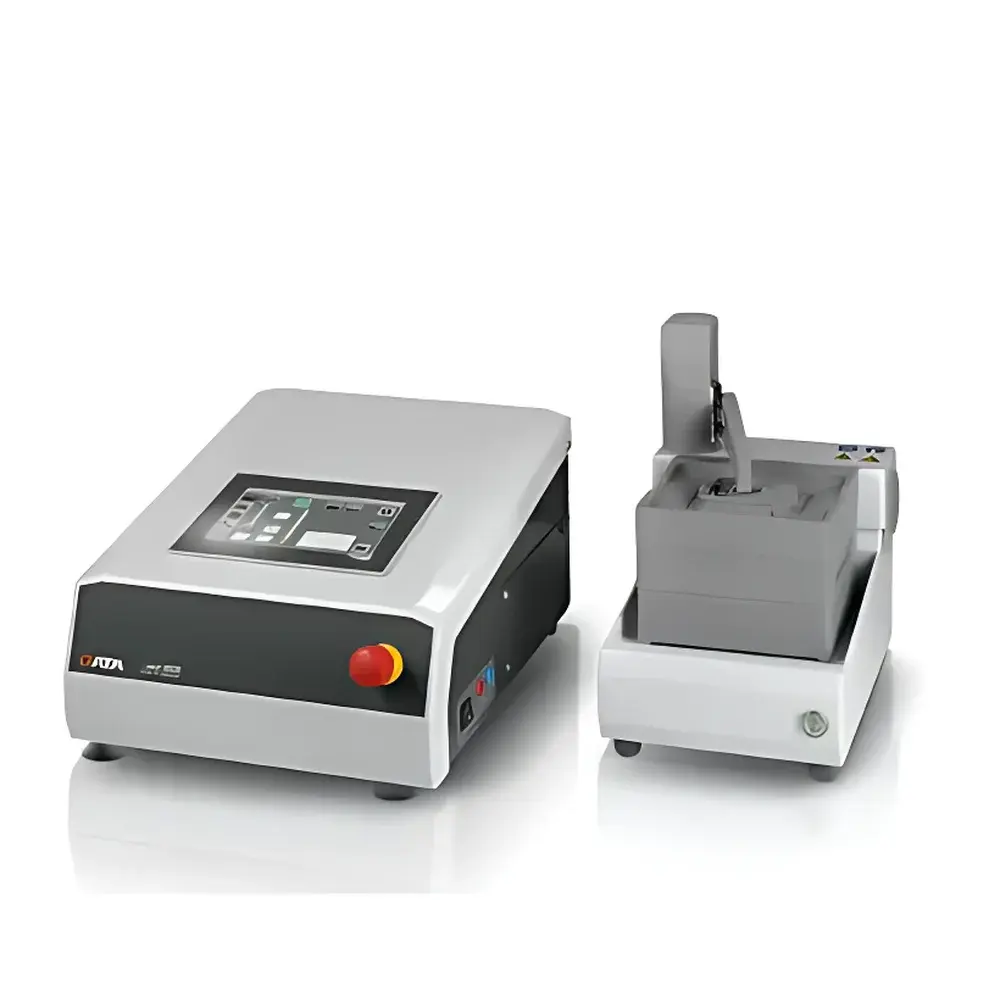
QATM QETCH 1000 Fully Automated Electrolytic Polishing and Etching System
| Brand | QATM |
|---|---|
| Origin | Germany |
| Model | QETCH 1000 |
| Dimensions (L×W×D) | 330 × 220 × 400 mm |
| Weight | ~7 kg |
| Power Supply | 2 kVA |
| Max. Output Voltage | 90 V DC |
| Max. Current | 14 A |
| Polishing Time Range | 1 s – 25 min |
| Etching Time Range | 1 s – 5 min |
| Electrolyte Volume | 1 L (sealed, exchangeable cell) |
| Control Interface | Touchscreen with QATM proprietary software |
| Programmable Methods | Up to 200 user-defined protocols with password protection |
| Real-time Display | Simultaneous current & voltage monitoring |
| Compliance | Designed for fume hood integration |
| Cleaning | Automated water-based rinse cycle |
Overview
The QATM QETCH 1000 is a fully automated, benchtop electrolytic polishing and etching system engineered for reproducible, operator-independent preparation of metallographic specimens—particularly for light microscopy (LM), scanning electron microscopy (SEM), and electron backscatter diffraction (EBSD) analysis. It operates on the principle of controlled anodic dissolution in aqueous or organic electrolytes, enabling selective removal of surface material without mechanical deformation. Unlike manual or semi-automated setups, the QETCH 1000 integrates real-time electrochemical characterization via its built-in I–V scanning function: prior to processing, it autonomously acquires the current–voltage response curve of the specimen, identifying optimal potential windows for electropolishing or selective etching. This eliminates reliance on prior metallurgical knowledge of the sample’s phase composition or grain structure—critical for unknown alloys, multi-phase steels, or additively manufactured components.
Key Features
- Fully integrated touchscreen interface running QATM’s dedicated control software, supporting intuitive method setup, execution, and parameter logging.
- Dual-unit architecture: physically separated polishing/etching cell and electronics control unit—enabling safe operation inside chemical fume hoods without compromising electrical integrity.
- Sealed, disposable 1 L electrolyte reservoir with quick-swap design—minimizing cross-contamination between samples and eliminating manual pipetting or open-bath handling.
- Real-time digital monitoring of applied voltage, instantaneous current, elapsed time, and process stability indicators during each run.
- Programmable protocol library supporting up to 200 distinct methods, each configurable with password-restricted access, time-stamped audit trails, and exportable CSV data logs.
- Automated post-process cleaning cycle using deionized water—reducing residual electrolyte carryover and improving inter-run consistency.
- Compact footprint (330 × 220 × 400 mm) and low mass (~7 kg) facilitate integration into shared lab spaces, cleanrooms, or mobile metallography stations.
Sample Compatibility & Compliance
The QETCH 1000 accommodates standard metallographic specimens up to 30 mm in diameter and 25 mm in height, including embedded and unmounted samples. It supports a broad range of conductive materials: austenitic and ferritic stainless steels, aluminum alloys, titanium grades (e.g., Ti-6Al-4V), nickel-based superalloys (Inconel, Hastelloy), copper, and refractory metals. Non-conductive coatings or oxides must be removed prior to use. The system complies with IEC 61000-6-3 (EMC emission standards) and IEC 61010-1 (safety requirements for laboratory electrical equipment). Its sealed-cell design and fume-hood compatibility align with OSHA 1910.1200 (Hazard Communication Standard) and EU CLP Regulation (EC No. 1272/2008) for safe handling of corrosive electrolytes (e.g., perchloric acid–ethanol, phosphoric–chromic acid mixtures).
Software & Data Management
QATM’s proprietary software provides ISO/IEC 17025-aligned data integrity features: all runs are timestamped, user-logged, and stored with full parameter metadata (voltage setpoint, current profile, duration, electrolyte ID, ambient temperature if externally sensed). Audit trail functionality meets GLP and GMP documentation requirements; exported datasets include raw I–V curves and time-series voltage/current traces for post-acquisition analysis in MATLAB, Python, or Excel. Software updates are delivered via secure USB import—no internet connectivity required—ensuring compliance with air-gapped lab environments subject to FDA 21 CFR Part 11 electronic record controls.
Applications
- Preparation of dislocation-free surfaces for TEM lamella lift-out via FIB-SEM.
- Routine electropolishing of stainless steel welds to reveal delta ferrite distribution per ASTM E562.
- Controlled etching of Al–Si cast alloys to delineate eutectic silicon morphology per ISO 13075.
- Surface conditioning of NiTi shape-memory alloys prior to XRD texture analysis.
- Removal of cold-work layers from cold-rolled titanium sheets for accurate grain size measurement (ASTM E112).
- Standardized specimen prep for interlaboratory round-robin studies requiring traceable, repeatable electrochemical endpoints.
FAQ
What electrolytes are compatible with the QETCH 1000?
Commonly used electrolytes include perchloric acid in ethanol (for austenitic steels), phosphoric–chromic acid (for aluminum), and oxalic acid (for titanium). Compatibility must be verified against material safety data sheets (MSDS) and local chemical handling regulations.
Can the QETCH 1000 perform both polishing and etching in a single sequence?
Yes—multi-step protocols can be programmed to execute sequential polishing followed by timed etching, with independent voltage, current, and duration parameters for each stage.
Is remote monitoring or network connectivity supported?
No—the system operates as a standalone instrument with local touchscreen control only, ensuring electromagnetic isolation and regulatory compliance in sensitive analytical environments.
How often does the electrolyte cell require maintenance?
The sealed 1 L cell is designed for single-use per electrolyte type; no internal cleaning or electrode replacement is required between runs—only routine external wipe-down and periodic inspection of O-ring seals.
Does the system support ASTM or ISO-standardized methods out-of-the-box?
Pre-loaded method templates conform to common standards (e.g., ASTM E407, ISO 3887) are available upon request; users may also configure custom methods validated against their internal SOPs.



