
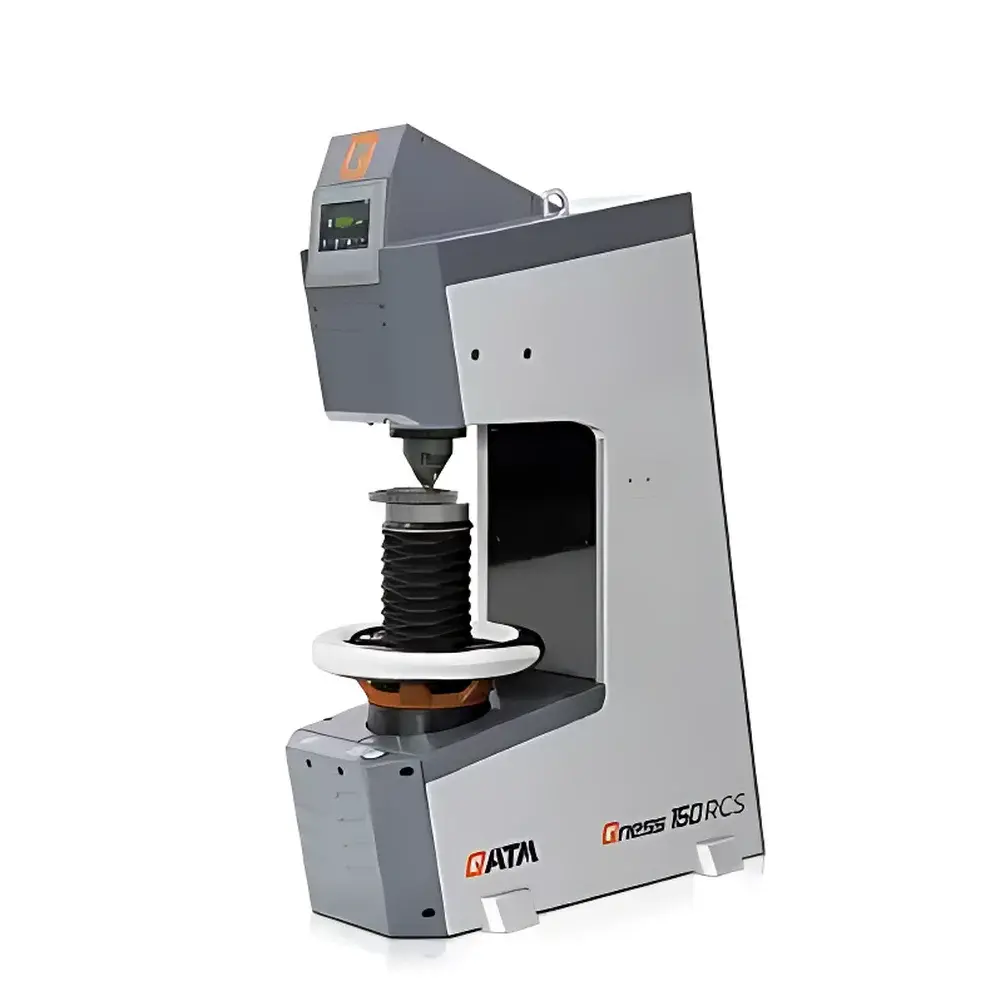
QATM QNESS 150 RCS Rockwell Hardness Tester
| Brand | QATM |
|---|---|
| Origin | Austria |
| Model | QNESS 150 RCS |
| Hardness Test Method | Rockwell C Scale (HRC) |
| Maximum Test Force | 150 kgf (1471.5 N) |
| Dual Force Range Capability | 62.5 kgf (613.1 N) and 150 kgf (1471.5 N) |
| Test Height Adjustment Range | 180 mm |
| Horizontal Test Space | 180 mm |
| Anvil Diameter | Ø100 mm |
| Machine Weight | 120 kg |
| Interface | 1 × RS232-C, 1 × RJ45 (Ethernet) |
| Power Supply | 230 V ~ 1/N/PE or 110 V ~ 1/N/PE |
| Max. Power Consumption | ~360 W |
| Control System | Siemens S7 PLC with 4" Touchscreen HMI |
| Cycle Time | <3 s per test |
Overview
The QATM QNESS 150 RCS is a high-precision, fully automated Rockwell hardness tester engineered for industrial metrology laboratories and production-integrated quality control environments. It operates on the principle of depth-differential indentation measurement in accordance with ASTM E18 and ISO 6508-1 standards, applying a major load to produce permanent deformation in metallic and hardened materials, followed by measurement of residual penetration depth using a diamond cone indenter (for HRC) or hardened steel ball (for HBT). Designed and manufactured in Austria, the system integrates a rigid C-frame architecture with preloaded rolling bearing guideways and precision-ground lead screws to ensure long-term mechanical stability and repeatability across thousands of test cycles. Its sub-3-second test cycle time—achieved via synchronized servo-controlled loading, dwell, and unloading sequences—enables high-throughput verification without compromising measurement integrity.
Key Features
- Siemens S7 programmable logic controller with real-time closed-loop force regulation and integrated 4-inch resistive touchscreen HMI for intuitive local operation and parameter configuration
- Dual-force capability: switchable between 62.5 kgf (HBT 2.5) and 150 kgf (HRC) test loads via software-selectable test method profiles
- Motorized Z-axis height adjustment with manual fine-tuning handwheel; total vertical travel of 180 mm accommodates large or irregularly shaped specimens
- Optimized optical workspace illumination with adjustable LED ring lighting to enhance indenter–specimen alignment and operator visibility
- Robust mechanical design featuring hardened steel frame, vibration-damped base, and precision-machined anvil (Ø100 mm) with standardized mounting interface
- RS232-C serial port and Ethernet (RJ45) connectivity for bidirectional data exchange, remote diagnostics, and integration into factory MES or LIMS platforms
Sample Compatibility & Compliance
The QNESS 150 RCS supports a broad range of metallic and alloyed materials—including case-hardened steels, tool steels, aluminum alloys, and titanium grades—within standard Rockwell test specimen thickness and surface flatness requirements (per ASTM E18 §7.2). Specimens up to 180 mm in height and 180 mm in horizontal span can be accommodated without repositioning. The instrument conforms to international calibration and traceability frameworks: its force application system is validated against national metrological standards (e.g., PTB, NIST), and hardness value output is traceable to SI units through certified reference blocks (e.g., NIST SRM 1263, 1264). Optional GLP/GMP-compliant audit trail logging and user access control modules support regulated manufacturing environments subject to FDA 21 CFR Part 11 or ISO/IEC 17025 accreditation.
Software & Data Management
Data acquisition and reporting are managed via QATM’s proprietary QnessControl software suite, deployable on external Windows-based PCs or embedded within optional industrial tablets. Each test record includes timestamp, operator ID, test method, load sequence, indentation depth, calculated hardness value (HRC/HBT), statistical deviation (±σ), and image-captured indenter view (when equipped with optional USB microscope). Export formats include CSV, XML, and PDF reports compliant with internal QA documentation workflows. Ethernet connectivity enables secure integration with enterprise-level databases and supports OPC UA protocol for seamless interoperability with SCADA and Industry 4.0 infrastructure.
Applications
- Final inspection of heat-treated components in automotive powertrain and aerospace structural assemblies
- In-process hardness verification during forging, quenching, and tempering lines
- Supplier qualification and incoming material inspection per IATF 16949 or AS9100 requirements
- Research and development of new alloy formulations and surface engineering processes (e.g., nitriding, carburizing)
- Calibration laboratory services supporting accredited hardness testing according to ISO/IEC 17025
FAQ
What Rockwell scales does the QNESS 150 RCS support out of the box?
The system is configured for HRC (150 kgf) and HBT 2.5 (62.5 kgf) as standard; additional scales (e.g., HRB, HRA) may be enabled via optional indenter kits and firmware updates.
Can the QNESS 150 RCS be integrated into an automated production cell?
Yes—its RS232 and Ethernet interfaces, programmable digital I/Os, and compatibility with Profinet (via optional ProBus module) allow full synchronization with robotic part handling, conveyor systems, and PLC-driven test sequencing.
Is calibration certificate included with delivery?
Each unit ships with a factory calibration report traceable to national standards; UKAS or DAkkS-accredited calibration certificates are available as optional add-ons.
What maintenance intervals are recommended?
Annual preventive maintenance is advised, including force sensor verification, indenter geometry inspection, and mechanical alignment check—per QATM’s documented service protocol (SOP-QN-MAINT-01).
Does the system meet ISO 6508-2 requirements for verification of hardness testers?
Yes—the QNESS 150 RCS complies with ISO 6508-2:2022 for direct verification of Rockwell hardness testing machines, including repeatability, force accuracy, and indenter conformity testing procedures.



