
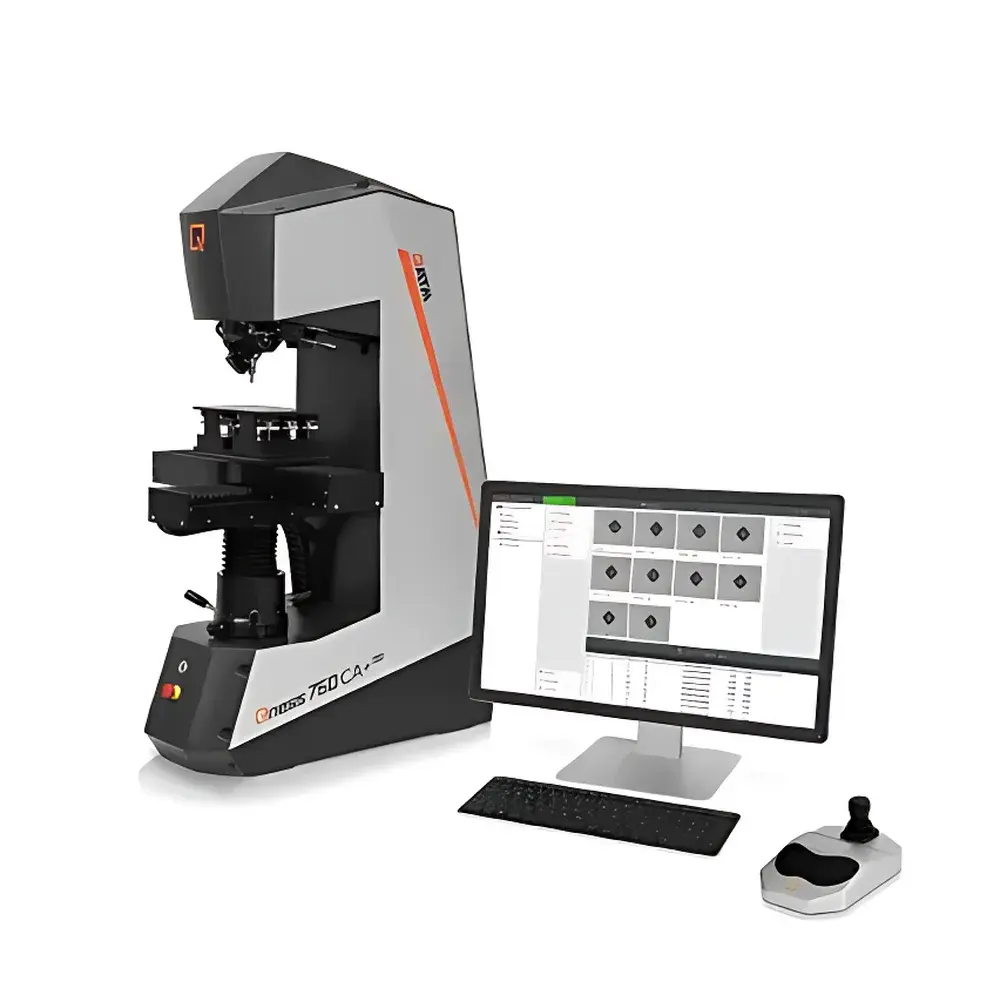
QATM QNESS 250 / 750 CA/CA+ EVO Fully Automated Macro Hardness Tester
| Brand | QATM |
|---|---|
| Origin | Austria |
| Model | QNESS 250 / 750 CA/CA+ EVO |
| Test Force Range | QNESS 250 CA EVO: 1–250 kg (9.81–2450 N) |
| QNESS 750 CA EVO | 0.3–750 kg (2.94–7358 N) |
| Test Height / Throat Depth | 250 / 220 mm |
| XY Motorized Stage Travel | X 260 mm / Y 266 mm |
| Max. Specimen Weight | 100 kg |
| Host Weight | 320 kg |
| Power Supply | 110–230 V~, 50–60 Hz, 1/N/PE |
| Max. Power Consumption | ~480 W |
| Software | Qpix Control2 |
| Camera | 5 MP Panoramic Imaging (CA+ only) |
| Supported Hardness Methods | Brinell, Vickers, Rockwell, Knoop, Polymer, Carbon Brush Testing |
Overview
The QATM QNESS 250 / 750 CA/CA+ EVO series represents a high-precision, fully automated macro hardness testing platform engineered for industrial quality control laboratories and R&D environments requiring repeatable, traceable, and standards-compliant hardness measurements across metallic, polymeric, and composite materials. Built upon QATM’s proven C-frame architecture — optimized for mechanical rigidity and minimal deflection under load — the system integrates motorized Z-axis height adjustment via precision-ground ball-screw guides, a high-resolution motorized XY stage, and intelligent optical alignment to ensure consistent indenter positioning and measurement repeatability. The EVO generation enhances long-term stability through thermally compensated load cell technology and advanced force feedback control, enabling reliable execution of ASTM E10 (Brinell), ASTM E384 (Knoop/Vickers micro/macro), ASTM E18 (Rockwell), ISO 6506/6507/6508, and ISO 2039 (polymer hardness) test protocols. Designed for integration into automated production workflows, the QNESS platform supports unattended batch testing sequences with full audit trail capability.
Key Features
- Rigid C-frame mechanical architecture with low thermal drift and high torsional stiffness, minimizing measurement uncertainty during high-force indentation cycles.
- Fully motorized XYZ axes: Z-height adjustment via backlash-free ball-screw drive with integrated clamping fixture; XY cross-stage (170 × 250 mm working area, 260 × 266 mm travel) with sub-micron positioning resolution.
- Dual-load-range capability: QNESS 250 CA/CA+ EVO covers 1–250 kgf (9.81–2450 N); QNESS 750 CA/CA+ EVO extends down to 0.3 kgf (2.94 N) for low-force polymer or thin-coating evaluation, up to 750 kgf (7358 N) for heavy-section metallurgical specimens.
- Modular 8-position automatic turret compatible with interchangeable indenters (Vickers, Rockwell, Brinell, Knoop) and objective lenses (5× to 100×), supporting both fixed and rotating indenter configurations for anisotropic material analysis.
- Qpix Control2 software suite featuring intuitive 3D GUI navigation, real-time force-displacement curve visualization, and embedded calibration wizards compliant with ISO 14644-1 cleanroom-ready operation.
- CA+ variant includes a 5-megapixel panoramic camera system for rapid specimen overview imaging, automated ROI selection, and multi-point hardness mapping across large or irregularly shaped components.
Sample Compatibility & Compliance
The QNESS 250 / 750 accommodates specimens up to 100 kg and 250 mm in height, with a throat depth of 220 mm — ideal for forged components, castings, weldments, and end-quench bars. Its modular stage and configurable anvils support flat, cylindrical, and contoured surfaces without re-fixturing. All test methods conform to international metrological standards: force accuracy certified per ISO 6506-2 (Brinell), ISO 6507-2 (Vickers), ISO 6508-2 (Rockwell), and ASTM E140 hardness conversion tables. System validation documentation includes as-delivered force calibration certificates (traceable to national metrology institutes), repeatability reports (per ISO 6506-3), and optional IQ/OQ/PQ protocols aligned with FDA 21 CFR Part 11 and EU Annex 11 requirements for regulated manufacturing environments.
Software & Data Management
Qpix Control2 operates on Windows-based embedded hardware with dual Ethernet (RJ45) connectivity for LAN integration and remote diagnostics. The software provides full GLP/GMP-compliant data handling: user-level access control, electronic signatures, timestamped audit trails, and encrypted database logging. Test reports export natively to PDF, CSV, and XML formats, including embedded images, force curves, and statistical summaries (mean, SD, CV%, min/max). Optional modules include End-Quench (Jominy) analysis with automated 8-position sample holder recognition, hardness gradient profiling, and SPC charting with Cp/Cpk calculation. Data integrity is reinforced by write-once-read-many (WORM) archiving and configurable backup intervals to network drives or NAS systems.
Applications
- Metallurgical QC in heat treatment facilities: verification of case depth, core hardness, and carburized layer uniformity per SAE AMS 2750 and DIN EN 10052.
- Aerospace component certification: turbine disk, landing gear, and fastener hardness validation per AMS 2249 and NADCAP AC7101.
- Automotive powertrain testing: crankshaft, camshaft, and gear tooth hardness mapping under variable loads.
- Research on polymer composites and elastomers using low-force Knoop or Rockwell M-scale protocols per ISO 2039-2.
- Carbon brush and electrical contact material characterization where surface homogeneity and edge-effect mitigation are critical.
FAQ
What hardness standards does the QNESS EVO series support?
ASTM E10, E18, E384, E92; ISO 6506 (Brinell), 6507 (Vickers), 6508 (Rockwell), 2039 (plastics), and EN ISO 1463 (coating thickness/hardness correlation).
Is the system suitable for ISO/IEC 17025-accredited laboratories?
Yes — when equipped with factory-validated force calibration, documented uncertainty budgets, and Qpix Control2’s Part 11-compliant audit trail, it meets ISO/IEC 17025 clause 6.4.6 for equipment verification.
Can the QNESS integrate with MES or LIMS platforms?
Via RESTful API and OPC UA support (optional license), enabling bidirectional data exchange with Siemens Opcenter, LabVantage, or Thermo Fisher SampleManager.
What maintenance intervals are recommended?
Annual force calibration and stage alignment verification; quarterly cleaning of optical paths and turret mechanism; daily verification using certified reference blocks per ISO 6506-3 Annex A.
Does the CA+ panoramic camera support automated hardness mapping?
Yes — the 5 MP camera enables pre-scan ROI definition, auto-focus stacking, and coordinate-linked indentation sequencing across defined grids or contours, reducing operator dependency and improving throughput by up to 40% in large-part applications.



