
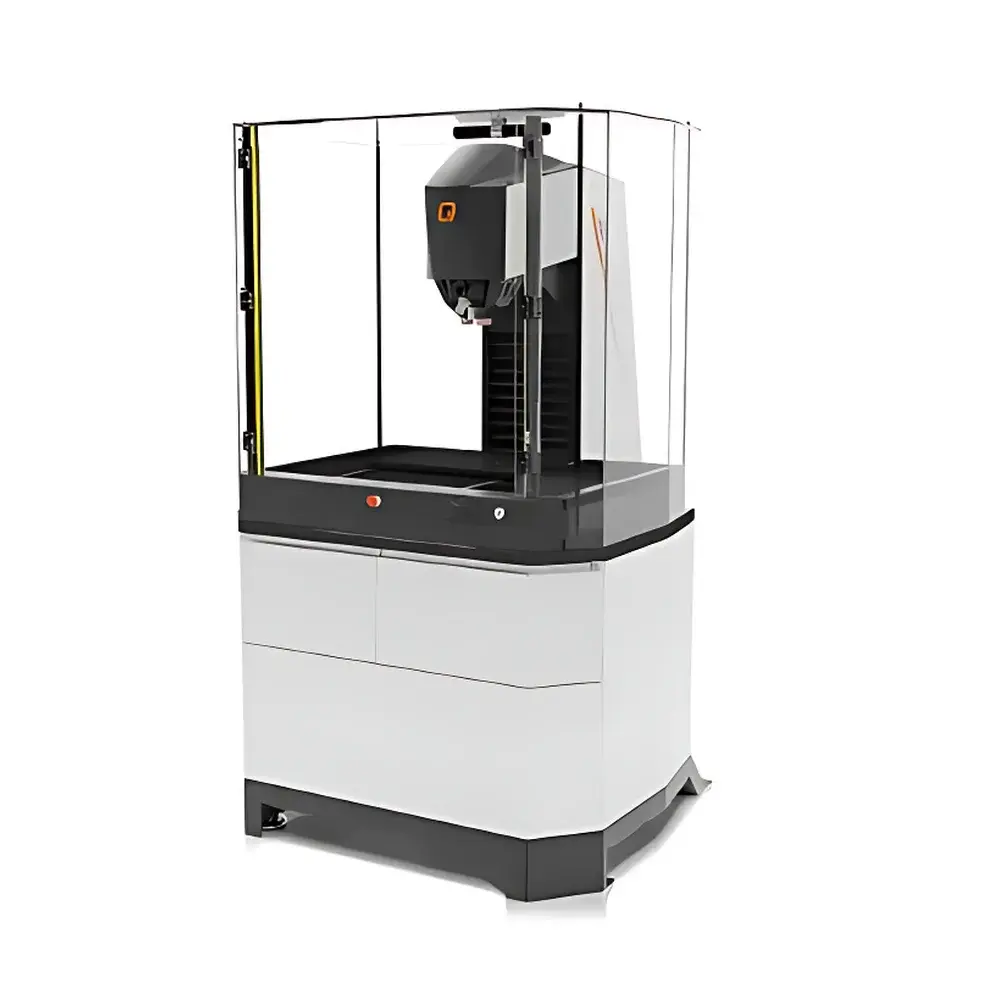
QATM QNESS 250 / Q750 / Q3000 A/A+ EVO Fully Automated Macro Hardness Tester
| Brand | QATM |
|---|---|
| Origin | Austria |
| Model | QNESS 250 A/A+, QNESS 750 A/A+, QNESS 3000 A/A+ EVO |
| Test Force Range | QNESS 250 A/A+: 1–250 kgf (9.81–2450 N) |
| QNESS 750 A/A+ | 0.3–750 kgf (2.94–7358 N) |
| QNESS 3000 A/A+ | 0.3–3000 kgf (2.94–29430 N) |
| Test Height Adjustment | Motorized asynchronous Z-axis, up to 3200 kg clamping force |
| Throat Depth / Max Vertical Clearance | 362 mm / 320 mm |
| XY Stage Travel | X 460 mm × Y 350 mm |
| Stage Size | 450 × 297 mm (motorized cross-slide) |
| Imaging System | 5 MP panoramic camera (A+ models only) |
| Software | Qpix Control2 with 3D UI, Ethernet interface (RJ45) |
| Compliance | Designed for ASTM E10, E18, E92, E384, ISO 6506, ISO 6507, ISO 6508, ISO 20422, and EN ISO 1463 |
Overview
The QATM QNESS 250 / Q750 / Q3000 A/A+ EVO series represents a benchmark in fully automated macro hardness testing for metallurgical laboratories, quality control departments, and R&D facilities requiring high-throughput, traceable, and standards-compliant hardness evaluation. Engineered for precision and repeatability, these systems implement closed-loop electro-mechanical force application and real-time load monitoring across the full test range—from light-force plastic indentation (0.3 kgf) to heavy-duty industrial macro-indentation (up to 3000 kgf). The core architecture integrates a rigid C-frame design with a motorized asynchronous Z-axis capable of dynamic height compensation and secure specimen clamping under forces up to 3200 kg—ensuring stable positioning regardless of sample geometry or surface irregularity. Each model supports all major standardized hardness methods: Brinell (HBW), Vickers (HV), Rockwell (HRA/B/C/D/E/F/G/L/M/P), Knoop (HK), and specialized plastic hardness (e.g., HRR, HDT-related indentation protocols), making the QNESS platform a true universal hardness solution compliant with ASTM, ISO, and EN standards.
Key Features
- Fully motorized 3-axis (X/Y/Z) motion control with programmable trajectory planning and sub-micron repeatability in stage positioning
- Asynchronous Z-axis drive enabling precise, vibration-damped test head approach and automatic height adaptation across heterogeneous sample batches
- Integrated safety enclosure with interlocked access doors, fixed or rotating indenter guard, and visual status indicators (standard on A and A+ variants)
- High-resolution optical imaging system: A+ models feature a 5-megapixel panoramic camera with auto-focus and wide-field stitching for full-sample overview and multi-point mapping
- Qpix Control2 software with intuitive 3D graphical interface, drag-and-drop test sequence builder, and real-time load-displacement curve visualization
- Modular indenter turret support for rapid switching between Vickers, Rockwell, Brinell, and Knoop indenters (5×–100× objectives available)
- Motorized cross-slide stage (450 × 297 mm) with 460 mm X- and 350 mm Y-axis travel—optimized for large castings, weldments, and end-quench specimens
- Comprehensive accessory ecosystem including end-quench 8-position fixtures, LED illumination modules (XLED1/2/5), and Part 11–ready user authentication and electronic signature modules
Sample Compatibility & Compliance
The QNESS EVO platform accommodates specimens of unrestricted mass and variable geometry—including forged components, heat-treated plates, turbine blades, and automotive castings—thanks to its open-throat design (362 mm vertical clearance, 320 mm throat depth) and high-capacity Z-clamp. All models are engineered to meet stringent regulatory requirements: test sequences are timestamped and logged with full operator attribution; raw image data, load curves, and measurement metadata are stored immutably; audit trail functionality satisfies GLP and GMP documentation mandates. The system is validated for compliance with ASTM E10 (Brinell), E18 (Rockwell), E92 (Vickers), E384 (Micro/Knoop), ISO 6506 (Brinell), ISO 6507 (Vickers), ISO 6508 (Rockwell), ISO 20422 (Plastics hardness), and EN ISO 1463 (coating thickness correlation). Optional 21 CFR Part 11 configuration enables electronic records suitable for pharmaceutical and medical device QA environments.
Software & Data Management
Qpix Control2 serves as the central operational and analytical hub. Its native file format (.qpx) embeds calibrated images, force-time profiles, geometric measurements, and statistical summaries in a single container. Batch reporting supports customizable templates (PDF, Excel, CSV) with embedded pass/fail thresholds, Cp/Cpk calculation, and SPC charting. Network integration via RJ45 Ethernet allows remote monitoring, centralized database synchronization (SQL-compatible), and LIMS interfacing through standard OPC UA or REST API adapters. Version-controlled method libraries ensure consistent test execution across shifts and sites, while role-based access control (RBAC) enforces procedural integrity. Raw image archives are stored with EXIF metadata—including objective magnification, lighting parameters, and environmental sensor readings (optional ambient temperature/humidity logging).
Applications
- Metallurgical process validation: case depth verification, carburizing/nitriding uniformity assessment, and grain-boundary hardness profiling
- Aerospace component certification: turbine disk rim hardness mapping, blade root indentation arrays, and weld HAZ characterization
- Automotive powertrain QA: crankshaft journal hardness gradients, gear tooth flank testing, and bearing raceway evaluation
- Energy sector compliance: pipeline weld qualification per API RP 2X, nuclear pressure vessel material verification per ASME Section IX
- R&D material development: comparative hardness screening of novel alloys, composite interfaces, and additive-manufactured microstructures
- End-quench testing per ASTM D638 or ISO 6506-2 using dedicated 8-position fixtures with integrated thermal history tracking
FAQ
What hardness standards does the QNESS EVO series support?
ASTM E10, E18, E92, E384, ISO 6506, ISO 6507, ISO 6508, ISO 20422, EN ISO 1463, and DIN 50133.
Is the system compatible with existing laboratory information management systems (LIMS)?
Yes—via Ethernet-connected OPC UA or RESTful API integration; custom middleware development support is available upon request.
Can the QNESS perform automated hardness mapping across large-area specimens?
Yes—using programmable XY raster patterns, multi-point indentation grids, and panoramic image stitching (A+ models only) for spatial hardness distribution analysis.
What safety certifications does the instrument carry?
CE marked per Machinery Directive 2006/42/EC, EMV Directive 2014/30/EU, and RoHS 2011/65/EU; optional UL/CSA certification available for North American deployment.
How is calibration traceability maintained?
Through integrated NIST-traceable force sensor validation, certified reference blocks (HBW/HV/HR), and automated calibration routine logging with digital signature and timestamp.



