
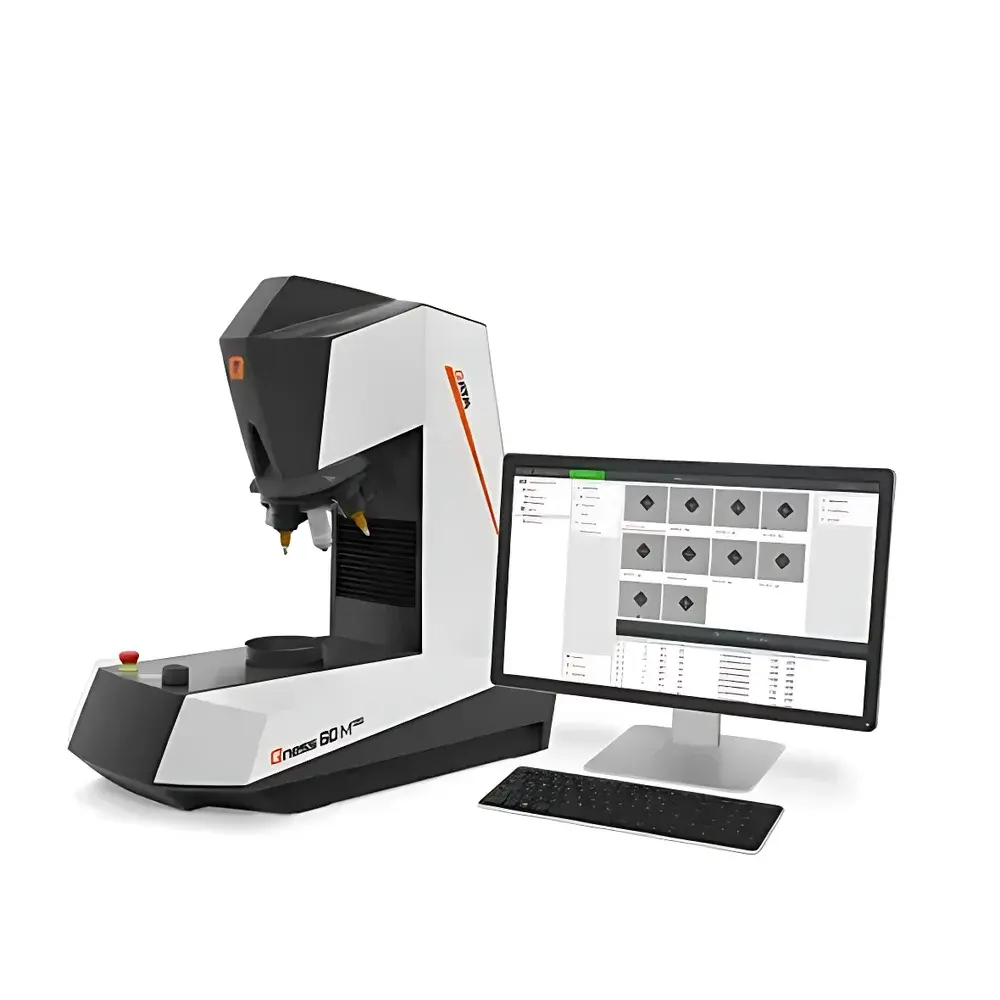
QATM Qness 60 M EVO Microhardness Tester
| Brand | QATM |
|---|---|
| Origin | Austria |
| Model | Qness 60 M EVO |
| Instrument Type | Microhardness Tester |
| Test Force Range | 0.00245 N – 613.1 N (0.25 g – 62.5 kg) |
| Test Space (Height/Throat Depth) | 145 mm / 170 mm |
| Stage Options | Manual Cross-Slide XY Stage (135 × 135 mm) or Standard Ø100 mm Anvil |
| X/Y Travel | 150 mm × 150 mm |
| Z-Travel | 145 mm |
| Max. Specimen Weight | 50 kg |
| Host Weight | 55 kg |
| Power Supply | 100–240 V, ~1/N/P, 45–65 Hz |
| Software | Qpix Control2 M with INSPECT metallographic analysis module |
| Test Methods Supported | Vickers, Knoop, Brinell |
| Turret | 8-position motorized, configurable with up to 3 hardness modules and 6 objective lenses |
| Illumination | White LED with motorized iris shutter |
| Imaging | High-resolution color camera integrated into optical path |
| Compliance | ASTM E384, ISO 6507, ISO 6508, EN ISO 14978, DAkkS-accredited Vickers diamond indenter included |
Overview
The QATM Qness 60 M EVO is a high-precision manual microhardness tester engineered for laboratories requiring rigorous metallurgical quality control, failure analysis, and R&D-grade material characterization. Based on the fundamental principles of static indentation hardness testing—specifically Vickers (HV), Knoop (HK), and Brinell (HBW) methods—the system applies a precisely controlled test force via a diamond pyramid or spheroconical indenter onto a polished specimen surface, followed by optical measurement of the residual impression under calibrated magnification. Unlike semi-automated or fully automated platforms, the M-series prioritizes operator-directed flexibility: it enables full manual control over stage positioning, focus, lighting, and indenter selection—ideal for low-throughput environments where sample heterogeneity, irregular geometry, or exploratory microstructural investigation demands real-time human judgment. Its robust mechanical architecture, thermally stable granite base, and vibration-damped column ensure long-term repeatability even in non-dedicated metrology labs.
Key Features
- Wide test force range from 0.00245 N (0.25 gf) to 613.1 N (62.5 kgf), covering ultra-low-load microhardness (e.g., thin coatings, intermetallic phases) through macro-scale Brinell testing on bulk alloys.
- 8-position motorized dynamic turret with programmable indexing—supports simultaneous installation of up to three independent hardness modules (e.g., Vickers + Knoop + Brinell) and six objective lenses (2.5× to 100×), enabling rapid method switching without manual recalibration.
- Integrated high-resolution color imaging system with white LED illumination and motorized iris shutter—ensures consistent contrast, glare-free illumination, and repeatable image acquisition across varying surface finishes and reflectivity.
- Manual cross-slide XY stage (135 × 135 mm travel) with fine-pitch micrometer controls and digital position feedback—provides tactile precision for targeted indenter placement on complex microstructures such as weld zones, heat-affected areas, or multi-phase composites.
- DAkkS-certified Vickers diamond indenter included as standard, traceable to national metrology institutes—meets requirements for ISO/IEC 17025-accredited testing laboratories performing hardness verification per ASTM E92, ASTM E384, and ISO 6507-1.
Sample Compatibility & Compliance
The Qness 60 M EVO accommodates specimens up to 50 kg and 170 mm throat depth, supporting large castings, forged components, and sectioned weld coupons without disassembly. Its open-column design permits vertical access for tall or asymmetric samples. The system complies with international standards governing hardness testing methodology, equipment validation, and result reporting—including ASTM E384 (microindentation), ISO 6507 (Vickers), ISO 6508 (Rockwell), and EN ISO 14978 (metrological requirements for hardness testing machines). All hardness values are calculated using standardized diagonal measurement algorithms compliant with ISO 6507-4; raw image data and metadata (load, dwell time, lens ID, indenter type) are embedded in exported reports for audit readiness. While not inherently 21 CFR Part 11-compliant, Qpix Control2 M supports user-level access control, electronic signatures, and audit-trail-enabled operation when deployed within validated GxP environments under laboratory-defined SOPs.
Software & Data Management
Qpix Control2 M is a Windows-based application delivering full instrument control, image capture, hardness calculation, and metallographic analysis via the integrated INSPECT module. It supports automated single-point and linear array measurements (CHD/NHD/SHD), phase identification (threshold-based segmentation), layer thickness quantification (interface detection), grain size evaluation (ASTM E112), and weld seam profiling. All measurement parameters—including dwell time, loading/unloading rates, and image exposure—are stored with each test record. Data export options include CSV, PDF, and XML formats compatible with LIMS integration. Image archives retain original TIFF files with EXIF metadata (magnification, calibration scale, timestamp), ensuring full traceability for internal audits or external accreditation reviews.
Applications
This platform serves critical roles in metallurgical laboratories across aerospace, power generation, automotive, and academic research sectors. Typical use cases include: evaluating case depth and gradient profiles in carburized or nitrided steels; assessing interfacial hardness in clad materials and dissimilar metal welds; characterizing brittle phases (e.g., carbides, borides) in tool steels and superalloys; validating heat treatment uniformity across large turbine discs; and conducting failure analysis on fractured surfaces where localized hardness anomalies correlate with crack initiation sites. Its manual workflow also makes it suitable for teaching labs—enabling students to develop hands-on proficiency in indenter alignment, focus optimization, and impression interpretation before transitioning to automated systems.
FAQ
Does the Qness 60 M EVO support automatic focusing or autofocus routines?
No—focus is manually adjusted via coaxial coarse/fine focus knobs. This preserves optical fidelity and eliminates algorithmic uncertainty in edge detection during low-load indentation on reflective or textured surfaces.
Can the system perform hardness mapping across large areas?
Yes—when paired with the optional digital XY stage (not included with the M variant), users can define grid-based measurement sequences; however, the base M model relies on manual stage positioning for each test point.
Is calibration verification required between tests?
Per ISO 6507-2, daily verification using certified reference blocks is recommended before initiating a test series; the system includes built-in calibration check routines accessible via Qpix Control2 M.
What level of training is required to achieve ISO 17025-compliant results?
Operators must complete QATM’s certified training program covering indenter maintenance, optical alignment, force verification, and uncertainty budgeting—documented in lab-specific competency records.
Are third-party objective lenses or indenters compatible?
Only QATM-branded, factory-aligned objectives and DAkkS-traceable indenters are supported to maintain measurement integrity and warranty validity.



