
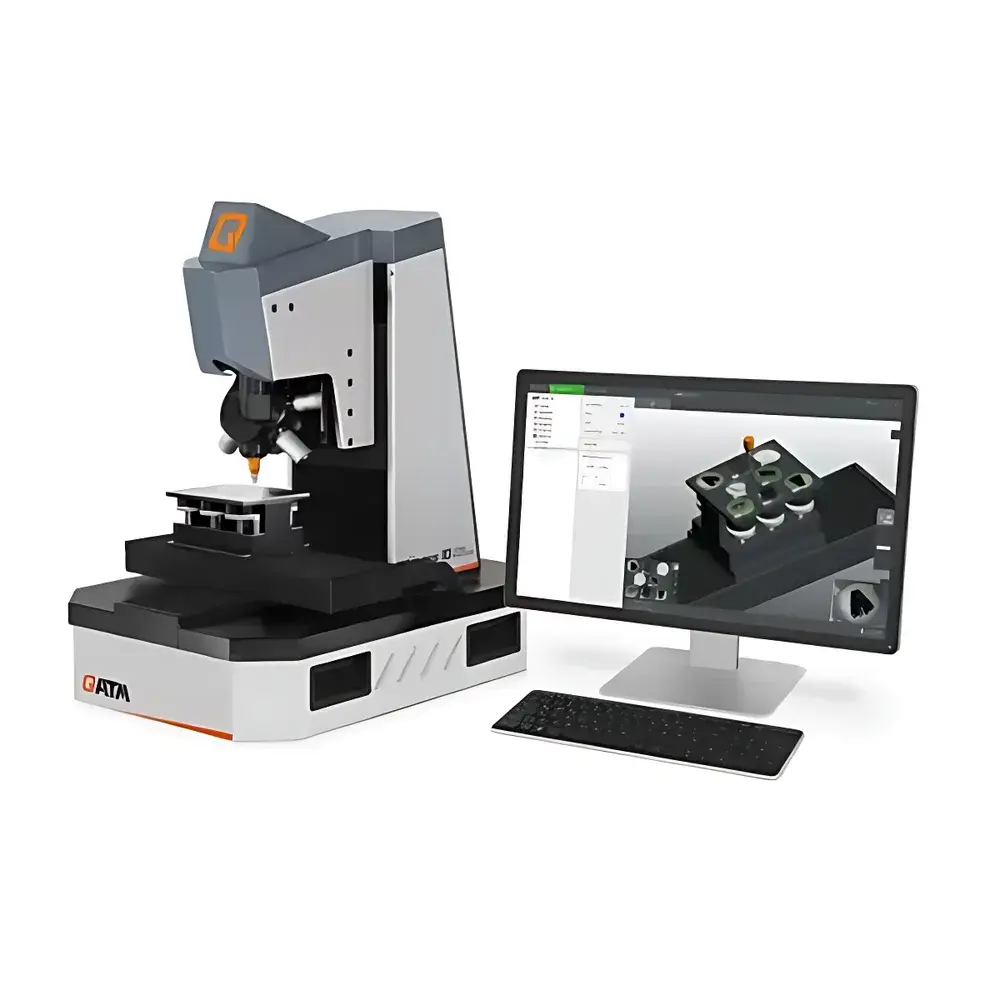
QATM QNESS CHD MASTER+ Fully Automated Microhardness Tester
| Brand | QATM |
|---|---|
| Origin | Austria |
| Model | QNESS CHD MASTER+ |
| Hardness Testing Methods | Vickers, Knoop, Brinell |
| Test Load Range | 0.49 – 98.1 N (50 g – 10 kgf) |
| Turret | 6-position, motorized |
| X/Y/Z Travel | 150 × 150 × 145 mm |
| Specimen Weight Capacity | ≤ 50 kg |
| Host Weight | 58 kg |
| Camera System | 5 MP color CMOS |
| Positioning Repeatability | ±3.5 µm |
| Interface | 1× USB 3.0 (hardness tester–PC), optional QDAS/PCI/AMS/REMOTE modules |
| Power Supply | 230 V ~ 1/N/PE or 110 V ~ 1/N/PE |
| Max. Power Consumption | ~200 W |
| Objective Lenses | 4×, 20×, 40× |
| Certified Vickers Indenters | DakkS-accredited |
| Sample Holders | CHD Master+: single-position (Ø30/40/50 mm), quad-position (Ø30/40/50 mm), octo-position (Ø30/40 mm) |
Overview
The QATM QNESS CHD MASTER+ is a fully automated microhardness testing system engineered for precision, repeatability, and compliance in demanding metallurgical, quality control, and R&D environments. Based on the fundamental principles of indentation hardness measurement—where a geometrically defined indenter (Vickers pyramid or Knoop diamond) is loaded onto a polished specimen surface under controlled force—the QNESS CHD MASTER+ delivers traceable, quantitative hardness values according to ISO 6507, ASTM E384, ASTM E92, and ISO 6506 standards. Its modular architecture integrates high-resolution optical imaging, closed-loop motorized positioning, and real-time load-cell feedback to ensure consistent indentation geometry across the full test load range (0.49–98.1 N). Designed and manufactured in Austria, the system meets stringent European mechanical and electromagnetic compatibility directives (CE, RoHS), with DakkS-accredited Vickers indenters providing metrological traceability to national standards.
Key Features
- Fully motorized 6-position turret enabling rapid, programmable switching between indenters and objectives without manual intervention
- High-precision XYZ stage with 150 × 150 × 145 mm travel range and ±3.5 µm positioning repeatability—critical for multi-point CHD (Case Hardness Depth), NHD (Nitrided Hardness Depth), and RHD (Rockwell Hardness Depth) profiling
- 5 MP color CMOS camera system with real-time autofocus and adjustable white balance, supporting high-fidelity image capture for automated indentation detection and measurement
- Integrated load cell with active force feedback ensures true load application accuracy—eliminating spring-based drift common in legacy systems
- Comprehensive optical suite including 4×, 20×, and 40× long-working-distance objectives optimized for depth-of-field stability during Z-axis scanning
- Modular sample handling options: CHD Master+ supports single-, quad-, and octo-position fixtures accommodating specimens up to Ø50 mm and 50 kg—enabling unattended batch testing of gears, bearing races, and case-hardened components
Sample Compatibility & Compliance
The QNESS CHD MASTER+ accommodates a broad spectrum of metallic and ceramic materials—from soft aluminum alloys and annealed steels to hardened tool steels, carbides, and nitrided surfaces. Its large Z-travel (145 mm) and robust 58 kg base structure minimize vibration coupling during high-load Brinell testing (up to 10 kgf). All hardness measurements comply with ISO/IEC 17025 requirements when operated within validated procedures; DakkS-certified Vickers indenters provide documented uncertainty budgets per DIN EN ISO/IEC 17025. The system supports GLP/GMP documentation workflows via audit-trail-enabled software (Qpix Control2), and optional QDAS interface enables direct integration into enterprise LIMS or MES platforms compliant with FDA 21 CFR Part 11.
Software & Data Management
Qpix Control2 is the embedded control and analysis platform—designed specifically for microhardness metrology. It provides intuitive workflow configuration for standardized tests (e.g., ISO 6507-1 CHD sequences), custom multi-load series, and grid-based mapping. Measurement data—including indentation images, load-hold-time parameters, HV/HK/HRW values, statistical summaries (mean, SD, Cpk), and depth-profile plots—are stored in vendor-neutral XML/CSV formats. Optional interfaces include QDAS (QATM Data Acquisition Standard) for third-party analytics, PCI (Process Control Interface) for SPC integration, AMS (Automated Measurement Station) for inline production environments, and REMOTE for secure off-site monitoring and troubleshooting.
Applications
- Case depth verification of carburized, carbonitrided, and induction-hardened components in automotive and aerospace supply chains
- Quality assurance of sintered metal parts, PVD/CVD coatings, and thin-film substrates where surface and subsurface hardness gradients are critical
- Metallurgical laboratory research into phase transformation kinetics, tempering response, and heat-affected zone (HAZ) characterization
- Failure analysis labs performing comparative hardness mapping across fracture surfaces, weld zones, and fatigue crack paths
- Calibration laboratories conducting inter-laboratory comparisons under ISO/IEC 17025 accreditation scopes
FAQ
Does the QNESS CHD MASTER+ support automatic indentation measurement without user intervention?
Yes—Qpix Control2 performs fully automated indentation detection, diagonal measurement, and hardness calculation using adaptive edge-detection algorithms trained on >20,000 reference indentations.
Can the system be integrated into an existing factory automation infrastructure?
Yes—via optional PCI or REMOTE interfaces, the instrument supports OPC UA communication, PLC-triggered test initiation, and real-time result streaming to SCADA or MES platforms.
What calibration documentation is provided with DakkS-certified indenters?
Each indenter ships with a DakkS-accredited calibration certificate (D-K-15048) listing expanded uncertainty (k=2), traceability chain to PTB, and verification against ISO 6507-2 Annex A requirements.
Is thermal drift compensation available during extended Z-axis profiling runs?
Yes—the system monitors ambient temperature and stage thermal expansion in real time, applying dynamic Z-offset correction based on empirical thermal coefficient models derived from QATM’s internal metrology database.
How is measurement reproducibility verified during routine operation?
Built-in daily verification routines execute traceable reference block measurements (e.g., NIST SRM 2820), automatically generating control charts and flagging deviations exceeding ISO 6507-1 repeatability thresholds (≤3% RSD for HV10).



