
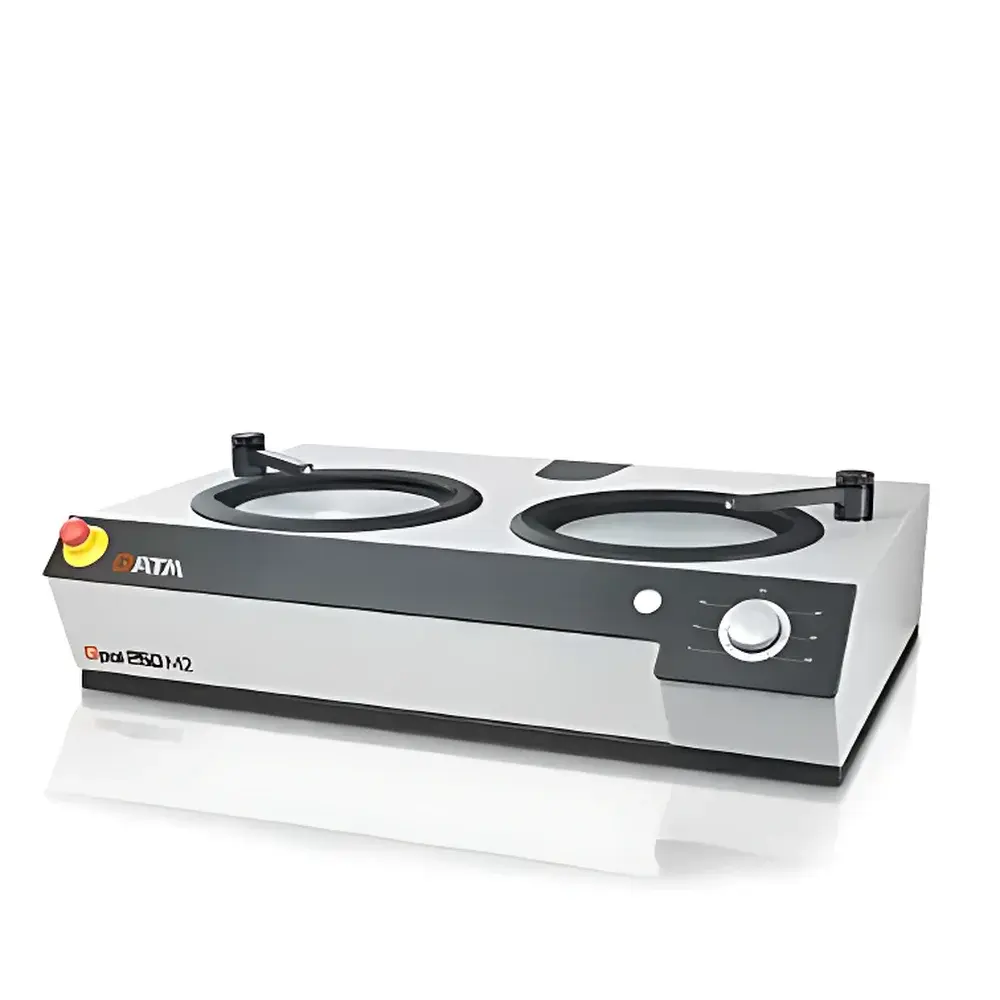
QATM Qpol 250 M2 Manual Dual-Disc Grinding and Polishing System
| Brand | QATM |
|---|---|
| Origin | Germany |
| Model | Qpol 250 M2 |
| Speed Range | 30–600 rpm, continuously adjustable |
| Platen Diameter | Ø 200 / 250 mm |
| Number of Platens | 2 |
| Dimensions (L×W×D) | 901 × 265 × 710 mm |
| Power Supply | 1.0 kVA |
| Rated Output (S1 duty) | 0.55 kW |
| Weight | ~45–49 kg |
| Water Inlet | R½", max. 6 bar |
| Optional Dosing System | Qdoser GO or Qdoser ONE |
Overview
The QATM Qpol 250 M2 is a precision-engineered manual dual-disc grinding and polishing system designed for reproducible, high-fidelity metallographic sample preparation in research laboratories, quality control environments, and accredited testing facilities. Built upon the legacy of the Saphir 250 M2 platform, this instrument implements classical abrasive-based material removal principles—leveraging controlled rotational motion, consistent pressure application (via operator-applied force), and precise slurry or coolant delivery—to achieve planarization, leveling, and surface finish optimization across diverse metallic, ceramic, and composite specimens. Its dual-platen architecture enables parallel or sequential operation—one platen dedicated to coarse grinding (e.g., SiC paper), the other to fine polishing (e.g., diamond suspension or colloidal silica)—reducing cross-contamination risk and minimizing procedural downtime. The system operates under strictly manual control, ensuring full operator agency over dwell time, specimen orientation, and applied load—critical for method development, failure analysis, and standards-compliant microstructural evaluation per ASTM E3, ISO 13081, and EN 10365.
Key Features
- Dual independently driven platens with Ø 200 mm and Ø 250 mm configurations—interchangeable to accommodate standard consumables and optimize contact area for varying specimen geometries.
- Continuously adjustable speed control from 30 to 600 rpm, calibrated via integrated digital tachometer feedback; motor delivers high torque at low speeds for robust grinding and smooth transition into polishing regimes.
- Bi-directional rotation capability (clockwise and counterclockwise) per platen—enabling optimized abrasion patterns, extended pad life, and reduced directional artifact formation on polished surfaces.
- Integrated “Spin-Dry” function: automatic 3-second spin at 750 rpm upon cycle completion to centrifugally remove residual liquid from platen surfaces—accelerating cleanup and mitigating cross-contamination between preparation steps.
- Robust aluminum housing with electrostatic powder coating—providing corrosion resistance, thermal stability, and electromagnetic shielding; internal shock-absorbing plastic liner dampens vibration and ensures acoustic noise <62 dB(A) at 1 m distance.
- Ergonomic manual lift mechanism allows full vertical retraction of platens for unobstructed access to the base bowl—facilitating rapid rinsing, debris removal, and maintenance without tools.
Sample Compatibility & Compliance
The Qpol 250 M2 supports preparation of specimens up to 150 mm in diameter (standard mounting cups) and accommodates irregular shapes via custom holders. It is routinely deployed for ferrous and non-ferrous alloys, sintered metals, hardmetals, geological thin sections, and electronic packaging substrates. All mechanical and electrical subsystems comply with CE marking requirements under the Machinery Directive 2006/42/EC and Low Voltage Directive 2014/35/EU. The unit meets IP22 ingress protection classification and conforms to IEC 61000-6-2 (immunity) and IEC 61000-6-4 (emission) standards. When integrated with Qdoser GO or Qdoser ONE automated dispensing modules (sold separately), the system supports traceable, repeatable reagent delivery aligned with GLP documentation workflows and audit-ready process logs.
Software & Data Management
As a manually operated system, the Qpol 250 M2 does not incorporate embedded firmware or touchscreen interfaces. However, its mechanical repeatability and standardized operational parameters make it fully compatible with external laboratory information management systems (LIMS) and digital SOP platforms. Operators may record critical preparation metadata—including speed, duration, abrasive type, and rinse cycles—in structured electronic notebooks compliant with 21 CFR Part 11 when paired with validated signature-capable software. Optional Qdoser ONE integration provides USB- or Ethernet-connected dose logging (volume, timing, sequence), enabling correlation of consumable usage with specimen ID and technician assignment—supporting root cause analysis and CAPA documentation.
Applications
- Metallographic sectioning validation and edge retention assessment in aerospace turbine blade inspection.
- Grain structure quantification for ASTM E112 grain size analysis in heat-treated steel billets.
- Interfacial integrity evaluation of brazed or diffusion-bonded joints in power electronics modules.
- Porosity and inclusion mapping in additively manufactured Ti-6Al-4V components per ASTM E1245.
- Preparation of cross-sections for SEM-EDS and EBSD analysis in battery electrode R&D.
- Quality assurance of sintered carbide inserts used in cutting tool manufacturing.
FAQ
Is the Qpol 250 M2 suitable for automated production environments?
No—it is explicitly engineered as a manual, operator-guided system optimized for method development, small-batch QC, and teaching labs where procedural transparency and hands-on control are prioritized over throughput automation.
Can both platens operate simultaneously at different speeds?
Yes—each platen is independently driven and speed-controlled, allowing concurrent use at distinct rotational velocities (e.g., 300 rpm for grinding, 150 rpm for polishing) without mechanical coupling.
What safety certifications does the unit carry?
It bears CE marking per EU Machinery and EMC directives, complies with EN 60204-1 (electrical safety), and includes emergency stop functionality meeting Category 0 requirements per ISO 13850.
Is water cooling integrated into the base bowl?
No—the system relies on external coolant or lubricant delivery via optional Qdoser modules or manual pouring; the bowl is designed for rapid drainage and cleaning, not active thermal management.
Does QATM provide validation documentation for GMP-regulated labs?
Yes—upon request, QATM supplies Factory Acceptance Test (FAT) reports, calibration certificates for speed control, and IQ/OQ protocol templates aligned with ISO/IEC 17025 and ASTM E883 guidance for optical microscopy sample preparation equipment.



