
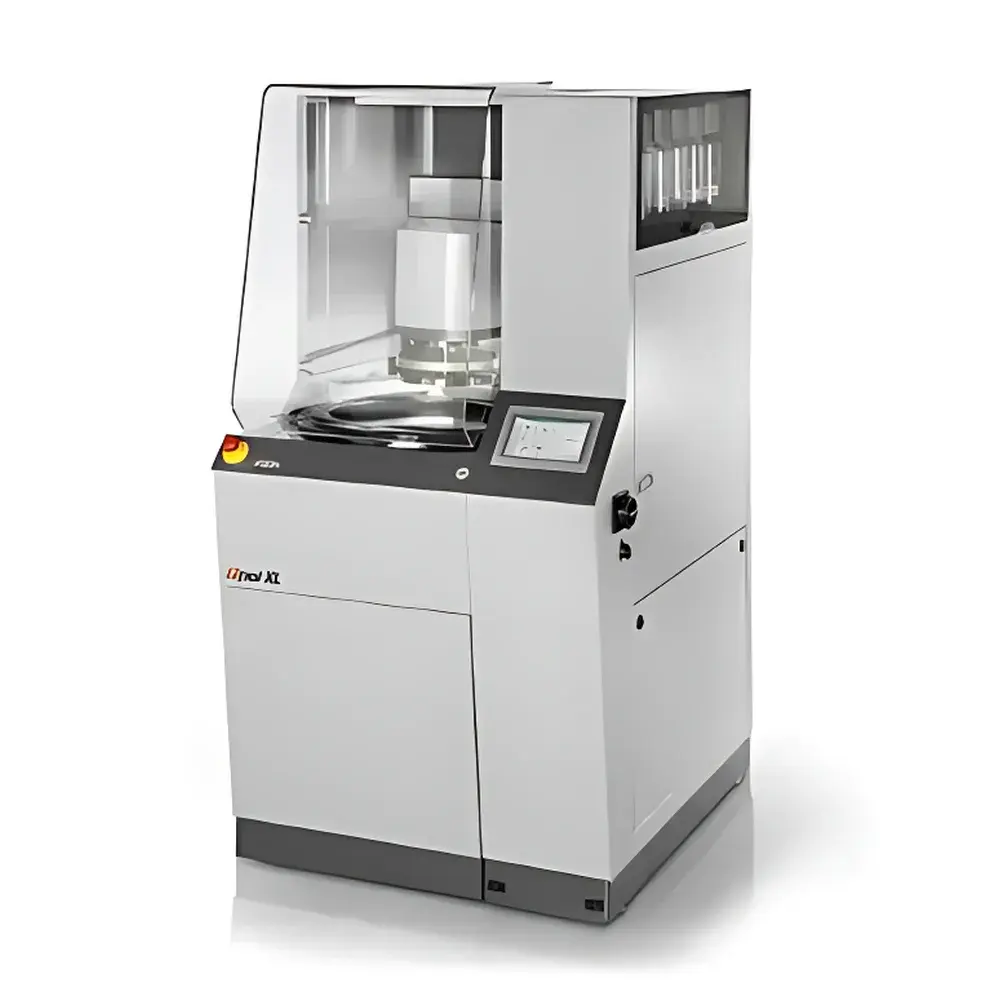
QATM QPOL XL Vertical Grinding and Polishing System
| Brand | QATM |
|---|---|
| Origin | Germany |
| Model | QPOL XL |
| Drive Motor Power (Platen) | 2.2 kW (S1) |
| Drive Motor Power (Head) | 0.75 kW (S1) / 1.1 kW (S3) |
| Platen Diameter | 300 / 350 mm |
| Platen Speed | 50–600 rpm |
| Head Rotation Speed | 50–350 rpm |
| Applied Force Range | 50–750 N |
| Force Control | Electronic load cell with real-time feedback |
| Number of Liquid Dispensers | Up to 6 |
| Safety Hood | Motorized, interlocked |
| Weight | ~390 kg |
| Dimensions (L×W×H) | 1055 × 860 × 1600 mm |
| Electrical Supply | 400 V / 50 Hz (3Ph/N/PE), 480 V / 60 Hz (3Ph/N/PE), or 220 V / 60 Hz (3Ph/N/PE) |
| Max. Power Consumption | 6 kVA |
Overview
The QATM QPOL XL is a high-precision, vertically oriented grinding and polishing system engineered for reproducible, high-throughput metallographic sample preparation in industrial quality control laboratories and R&D facilities. Designed around the principles of controlled material removal via rotational shear and pressure-mediated abrasion, the QPOL XL implements a dual-motor architecture—separate drives for the platen and specimen head—to enable independent speed and direction control. This configuration supports standardized preparation protocols per ASTM E3, ISO 13076, and EN 10365, ensuring compliance with metallurgical best practices for microstructural analysis. Its rigid cast-iron frame, precision-ground guideways, and dynamically balanced rotating assemblies minimize vibration and thermal drift, contributing to exceptional planarity and edge retention across batches of up to 12 specimens per cycle.
Key Features
- Electronic force control system with integrated load cell (50–750 N range), delivering real-time closed-loop pressure regulation and sub-Newton repeatability across sequential cycles.
- Modular liquid dispensing platform supporting up to six independently programmable reagent bottles, compatible with water-based slurries, colloidal silica, diamond suspensions, and electrolytic etchants.
- Automated rotating dispensing arm ensures uniform distribution of abrasive media across the full platen surface—critical for consistent removal rates and minimized edge rounding.
- Spin-dry function accelerates post-process cleaning by centrifugally removing residual slurry from the platen within seconds, reducing cross-contamination and downtime.
- Motorized safety hood with electromagnetic interlock halts all motion upon opening and complies with EN 60204-1 and ISO 13857 mechanical safety standards.
- Tool-free platen replacement mechanism enables rapid changeover between 300 mm and 350 mm platens—no calibration recalibration required.
- Intuitive touchscreen interface with multi-level user management (admin, technician, operator) and audit-trail-capable method storage for up to 200 pre-defined preparation sequences.
Sample Compatibility & Compliance
The QPOL XL accommodates specimens ranging from Ø159 mm to Ø204 mm in diameter, including mounted and unmounted metallic, ceramic, and composite samples. Its bidirectional head rotation (clockwise/counter-clockwise) and variable speed pairing allow optimization for soft alloys (e.g., aluminum, copper), hard steels, carbides, and brittle materials such as sintered tungsten or silicon nitride. All operational parameters—including force ramp profiles, dwell times, and dispensing schedules—are configurable to meet ASTM E3-22, ISO 15630-1, and VDI 2658 requirements for metallographic reproducibility. The system’s firmware supports GLP/GMP-aligned data integrity features, including electronic signatures, time-stamped event logs, and exportable CSV reports traceable to individual users and methods.
Software & Data Management
The embedded QATM PrepControl™ software provides a validated environment for method development, execution, and documentation. Each stored protocol includes force vs. time curves, rotational speed profiles, liquid dispensing timestamps, and spin-dry activation status—all retained locally with optional network backup. Role-based access control enforces procedural discipline in regulated environments; administrator privileges are required to modify force limits or delete historical runs. Export functions generate PDF-certified preparation certificates compliant with ISO/IEC 17025 documentation requirements. Optional integration with LIMS platforms is supported via OPC UA and RESTful API interfaces.
Applications
- Routine QC preparation of ferrous and non-ferrous alloys for optical microscopy, SEM, and EBSD analysis.
- High-volume production lab workflows requiring >50 samples/day with ≤2% inter-run variation in surface roughness (Ra) and subsurface deformation depth.
- Failure analysis labs preparing cross-sections of welds, coatings, and additive-manufactured components where edge preservation and artifact minimization are critical.
- Research institutions developing novel polishing chemistries or evaluating new abrasive media—enabled by granular control over dispensing timing, volume, and mixing (with optional magnetic stirrer).
- Accredited testing laboratories performing certified metallographic services under ISO/IEC 17025 scope, where instrument qualification (IQ/OQ/PQ) templates and calibration records are maintained per manufacturer guidelines.
FAQ
What platen sizes are supported, and is recalibration required when switching?
The QPOL XL accepts both 300 mm and 350 mm platens. No recalibration is needed—the system auto-detects platen diameter via encoder indexing and adjusts torque limits and dispensing geometry accordingly.
Can the force control system be validated for ISO/IEC 17025 compliance?
Yes. The integrated load cell is factory-calibrated traceable to DAkkS-accredited standards, and certificate-of-calibration documentation is provided with each unit. Annual verification procedures are outlined in the OQ manual.
Is remote monitoring or troubleshooting supported?
The system includes Ethernet connectivity and supports secure remote desktop access (via customer-approved VPN) for technical support diagnostics, subject to IT policy approval.
Does the QPOL XL meet FDA 21 CFR Part 11 requirements for electronic records?
While not inherently Part 11-compliant out-of-the-box, the PrepControl™ software architecture supports audit trail generation, electronic signatures, and role-based permissions—enabling validation against Part 11 when implemented within a qualified laboratory IT infrastructure.
What maintenance intervals are recommended for routine operation?
Daily: wipe-down of dispensing arm and hood interior; weekly: inspection of platen mounting bolts and liquid tubing integrity; biannual: motor brush inspection (if applicable) and load cell zero-point verification using certified test weights.



