
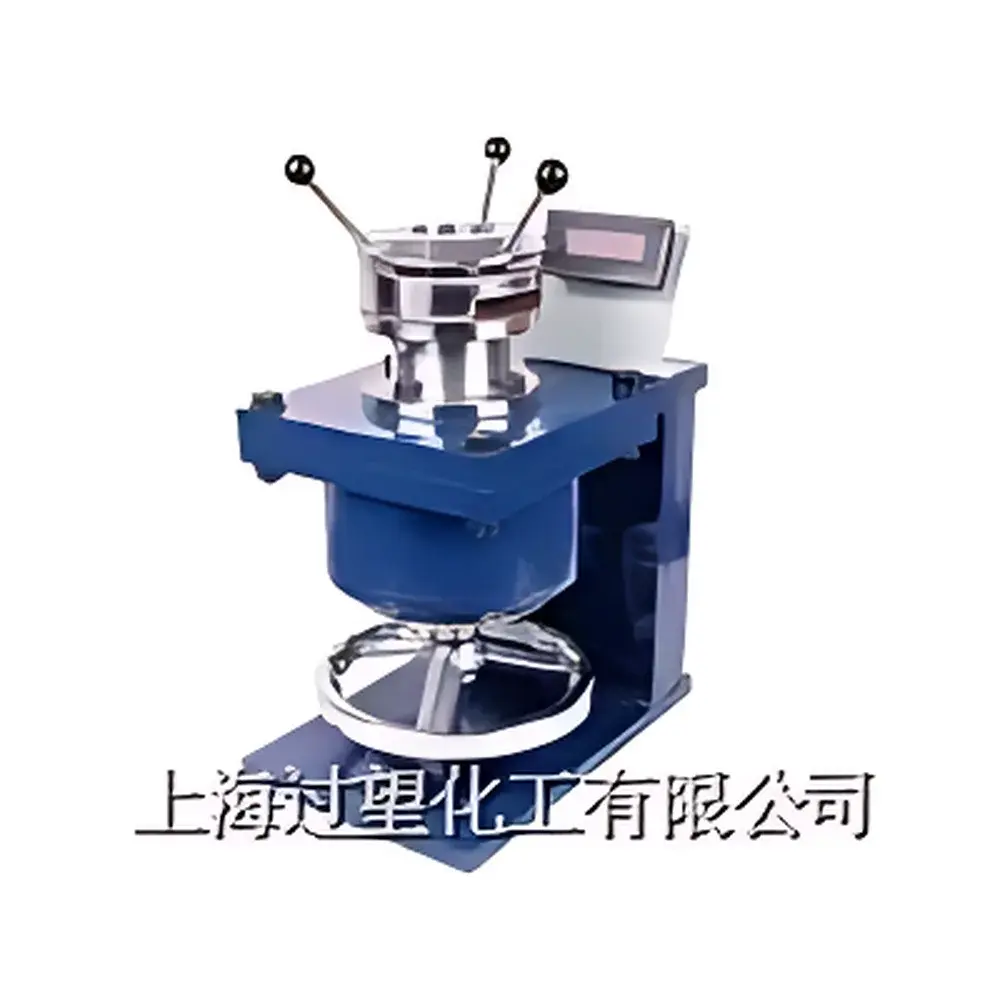
QBJ Erichsen Cupping Tester
| Origin | Shanghai, China |
|---|---|
| Manufacturer Type | Authorized Distributor |
| Origin Category | Domestic (China) |
| Model | QBJ |
| Pricing | Available Upon Request |
| Punch Diameter | 20 mm |
| Maximum Indentation Depth | 10 mm |
| Indentation Resolution | 0.05 mm |
| Digital Depth Display | 0.01 mm resolution |
| Specimen Size | 70 mm × 70 mm |
| Specimen Thickness Range | 0.30–1.25 mm |
| Substrate Material | Polished Steel Plate per GB/T 9271 |
Overview
The QBJ Erichsen Cupping Tester is a precision mechanical testing instrument engineered for quantitative evaluation of the ductility and adhesion integrity of organic coatings—such as paints, varnishes, and lacquers—applied to metallic substrates. It operates on the fundamental principle of controlled biaxial stretching: a standardized polished steel specimen, coated on one side, is clamped uniformly and subjected to progressive axial displacement by a hemispherical punch until coating failure occurs (e.g., cracking, flaking, or loss of adhesion). The resulting cupping depth—measured at the point of first visible crack under 10× magnification—is reported in millimeters and serves as an objective, repeatable metric for comparative quality control and formulation development. Designed in strict accordance with ISO 1520:2022 and GB/T 9753–2007 (equivalent to ISO 1520), this tester delivers high reproducibility across laboratories and production lines where coating performance under deformation must be rigorously documented.
Key Features
- Robust cast-iron frame with precision-machined guide columns ensuring vertical alignment and minimal lateral deviation during punch travel.
- Hemispherical punch with nominal diameter of 20 mm, manufactured from hardened tool steel (HRC ≥ 60) and certified geometric tolerance ≤ ±0.02 mm.
- Manually operated hydraulic loading system with fine-threaded screw advancement, enabling smooth, jerk-free indentation without inertial overshoot.
- Digital depth indicator with 0.01 mm resolution and ±0.05 mm maximum permissible error per ISO 1520 Annex B calibration requirements.
- Adjustable clamping force mechanism compliant with ISO 1520’s specified 10 kN ± 0.5 kN holding load, verified via traceable load cell calibration.
- Specimen support plate designed to maintain flatness within 0.03 mm over 70 mm span, minimizing substrate bending artifacts during deformation.
Sample Compatibility & Compliance
The QBJ tester accommodates flat, rigid metallic panels measuring 70 mm × 70 mm, with thicknesses ranging from 0.30 mm to 1.25 mm. Substrates must conform to GB/T 9271–2007 (identical to ISO 1514:2019) specifications for polished cold-rolled steel plates—including surface roughness (Ra ≤ 0.8 µm), hardness (120–150 HV), and dimensional stability after degreasing and conditioning at 23 °C ± 2 °C and 50 % ± 5 % RH for ≥24 h. Coated specimens are evaluated under ambient laboratory conditions per ISO 288:2021. Test reports generated using this instrument satisfy documentation requirements for ISO 9001:2015 clause 8.5.2 (Identification and traceability) and support internal GLP-compliant QC workflows.
Software & Data Management
While the QBJ Erichsen Cupping Tester is a manually operated mechanical instrument without embedded firmware or digital connectivity, its analog-to-digital depth readout enables seamless integration into enterprise quality management systems (QMS). Operators record cupping depth values directly into LIMS or Excel-based templates aligned with ASTM D4145 and ISO/IEC 17025:2017 data integrity guidelines. Calibration certificates for the depth indicator and verification records for clamping force are maintained per ISO/IEC 17025 clause 6.4.3; all measurement uncertainty budgets (k=2) are documented and traceable to NIM (National Institute of Metrology, China) standards.
Applications
- Quality assurance of coil-coated and pre-painted metal sheets used in automotive body panels and appliance housings.
- Formulation screening of waterborne and high-solids industrial coatings for improved stretch resistance.
- Supplier qualification testing per OEM specifications (e.g., Ford WSS-M2P175-B1, GMW14872).
- Root-cause analysis of coating delamination incidents in humid or thermal cycling environments.
- Regulatory submission support for CE-marked architectural coatings under EN 10169 compliance frameworks.
FAQ
What standards does the QBJ Erichsen Cupping Tester comply with?
It is fully compliant with ISO 1520:2022, GB/T 9753–2007, and referenced in ASTM D4145–21 for coil coating evaluation.
Can the instrument test non-steel substrates?
No—it is validated exclusively for polished cold-rolled steel plates meeting GB/T 9271 requirements; aluminum or zinc-coated substrates require method validation per ISO 20489.
Is third-party calibration available?
Yes—certified calibration services are provided by CNAS-accredited labs, including depth indicator linearity verification and clamping force audit against primary standards.
What maintenance is required for long-term accuracy?
Monthly cleaning of punch and guide surfaces with isopropyl alcohol, annual re-lubrication of lead screws, and biannual verification of depth indicator zero drift per ISO 1520 Annex C.
How is operator training delivered?
On-site or virtual technical training covers specimen preparation, clamp torque verification, failure mode identification (crack vs. pull-off), and reporting per ISO 1520 Clause 9.



