
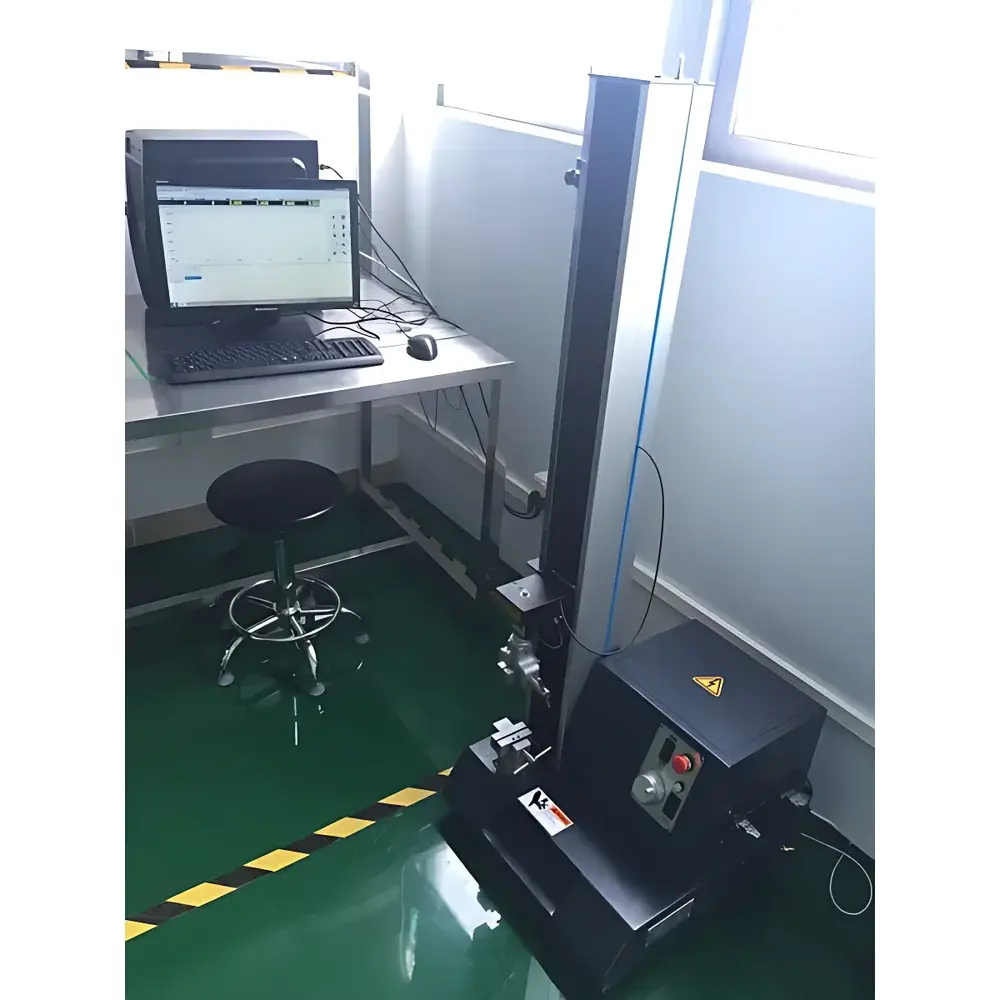
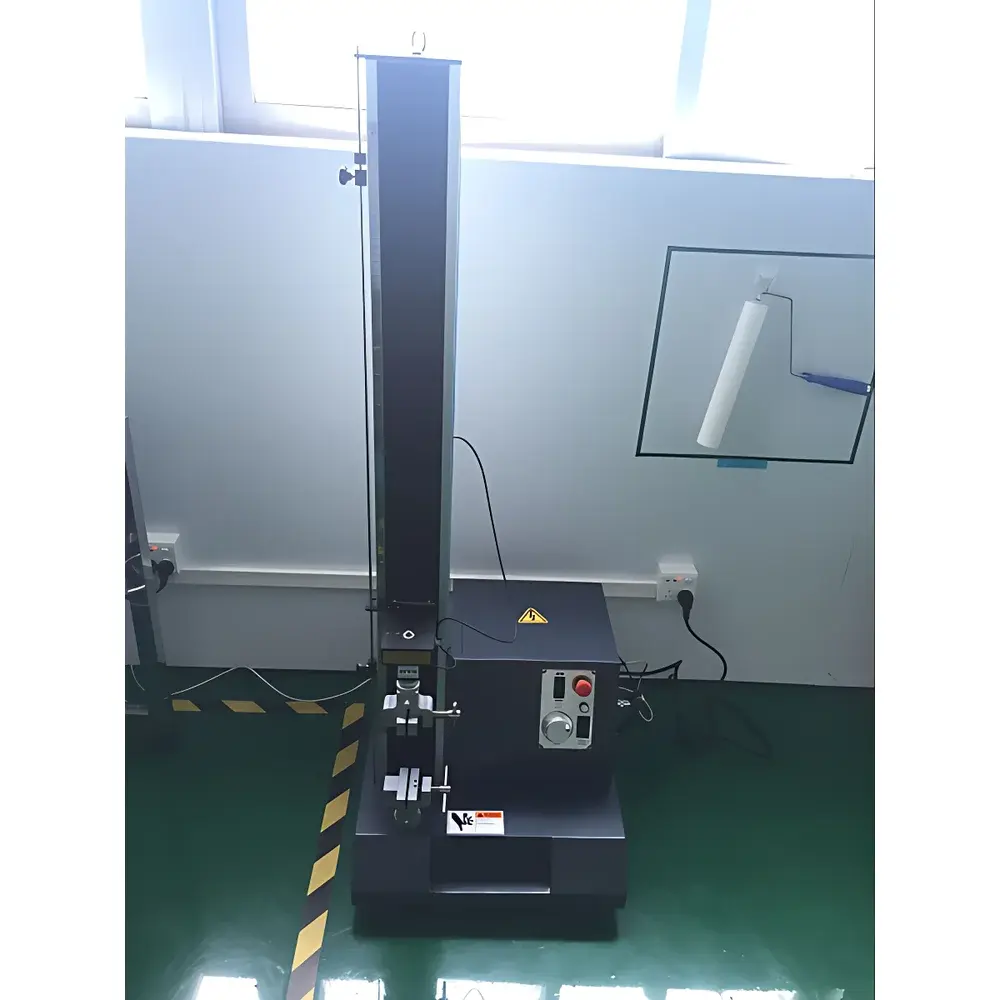
QC-508M1 Tensile Testing Machine – Single-Column Electromechanical Universal Tester
| Origin | Taiwan |
|---|---|
| Manufacturer Type | Authorized Distributor |
| Regional Origin | Asia-Pacific |
| Model | QC-508M1 |
| Price Range | USD 14,000 – 28,000 |
| Instrument Type | Electromechanical Tensile Tester |
| Max Test Load | 10–50 kN |
| Load Cell Capacity | 50 kN Full Scale |
| Force Accuracy | ±0.01% FS |
| Test Stroke | 700 mm (standard) / up to 800 mm (with extended configuration) |
| Displacement Resolution | 0.001 mm |
| Speed Range | 0.03–1000 mm/min |
| Data Acquisition Rate | 100 Hz |
| Compliance | ISO 7500-1, ASTM E4, ASTM D76, DIN 51221, JIS B7721/B7733, EN 10002-2, BS 1610, GB/T 228.1 |
Overview
The QC-508M1 Tensile Testing Machine is a single-column, electromechanical universal testing system engineered for precision mechanical property evaluation of metallic, polymeric, composite, and elastomeric materials. Designed in accordance with international metrological standards—including ISO 7500-1 (class 0.5), ASTM E4 (verification of force-measuring instruments), and ASTM D76 (tensile testing of textiles)—the QC-508M1 delivers traceable, repeatable force and displacement measurements across a wide operational envelope. Its servo-motor-driven actuation system eliminates mechanical backlash and ensures smooth, programmable motion control without maintenance-intensive gearboxes or hydraulic components. The machine operates under closed-loop digital control, where load, displacement, and speed are continuously monitored and adjusted in real time via high-fidelity strain-gauge-based load cells and optical linear encoders. With a maximum rated capacity of 50 kN and force resolution down to 1/10,000 of full scale, the QC-508M1 supports both routine quality control and R&D-grade tensile, compression, flexural, peel, and shear testing protocols.
Key Features
- Auto-identification system for interchangeable fixtures and load cells—eliminates manual calibration parameter entry and reduces setup errors.
- Precision handwheel for fine-positioning of crosshead during specimen alignment—enables sub-millimeter positioning accuracy without motorized intervention.
- Dual-stage overload protection: hardware-based upper/lower limit switches complement software-defined safety thresholds to prevent over-travel and transducer damage.
- Integrated TCP/IP interface enables direct network connectivity to LAN-based lab infrastructure—supports remote monitoring, centralized data logging, and integration into LIMS environments.
- Rigid frame construction (284 kgf stiffness rating) minimizes deflection under load, ensuring compliance with ISO 7500-1 geometric error requirements for class 0.5 verification.
- Wide dynamic speed range (0.03–1000 mm/min) with ±0.1% speed stability—programmable via Windows-based controller for multi-step test profiles including ramp-hold-relax sequences.
Sample Compatibility & Compliance
The QC-508M1 accommodates specimens ranging from thin films (<0.1 mm thickness) to structural metal coupons (up to 25 mm width × 5 mm thickness), leveraging standardized grips (pneumatic, wedge, vise, and pneumatic roller types) and custom fixture interfaces. It meets mechanical testing requirements defined in ISO 6892-1 (metallic materials), ISO 527-1/2 (plastics), ASTM D638/D3039 (tensile properties of plastics/composites), and ISO 1133 (melt flow index correlation). All force measurement subsystems are factory-calibrated against NIST-traceable deadweight standards and support periodic in-house verification per ASTM E4 procedures. The system architecture complies with GLP/GMP documentation integrity principles, including audit-trail-enabled user access logs and electronic signature support for regulated environments.
Software & Data Management
Control and analysis are performed using proprietary Windows-native software compatible with Windows 7 through Windows 11 (64-bit). The application provides multilingual UI (English, Chinese, Korean, Spanish, German), dual-unit switching (SI/metric and imperial), real-time dual-axis plotting (load vs. displacement, stress vs. strain), and automated calculation of modulus, yield strength, ultimate tensile strength (UTS), elongation at break, and Poisson’s ratio. Raw data exports are available in CSV, XLSX, and XML formats; report templates adhere to ISO/IEC 17025 documentation guidelines. Data acquisition occurs at up to 100 Hz with timestamped metadata (operator ID, environmental conditions, calibration status), and all test sessions generate immutable binary archives for regulatory review. Optional FDA 21 CFR Part 11 compliance modules provide electronic signature validation, role-based permissions, and change-control tracking.
Applications
- Quality assurance of incoming raw materials (e.g., stainless steel wire, PET film, medical-grade silicone tubing).
- Process validation for extrusion, injection molding, and heat treatment lines.
- Mechanical characterization of biomedical implants and suture materials per ISO 13485 and ASTM F2129.
- Adhesion strength evaluation of pressure-sensitive adhesives and laminated packaging structures.
- Stress-strain curve generation for finite element model input in structural simulation workflows.
- Educational use in university materials science laboratories for ASTM-standardized student experiments.
FAQ
What is the maximum allowable test speed deviation under load?
Speed accuracy remains within ±0.1% of setpoint across the full 0.03–1000 mm/min range, verified per ISO 2041 and ASTM D76 Annex A3.
Can the QC-508M1 perform cyclic loading tests?
Yes—the controller supports waveform generation (sine, triangle, trapezoidal) with user-defined amplitude, frequency, and dwell parameters for low-cycle fatigue pre-screening.
Is third-party calibration certification included with shipment?
Each unit ships with a factory-issued calibration certificate traceable to national metrology institutes; optional UKAS-accredited calibration services are available upon request.
How is mechanical alignment verified during installation?
The system includes a laser collimation kit and alignment jig per ISO 7500-1 Annex C, enabling on-site verification of crosshead parallelism and load train coaxiality.
Does the software support automated pass/fail decision logic based on specification limits?
Yes—customizable acceptance criteria can be embedded into test methods, triggering visual alerts and auto-flagging non-conforming results in generated reports.



