
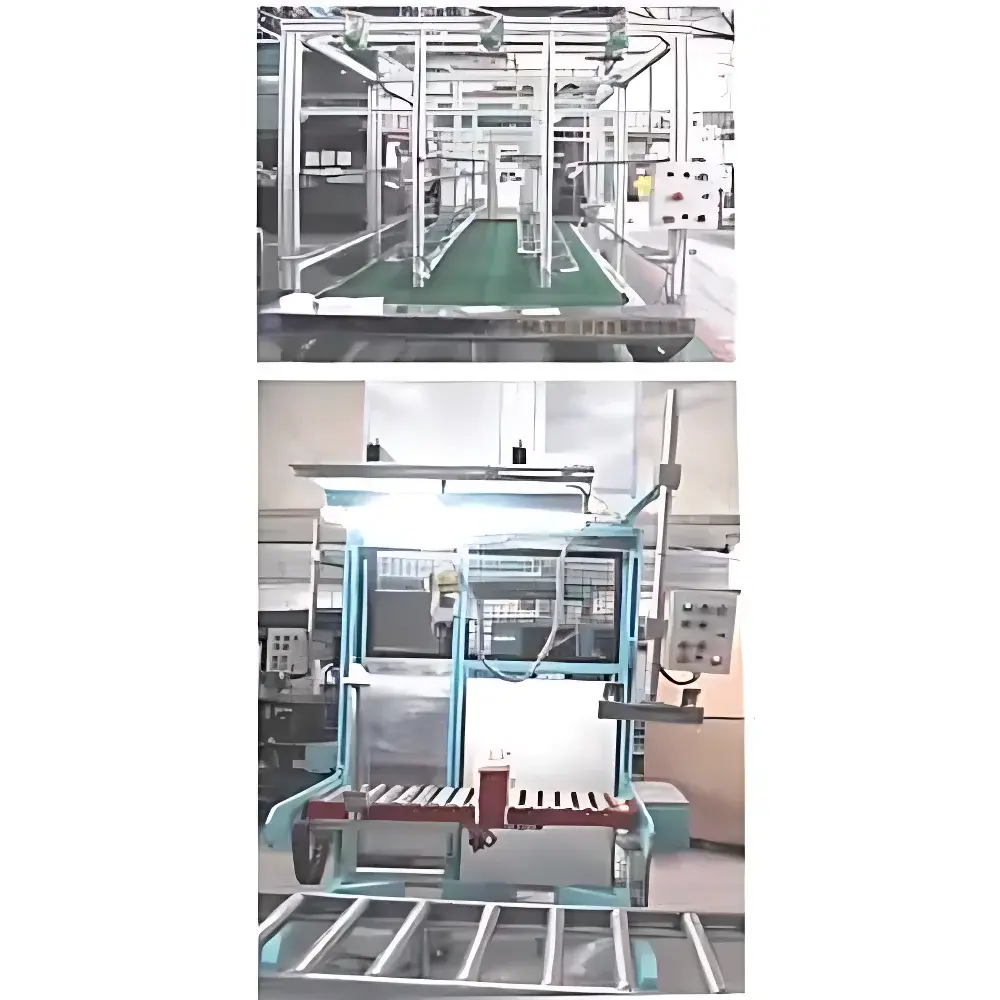
QC-III Automotive Fuel Tank Vibration Durability Testing System
| Origin | Jilin, China |
|---|---|
| Manufacturer Type | Authorized Distributor |
| Origin Category | Domestic (China) |
| Model | QC-III |
| Pricing | Available Upon Request |
| Vibration Axes | Z (vertical), X & Y (horizontal, sequential) |
| Max. Acceleration | 30 m/s² (adjustable) |
| Frequency Range | 1–35 Hz (programmable) |
| Amplitude Range | 0.1–5 mm (frequency-dependent, programmable) |
| Test Duration | Z-axis: 4 h |
| X-axis | 2 h |
| Y-axis | 2 h (independently configurable) |
| Fill Level | Up to 50% of rated capacity (configurable) |
| Pressure Monitoring | 0–30 kPa / 0–80 kPa dual-range, ±0.5% FS |
| Temperature Sensing | 0–100 °C, ±1 °C accuracy |
| Time Control Resolution | 1 s |
| Compliance Support | ASTM D471, ISO 16750-3, SAE J1739, GB/T 28046.3 |
Overview
The QC-III Automotive Fuel Tank Vibration Durability Testing System is an engineered test platform designed to evaluate structural integrity, sealing performance, and long-term fatigue resistance of fuel tanks under controlled multi-axis mechanical vibration—simulating real-world road-induced dynamic loading conditions encountered during vehicle operation. Based on inertial excitation principles, the system applies calibrated sinusoidal or swept-sine acceleration profiles across three orthogonal axes (Z, X, Y) in accordance with internationally recognized automotive environmental stress standards. Its architecture separates vertical (Z-axis) and horizontal (X/Y-axis) vibration modules to enable independent parameter control, ensuring compliance with sequential test protocols required by OEM engineering specifications. The system integrates closed-loop servo control for precision amplitude and frequency fidelity, coupled with synchronized fluid-level management and real-time environmental monitoring—critical for replicating operational boundary conditions where fuel slosh, thermal expansion, and pressure differentials interact with mechanical resonance.
Key Features
- Modular tri-axial vibration architecture: Dedicated Z-axis (vertical) module and dual independent X/Y-axis (horizontal) modules—enabling sequential, non-simultaneous testing per ISO 16750-3 Annex B requirements.
- Two configuration options: Precision-grade linear motor actuation (Parker Electromechanical, Germany) for high-fidelity waveform reproduction and low acoustic emission; or cost-optimized cam-driven mechanism for entry-level validation where spectral purity is secondary to functional pass/fail screening.
- Programmable acceleration profile: Adjustable peak acceleration up to 30 m/s² across 1–35 Hz range, with amplitude modulation constrained by physical amplitude–frequency response characteristics (0.1–5 mm).
- Integrated fluid management subsystem: Automated fill/drain control via solenoid valves and level-sensing circuitry, supporting precise 50% volumetric fill ratio (relative to tank’s rated capacity up to 1.22 m³) as specified in SAE J1739 Clause 5.3.2.
- Real-time multi-parameter acquisition: Simultaneous monitoring of internal tank pressure (dual-range: 0–30 kPa / 0–80 kPa), ambient/liquid temperature (0–100 °C, ±1 °C), elapsed test time (0–5 h, 1 s resolution), and pass/fail status logging.
- Ruggedized mechanical frame (ZNS-NJ01 base platform) with optical encoder feedback (three-axis grating scale system) for position verification and repeatability assurance over extended duty cycles.
Sample Compatibility & Compliance
The QC-III accommodates both metallic and polymeric fuel tanks within defined dimensional envelopes: up to 2000 × 872 × 700 mm (metal) or 1300 × 500 × 400 mm (plastic). Fixture tooling (CNC-machined, customizable per tank flange geometry) ensures secure clamping without localized stress concentration. The system supports full traceability for regulated testing environments: data acquisition timestamps, user authentication logs, and audit-ready output reports align with GLP principles. Test execution adheres to key automotive durability standards—including ISO 16750-3 (Mechanical loads), SAE J1739 (Fatigue Analysis Procedures), ASTM D471 (Rubber Property Changes in Fluids), and GB/T 28046.3 (Road Vehicles – Environmental Conditions). Optional 21 CFR Part 11–compliant software add-ons are available for pharmaceutical-adjacent applications requiring electronic signature and change-control records.
Software & Data Management
Control and monitoring are executed via a研祥 (Advantech) industrial PC running deterministic real-time OS firmware. The proprietary HMI interface provides synchronized waveform visualization, parameter setpoint entry, and live sensor overlays (pressure vs. time, temp vs. cycle count). All test sequences are stored as XML-based protocol templates, supporting version-controlled revision history. Raw data streams (100 Hz sampling) are archived in CSV/CSVZ format with embedded metadata (operator ID, tank ID, calibration certificate IDs, environmental chamber status if integrated). Built-in report generation includes summary statistics (max/min/mean pressure excursion, thermal drift rate), pass/fail determination per threshold logic (e.g., leakage >0.5 kPa drop in 60 s), and direct printing via HP DeskJet A4 color printer (model HPA4). Export modules support import into MATLAB, Python pandas, or LIMS platforms via standard OPC UA or Modbus TCP interfaces.
Applications
- OEM Tier-1 supplier qualification of fuel tank assemblies prior to vehicle integration.
- Validation of weld seam integrity, bladder adhesion, and cap seal performance under cyclic loading.
- Correlation studies between laboratory vibration spectra and field-return failure modes (e.g., connector cracking, vent valve fatigue).
- Development-stage evaluation of new polymer formulations (HDPE, multilayer coextrusions) for improved damping and creep resistance.
- Regulatory certification testing for homologation in EU (ECE R34), China (GB 18352), and North America (EPA 40 CFR Part 1065).
- Accelerated life testing of EV battery coolant reservoirs using identical mechanical boundary conditions (non-fuel fluid compatibility verified).
FAQ
Can the QC-III perform simultaneous X-Y-Z vibration?
Standard configuration supports sequential axis activation only, as mandated by ISO 16750-3. Simultaneous tri-axial excitation requires custom controller firmware, reinforced frame bracing, and upgraded power amplifiers—quoted separately upon technical review.
What is the calibration interval recommendation for pressure and temperature sensors?
Annual recalibration against NIST-traceable references is recommended. Certificate of Conformance (CoC) with as-found/as-left data is provided with each service event.
Is the system compatible with third-party DAQ systems like NI CompactDAQ?
Yes—via analog voltage outputs (0–10 V) for pressure, temperature, and encoder signals, plus TTL-level trigger I/O for external synchronization.
Does the water-fill subsystem support alternative test media such as ethanol-gasoline blends?
The wetted materials (EPDM seals, stainless steel valves, PVDF tubing) are chemically resistant to E10/E15 fuels. For higher ethanol concentrations or biodiesel, material compatibility verification per ASTM D471 must be conducted prior to use.
How is mechanical safety interlocked during operation?
Hardware-enforced safety chain includes door switch monitoring, emergency stop circuit (EN 60204-1 compliant), overload current sensing on all servo drives, and automatic shutdown on pressure deviation >±5% from setpoint for >30 seconds.



