
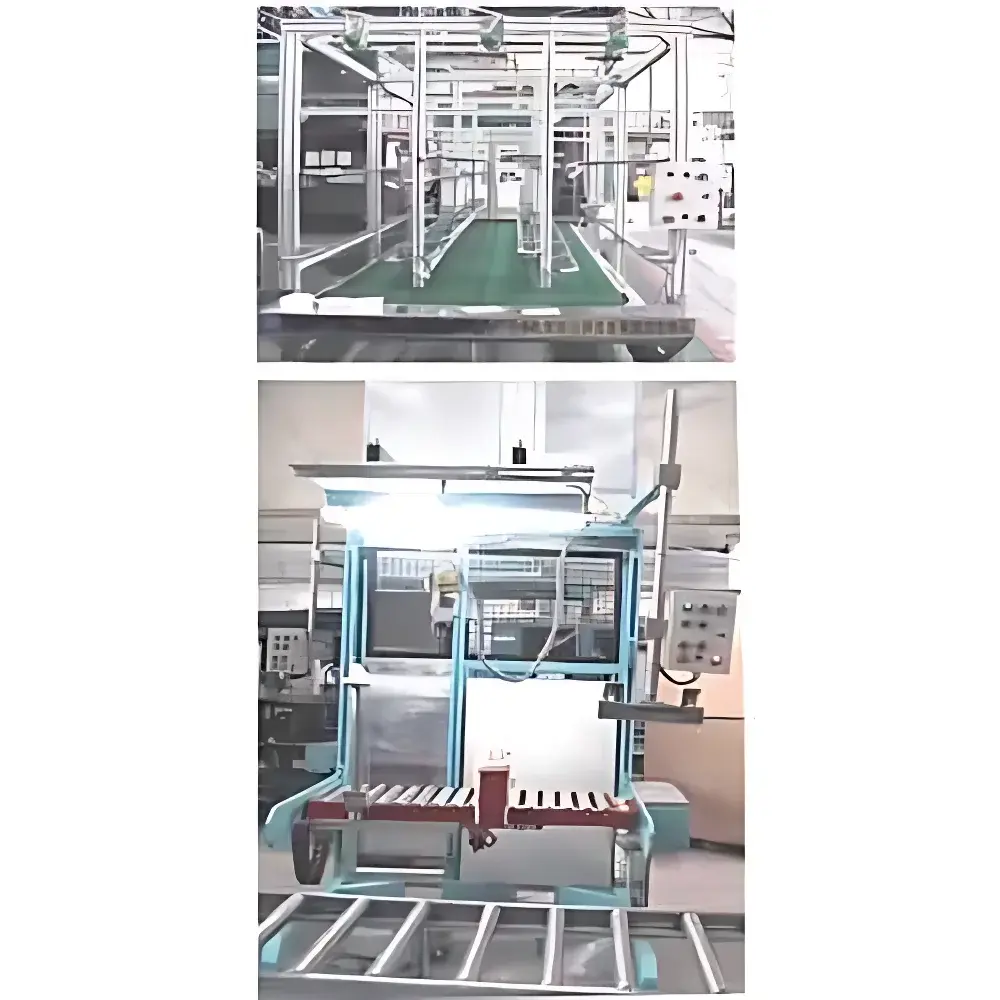
QC-I Universal Testing Machine for Fuel Tank Air-Tightness Verification
| Key | Origin: Jilin, China |
|---|---|
| Manufacturer Type | Distributor |
| Model | QC-I |
| Quotation | Upon Request |
| Pressure Range | 1–100 kPa |
| Pressure Resolution | 0.1 kPa |
| Pressure Accuracy | ±0.5% F.S. |
| Water Tank Volume | 2.4 m³ (2400 × 1000 × 1000 mm) |
| Fixture Dimensions | 2200 × 900 mm |
| Lift Stroke | 1000 mm |
| Max. Test Object | Metallic tank ≤ 2000 × 872 × 700 mm |
| Rated Capacity | 1.22 m³ |
| Power Supply | 380 V AC, 5 kW |
| Weight | 1000 kg |
| Overall Dimensions | 2600 × 1600 × 2000 mm |
Overview
The QC-I Universal Testing Machine is a purpose-built, industrial-grade air-tightness verification system engineered for regulatory-compliant pressure integrity testing of automotive and off-road fuel tanks. Unlike general-purpose tensile or compression testers, the QC-I implements a standardized immersion-based leak detection methodology grounded in ISO 20623:2018 (Road vehicles — Fuel tanks — Requirements and test methods) and SAE J1719. It operates on the principle of controlled pressurization followed by submerged visual inspection: the test specimen is sealed, pressurized to a user-defined setpoint within the 1–100 kPa range, mechanically lowered into a stainless-steel water bath, and held at nominal submersion depth (≤100 mm) for a configurable dwell time (standard 30 s). Any escaping gas manifests as discrete bubbles at leakage sites—enabling rapid, operator-interpreted pass/fail assessment without reliance on secondary instrumentation.
Key Features
- Robust stainless-steel immersion tank (2400 × 1000 × 1000 mm) with corrosion-resistant finish and integrated water-level monitoring.
- Electro-pneumatic lift mechanism featuring dual guided columns and a heavy-duty double-acting cylinder, delivering precise, repeatable vertical travel over a full 1000 mm stroke.
- Dual-control architecture: selectable operation modes—basic relay/timer logic for cost-sensitive QA labs or programmable logic controller (PLC) configuration using Omron CJ2M series (20 I/O points) for audit-ready sequence control, data logging, and interlock management.
- Integrated pressure regulation subsystem comprising high-stability piezoresistive pressure transducers (0.1 kPa resolution, ±0.5% F.S. accuracy), solenoid-controlled pneumatic valves, and calibrated flow restrictors to ensure consistent ramp rates and hold stability.
- Modular fixture system with CNC-machined mounting rails and adjustable restraint straps, accommodating both metallic (up to 2000 × 872 × 700 mm) and polymer-based fuel tanks (up to 1300 × 500 × 400 mm) while preserving OEM mounting geometry and cap orientation.
- Industrial-grade power interface (380 V AC, 5 kW) with circuit protection, EMI filtering, and grounding compliance per IEC 61000-6-2/6-4.
Sample Compatibility & Compliance
The QC-I accommodates fuel tanks across material classes and structural configurations typical of light-duty vehicles, agricultural machinery, and construction equipment. Its open-frame mechanical design permits unobstructed access for manual positioning and post-test inspection. All operational sequences—including pressure ramping, dwell timing, lift actuation, and exhaust venting—are fully programmable and traceable under PLC mode. The system supports documentation workflows aligned with ISO/IEC 17025-accredited laboratories and satisfies functional requirements referenced in GB/T 18411–2018 (China), ECE R34–03 (UN Regulation), and FMVSS 301 Appendix A. Optional calibration certificates traceable to NIM (National Institute of Metrology, China) are available upon request.
Software & Data Management
In PLC-configured units, the embedded Omron CJ2M controller executes deterministic real-time sequencing with timestamped event logging (start/stop, pressure setpoint, actual pressure, lift position, dwell duration, pass/fail flag). Logs export via USB or Ethernet to CSV format for integration into LIMS or internal QA databases. System firmware supports password-protected parameter editing, user-level access control (operator/engineer/admin), and electronic signature capability compliant with FDA 21 CFR Part 11 when paired with validated PC-based supervision software. Audit trails record all configuration changes, test executions, and calibration interventions—ensuring full GLP/GMP traceability.
Applications
- Pre-delivery validation of OEM and Tier-1 fuel tank assemblies prior to vehicle integration.
- Root-cause analysis of seam weld failures, gasket extrusion, or cap seal degradation during durability testing.
- Verification of repair integrity following field-service tank reconditioning or patching procedures.
- Process qualification of new blow-molded or stamped tank production lines.
- Supporting technical documentation for type-approval submissions to CNCA, TÜV, or other notified bodies.
FAQ
What standards does the QC-I comply with for fuel tank leak testing?
The QC-I implements test protocols aligned with ISO 20623:2018, SAE J1719, GB/T 18411–2018, and ECE R34–03 Annex 4.
Can the system be integrated into an automated production line?
Yes—PLC-mode units offer dry-contact I/O and Modbus TCP interfaces for synchronization with conveyor systems, barcode scanners, and MES platforms.
Is calibration certification included with delivery?
Factory calibration is performed pre-shipment; NIM-traceable calibration certificates are optional and quoted separately.
What maintenance is required for long-term reliability?
Scheduled quarterly verification of pressure sensor linearity, annual replacement of pneumatic seals, and biannual lubrication of lift guide rails per the maintenance manual.
Does the QC-I support custom test profiles beyond the standard 30-second dwell?
Yes—dwell time, pressure ramp rate, target pressure, and submersion depth are fully configurable in PLC mode, with up to 16 stored test programs.



