
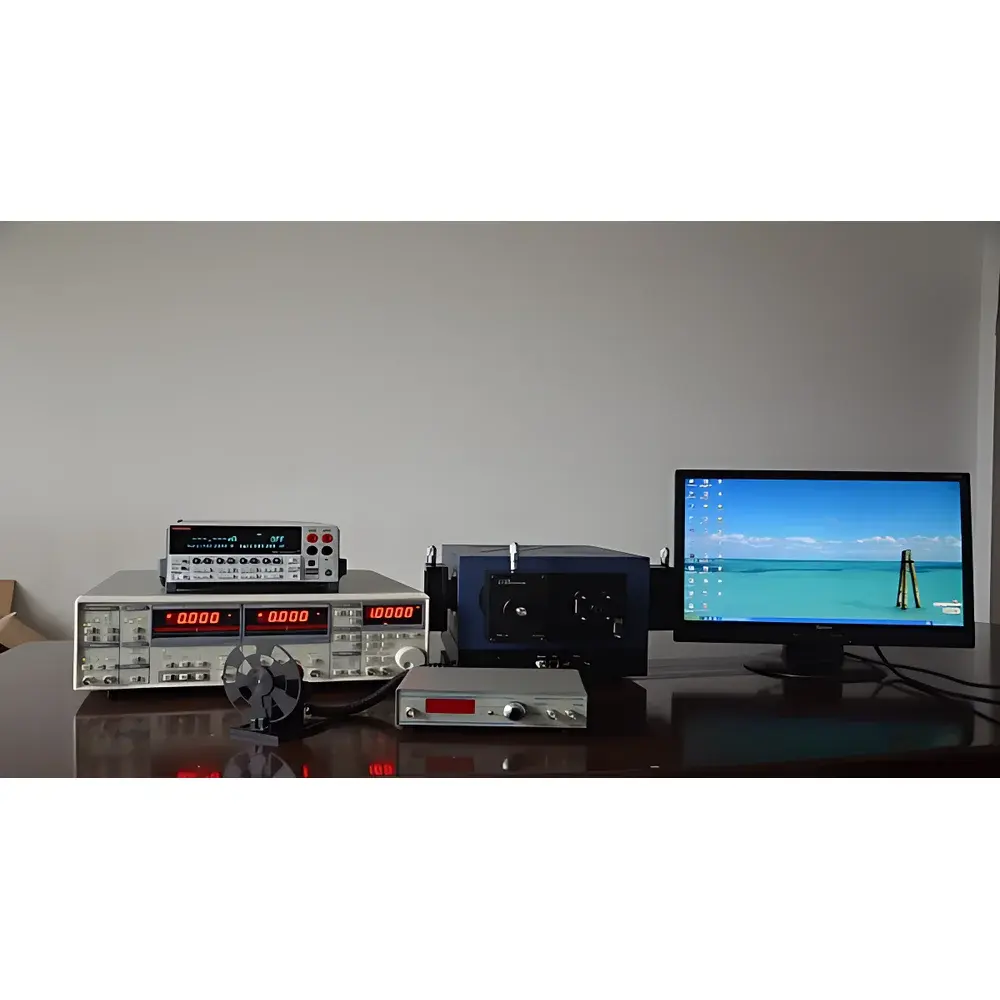
QE/IPCE Quantum Efficiency & Incident Photon-to-Current Efficiency Measurement System
| Brand | PerfectLight |
|---|---|
| Origin | Beijing, China |
| Model | IPCE |
| Light Source Wavelength Range | 300–1100 nm |
| Irradiance Calibration | 1000 W/m² |
| Focal Length | 300 mm |
| Relative Aperture | f/3.9 |
| Spectral Resolution | 0.1 nm |
| Reciprocal Linear Dispersion | 2.7 nm/mm |
| Chopper Frequency Range | 8.4 Hz – 3.7 kHz |
| Operating Frequency Range | 1 mHz – 102.4 kHz |
| Thermal Stability | 5 ppm/°C |
| Phase Resolution | 0.01° |
| Time Constant Range | 10 s – 30 ks (synchronous reference signal) |
| Irradiance Uniformity | < ±5% |
| Certified Reference Solar Cell Efficiency | >16%, FF > 0.7 |
| Sample Area Compatibility | 20 × 20 mm² |
| Filter Wheel | 7-position, including 550 nm bandpass |
| Detector | Hamamatsu S1337 UV-optimized photodiode (NIST-traceable calibration) |
| Optical Configuration | Dual-beam and single-beam modulation modes (with metrological certification) |
Overview
The PerfectLight IPCE Quantum Efficiency & Incident Photon-to-Current Efficiency Measurement System is a precision electro-optical instrumentation platform engineered for quantitative spectral responsivity characterization of photovoltaic devices. It operates on the principle of monochromatic photocurrent quantum yield analysis—measuring the ratio of collected charge carriers per incident photon across the ultraviolet–visible–near-infrared spectrum (300–1100 nm). Unlike broadband IV characterization, this system delivers wavelength-resolved external quantum efficiency (EQE) and incident photon-to-current conversion efficiency (IPCE), enabling rigorous evaluation of spectral response, charge collection losses, interfacial recombination, and optical coupling effects in solar cells, perovskite absorbers, organic photovoltaics (OPV), and photoelectrochemical (PEC) electrodes. The system integrates a high-stability xenon or halogen light source, a Czerny–Turner monochromator with 0.1 nm resolution, precision optical chopping, and lock-in detection synchronized to a thermally stabilized reference signal—ensuring traceable, reproducible, and GLP-compliant measurements.
Key Features
- Monochromator-based spectral scanning with 0.1 nm resolution and 2.7 nm/mm reciprocal linear dispersion, optimized for high-fidelity spectral deconvolution.
- Hamamatsu S1337 UV-enhanced silicon photodiode detector, NIST-traceably calibrated and certified for absolute irradiance measurement at key wavelengths (e.g., 350, 400, 550, 700, 900 nm).
- Dual optical path architecture supporting both single-beam (direct illumination) and dual-beam (reference-compensated) modulation modes—minimizing drift-induced errors during long-duration scans.
- Programmable chopper unit with frequency range from 8.4 Hz to 3.7 kHz, enabling optimal signal-to-noise ratio selection per sample type and measurement bandwidth.
- Lock-in amplifier with 1 mHz–102.4 kHz operating range, 0.01° phase resolution, and selectable time constants (10 s–30 ks), supporting low-frequency transient QE mapping and impedance-coupled photovoltage analysis.
- Thermally compensated optical bench (5 ppm/°C stability) and irradiance uniformity < ±5% over 20 × 20 mm² active area—meeting ISO 17025 requirements for spatial homogeneity in calibration-grade testing.
- Integrated filter wheel with seven positions, including a certified 550 nm bandpass filter for rapid spectral validation and system alignment checks.
Sample Compatibility & Compliance
The IPCE system accommodates rigid and flexible planar photovoltaic devices up to 20 × 20 mm², including silicon heterojunction (SHJ), CIGS, CdTe, perovskite thin films, dye-sensitized solar cells (DSSCs), and photoanodes for water splitting. All optical and electrical components comply with IEC 60904-8 (spectral mismatch correction), IEC 60904-9 (class AAA solar simulators), and ASTM E1021 (quantum efficiency measurement standard). The included certified reference cell—calibrated by an ISO/IEC 17025-accredited national metrology institute—provides traceability to SI units per ISO/IEC 17025:2017 and supports audit-ready documentation for GLP, GMP, and FDA 21 CFR Part 11 environments.
Software & Data Management
The system is controlled via a Windows-based application supporting automated wavelength sweep, bias voltage ramping, chopper synchronization, and real-time lock-in data acquisition. Software modules include spectral calibration import (NIST SRM files), EQE/IPCE calculation per ASTM E1021, spectral mismatch factor (MMF) computation, and export to CSV, HDF5, or MATLAB-compatible formats. Audit trail logging records operator ID, timestamp, instrument configuration, calibration certificate IDs, and raw lock-in outputs—enabling full data lineage for regulatory submissions. Optional integration with LabArchives ELN or Benchling supports structured metadata tagging and version-controlled experiment archiving.
Applications
- Wavelength-resolved quantum efficiency mapping of emerging PV technologies (e.g., tandem cell subcell contribution analysis)
- Quantitative loss mechanism identification: surface recombination vs. bulk transport limitations via EQE modeling
- Optical modeling validation—comparing measured IPCE with transfer-matrix simulations (e.g., using SCAPS or SETFOS)
- Stability assessment under sequential spectral stress (e.g., UV degradation kinetics)
- Photoelectrode performance benchmarking in PEC water splitting and CO₂ reduction systems
- Calibration transfer between reference cells and production-line QE testers
FAQ
What standards does the IPCE system comply with for traceable calibration?
The system adheres to IEC 60904-8, ASTM E1021, and ISO/IEC 17025 requirements. Its reference cell carries a metrological certificate issued by a CNAS-accredited national laboratory, with traceability to NIST SRM 2242 and PTB primary standards.
Can the system measure devices under bias or in electrolyte?
Yes—it supports three-terminal electrochemical configurations with potentiostatic control integration (via optional PGSTAT interface), enabling IPCE measurements under applied potential or in liquid-junction photoelectrochemical cells.
Is spectral mismatch correction automated?
Yes—the software imports spectral irradiance data and device external quantum efficiency to compute the spectral mismatch factor (MMF) per IEC 60904-7, adjusting reported efficiency values accordingly.
How is thermal drift mitigated during long scans?
The optical bench uses low-expansion materials and active temperature stabilization; combined with dual-beam referencing and 5 ppm/°C spectral calibration stability, drift remains below 0.15% over 2-hour continuous operation.
Does the system support batch processing of multiple samples?
Yes—through configurable sample stage macros and CSV-driven parameter templates, enabling unattended multi-sample QE mapping with auto-alignment and pass/fail threshold reporting.
Related Products




