
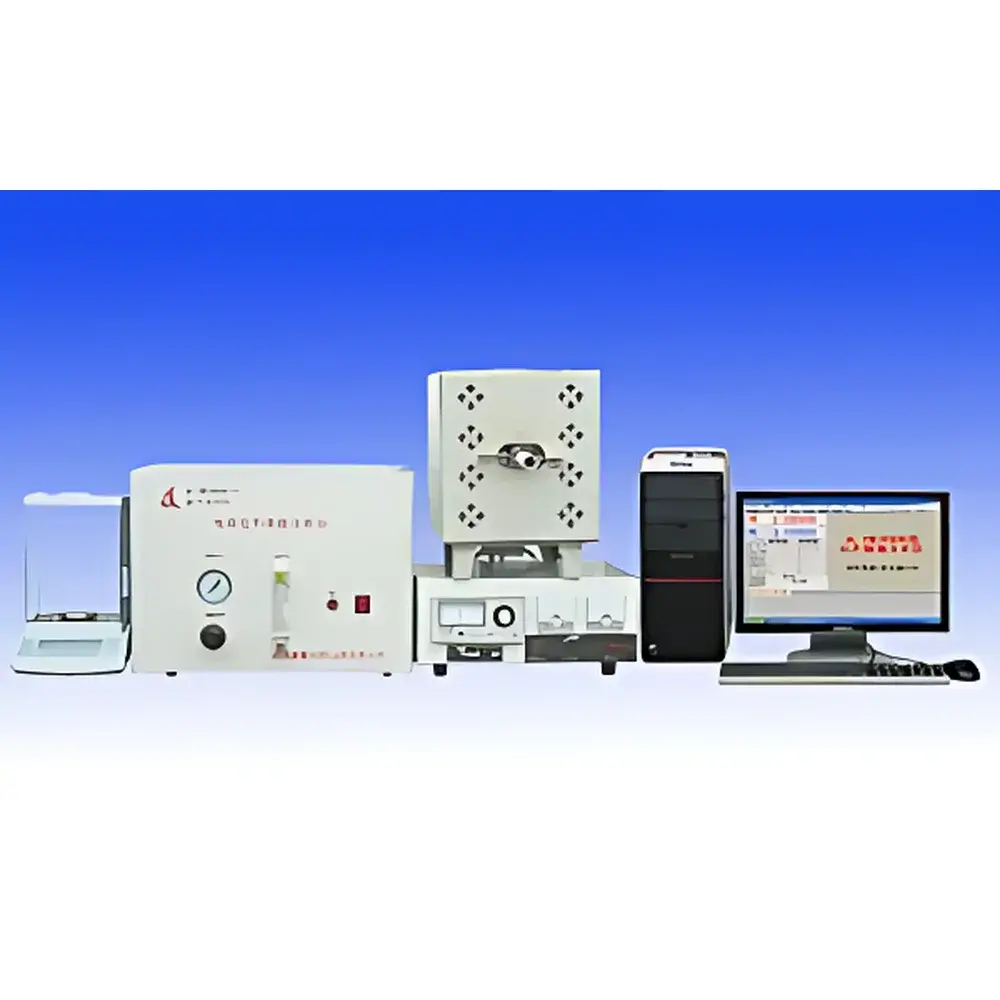
Qilin HW2000E(D) Desktop Tubular-Furnace Infrared Carbon-Sulfur Analyzer
| Brand | Qilin (QL) |
|---|---|
| Origin | Jiangsu, China |
| Model | HW2000E(D) |
| Measurement Principle | Non-Dispersive Infrared (NDIR) Absorption |
| Heating System | High-Frequency Induction Furnace |
| Carbon Range | 0.001–10.000 wt% (extendable to 99.999 wt%) |
| Sulfur Range | 0.0005–0.5000 wt% (extendable to 99.999 wt%) |
| Analysis Time | 25–60 s (typical: 35 s) |
| Power Consumption | <2.5 kVA |
| Weight | 135 kg |
| Compliance | Meets GB/T 20123–2006 and ISO 15350:2000 requirements for solid metallic materials |
Overview
The Qilin HW2000E(D) Desktop Tubular-Furnace Infrared Carbon-Sulfur Analyzer is a precision elemental analyzer engineered for rapid, quantitative determination of total carbon (C) and sulfur (S) mass fractions in solid metallic and inorganic samples. It operates on the principle of non-dispersive infrared (NDIR) absorption spectroscopy: sample combustion in a high-frequency induction furnace generates CO₂ and SO₂ gases, which are swept through dedicated optical cells where their characteristic infrared absorption bands at 4.26 µm (CO₂) and 7.35 µm (SO₂) are measured photometrically. The system integrates a tubular ceramic combustion tube with optimized gas flow dynamics and thermal stability, enabling consistent oxidation of refractory matrices including high-alloy steels, cast irons, ferroalloys, and non-ferrous metals. Designed as an evolution of the HW2000D platform, the HW2000E(D) retains full software compatibility while incorporating refined mechanical integration, enhanced thermal management, and modular hardware architecture—ensuring continuity in method validation and operational training across laboratory environments.
Key Features
- High-frequency induction furnace (≤2.5 kVA) with programmable power ramping and stable temperature control up to 1500 °C, ensuring complete combustion of carbon-rich and sulfur-retentive samples.
- Dual-channel NDIR detection system with thermoelectrically cooled detectors, calibrated against certified reference materials traceable to NIST SRMs.
- Extended dynamic range: C from 0.001 to 10.000 wt% (expandable to 99.999 wt% via dilution or low-gain mode); S from 0.0005 to 0.5000 wt% (expandable to 99.999 wt% with optional high-capacity absorption cells).
- Automated sample weighing interface compatible with RS232/USB-connected analytical balances for不定量 (variable-mass) sample introduction—eliminating fixed-weight constraints and improving throughput for heterogeneous batches.
- Robust gas handling subsystem featuring dual-stage dust filtration, copper-based desulfurization traps, and catalytic post-combustion conversion to ensure baseline stability and minimize cross-interference.
- Desktop footprint (W × D × H ≈ 650 × 580 × 520 mm) with integrated cooling fan and sealed optical compartment for long-term signal reproducibility in ambient lab conditions.
Sample Compatibility & Compliance
The HW2000E(D) is validated for use with ferrous and non-ferrous metals—including carbon steels, stainless steels, tool steels, nickel-based superalloys, aluminum alloys, copper alloys, titanium alloys—as well as inorganic matrices such as cement clinker, limestone, refractory ceramics, slag, and geological ores. Sample forms include drill chips, turnings, powders (<100 µm), and pressed pellets. The analyzer conforms to key international standards for combustion-based elemental analysis: GB/T 20123–2006 (China), ISO 15350:2000 (steel and iron), and ASTM E1019–22 (standard test methods for determining carbon, sulfur, nitrogen, and oxygen in steel and iron). Its hardware design supports GLP-compliant operation when paired with audit-trail-enabled software; data files retain full metadata (operator ID, timestamp, calibration status, gas pressure logs) in ASCII format for regulatory review.
Software & Data Management
The instrument runs the legacy HW2000 series Windows-based application—fully compatible with Windows 10/11 (32- and 64-bit), supporting multi-language UI (English and Chinese selectable). The software provides real-time spectral visualization, automatic baseline correction, peak area integration with manual override, and customizable reporting templates exportable to CSV, Excel, or PDF. Calibration curves are stored per element with up to 12-point polynomial fitting; drift compensation is enabled via periodic blank and standard measurements. All analysis records include embedded instrument configuration snapshots (furnace power profile, gas flow rate, cell temperature), satisfying FDA 21 CFR Part 11 requirements when deployed with appropriate network authentication and electronic signature modules.
Applications
This analyzer serves quality control laboratories in metallurgical production facilities, foundries, third-party testing centers, and R&D departments engaged in alloy development. Typical applications include incoming raw material verification (e.g., scrap metal sorting), melt process monitoring (ladle analysis pre-casting), finished product certification (ASTM A751 compliance), and failure analysis of brittle fracture specimens where interstitial carbon or segregated sulfur is suspected. Its extended upper range also supports research into carbide-forming alloys, ultra-high-carbon steels, and sulfur-doped functional ceramics—where conventional IR analyzers may saturate or require excessive dilution.
FAQ
What sample preparation is required prior to analysis?
Samples must be clean, dry, and free of oil or coolant residues. Metallic samples are typically machined into chips or drilled turnings (3–10 mg recommended); powders should be homogenized and sieved to <100 µm.
Is external carrier gas required?
Yes—a high-purity oxygen supply (≥99.995%, dew point <−40 °C) is mandatory for complete combustion; argon or helium may be used as auxiliary purge gases.
Can the system be integrated into a LIMS environment?
Yes—the software supports ODBC connectivity and configurable ASCII output directories, enabling automated ingestion into major LIMS platforms via scheduled file polling or API middleware.
What maintenance intervals are recommended?
Daily: filter inspection and desiccant replacement; monthly: optical cell cleaning and detector gain verification; annually: furnace tube inspection and thermocouple calibration by authorized service personnel.
Does the analyzer support differential measurement modes (e.g., surface vs. bulk carbon)?
No—it measures total carbon and sulfur content only; depth-resolved analysis requires complementary techniques such as glow discharge optical emission spectrometry (GD-OES) or SIMS.





