
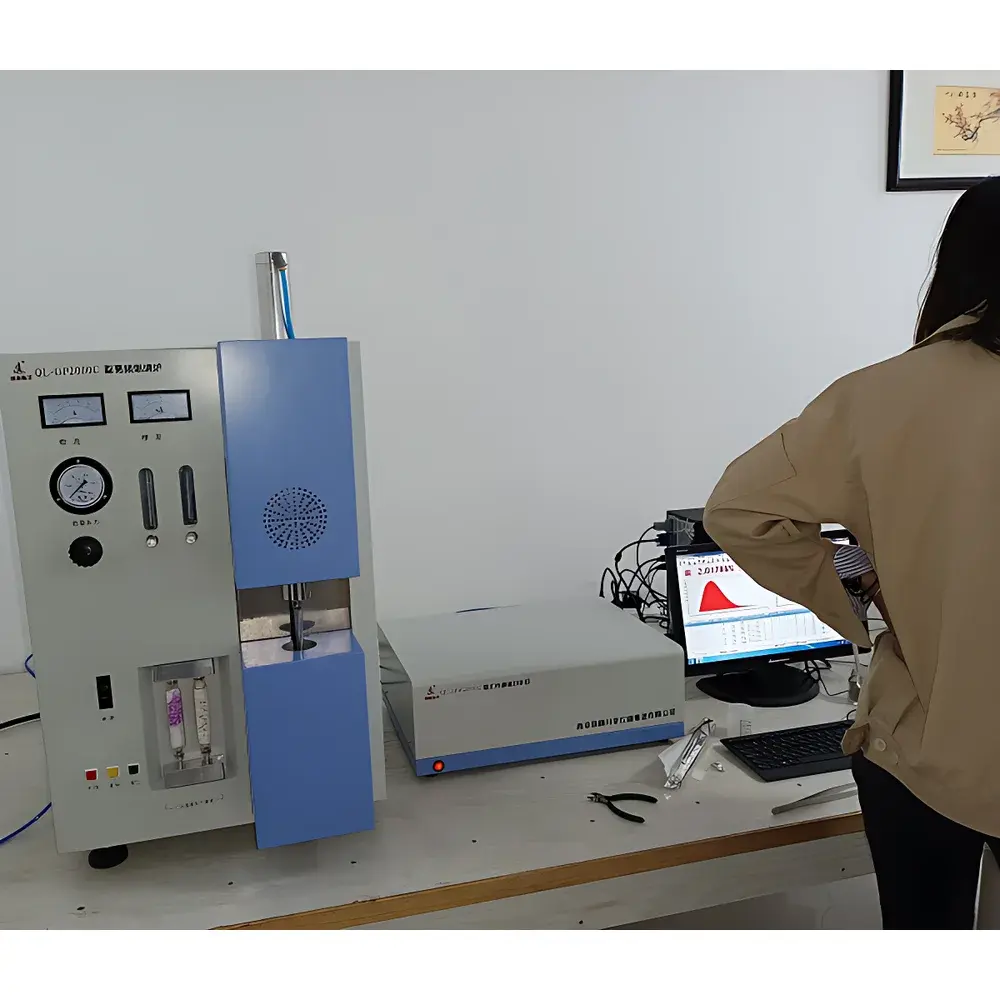
Qilin QL2000 High-Frequency Infrared Carbon-Sulfur Analyzer for Cast Iron and Ductile Iron
| Brand | Qilin / QL |
|---|---|
| Origin | Jiangsu, China |
| Manufacturer Type | Authorized Distributor |
| Country of Origin | China |
| Model | QL2000 |
| Price Range | USD 7,000–14,000 (FOB) |
| Measurement Principle | Non-Dispersive Infrared (NDIR) Absorption |
| Combustion System | High-Frequency Induction Furnace (2.2 kW, 20 MHz) |
| Carbon Range | 0.0001–25.0000 wt% (extendable to 99.999 wt%) |
| Sulfur Range | 0.0001–15.0000 wt% (extendable to 99.999 wt%) |
| Sensitivity | 0.1 ppm for both C and S |
| Precision | Compliant with GB/T 20123–2006 and ISO 15350:2000 |
| Analysis Time | Adjustable from 20–100 s (typical: 35 s) |
| Sample Mass | 0.5 g (standard steel reference material) |
| Continuous Operation | 24 h unattended |
Overview
The Qilin QL2000 is a high-frequency combustion infrared carbon-sulfur analyzer engineered for precise, simultaneous quantification of total carbon (C) and total sulfur (S) in ferrous and non-ferrous metallic materials—particularly cast iron, ductile (nodular) iron, steels, ferroalloys, and refractory ores. It operates on the fundamental principle of non-dispersive infrared (NDIR) absorption spectroscopy: sample combustion in a high-frequency induction furnace quantitatively converts carbon and sulfur into CO2 and SO2, respectively; these diatomic gases are then swept through dual-wavelength infrared absorption cells. At precisely tuned wavelengths—4.26 µm for CO2 and 7.4 µm for SO2—the gases exhibit characteristic vibrational-rotational absorption bands. The instrument measures attenuation of infrared radiation intensity at these wavelengths using thermoelectric detectors, enabling linear, calibration-based quantitation of elemental concentrations in accordance with Beer-Lambert law assumptions under controlled flow and temperature conditions.
Key Features
- High-frequency induction furnace (2.2 kW output, 20 MHz frequency) with real-time current/voltage/power regulation and auto-leak detection, enabling optimized thermal treatment across diverse sample matrices including high-carbon castings and low-sulfur stainless grades.
- Dual-channel NDIR detection system featuring gold-plated absorption cells, proprietary platinum-based infrared emitters (operating at 800 °C), and high-stability pyroelectric detectors—ensuring long-term baseline stability and minimal drift.
- Optimized gas handling architecture: precision mass-flow controllers maintain consistent carrier gas (oxygen) delivery; 0.4 µm sintered metal dust filters ensure complete particulate separation; integrated furnace-head heating improves SO2 recovery efficiency and analytical reproducibility for sulfur-rich samples.
- Modular dual-CPU architecture: Atmel ATmega162 microcontroller governs furnace control and gas sequencing; host PC executes spectral processing via USB 2.0 interface; Agilent 1521/2521 optical fiber coupling isolates detector electronics from electromagnetic interference generated by the RF furnace.
- Automated maintenance functions: motor-driven ash removal, programmable filter cleaning cycles, and high-pressure purge protocols minimize manual intervention and extend system uptime during extended batch analysis.
Sample Compatibility & Compliance
The QL2000 is validated for solid metallic samples—including gray iron, ductile iron, malleable iron, carbon steels, alloy steels, stainless steels, nickel-based superalloys, copper alloys, and rare-earth-containing ferroalloys—as well as inorganic matrices such as cement clinker, limestone, coke, coal, and iron ore concentrates. Its performance meets the repeatability and accuracy requirements of GB/T 20123–2006 (equivalent to ISO 15350:2000) for combustion-infrared determination of total carbon and sulfur. While not pre-certified for FDA 21 CFR Part 11 or GLP/GMP environments, the system supports audit-ready data logging (timestamped raw absorbance values, calibration history, operator ID, and method parameters) and can be configured with electronic signature workflows to align with laboratory quality management systems.
Software & Data Management
The embedded Windows-based analysis software provides full method configuration (combustion power ramping, oxygen flush duration, integration window selection), real-time spectral visualization, multi-point calibration curve generation (linear and polynomial), and automated drift correction. All measurement data—including raw detector signals, calculated %C/%S, standard deviation per replicate, and QC flagging—are stored in encrypted SQLite databases with immutable timestamps. Export formats include CSV, Excel-compatible XML, and PDF analytical reports compliant with internal QA documentation standards. Data integrity safeguards include automatic backup to external NAS drives and optional network synchronization with LIMS platforms via TCP/IP API.
Applications
This analyzer serves critical roles in foundry metallurgy quality control laboratories, where rapid verification of carbon equivalence (CE) and sulfur segregation is essential for predicting graphite morphology, machinability, and mechanical properties in cast irons. It supports incoming raw material inspection (e.g., scrap charge composition), melt process monitoring (pre- and post-desulfurization), and final product certification per ASTM A48, ASTM A536, or EN-GJS-400-15 specifications. Beyond metallurgy, it is routinely applied in cement manufacturing (loss-on-ignition correlation), coal-fired power plant fuel characterization, and geological survey labs assessing sulfide mineral content in exploration cores.
FAQ
What sample preparation is required prior to analysis?
Solid metallic samples must be cleaned of surface oxides and oil residues, then cut or drilled to produce homogeneous chips or turnings (particle size < 1 mm). No acid digestion or fluxing is needed—direct combustion is performed.
Can the instrument analyze non-metallic samples such as ceramics or polymers?
Yes—provided the sample is combustible and contains measurable C/S. Organic polymers require lower furnace power settings and may need tungsten oxide catalyst addition; refractory ceramics require flux-assisted fusion prior to analysis.
Is routine calibration required between sample batches?
Calibration verification using certified reference materials (CRMs) is recommended every 10–20 analyses or at start-of-shift. Full multi-point calibration is performed daily or after major maintenance events.
How does the system handle high-sulfur cast iron samples that risk SO2 saturation?
The furnace-head heating function (maintained at ~800 °C) prevents SO3 formation and condensation; combined with the 0.4 µm metal filter and optimized gas flow rate, it ensures quantitative SO2 transport without detector saturation or memory effects.
What maintenance intervals are recommended for optimal performance?
Dust filters should be replaced every 200–300 analyses; ceramic crucibles every 50–100 runs; IR source lamps every 12 months or 5,000 hours; and absorption cell windows cleaned weekly with spectroscopic-grade methanol.






