
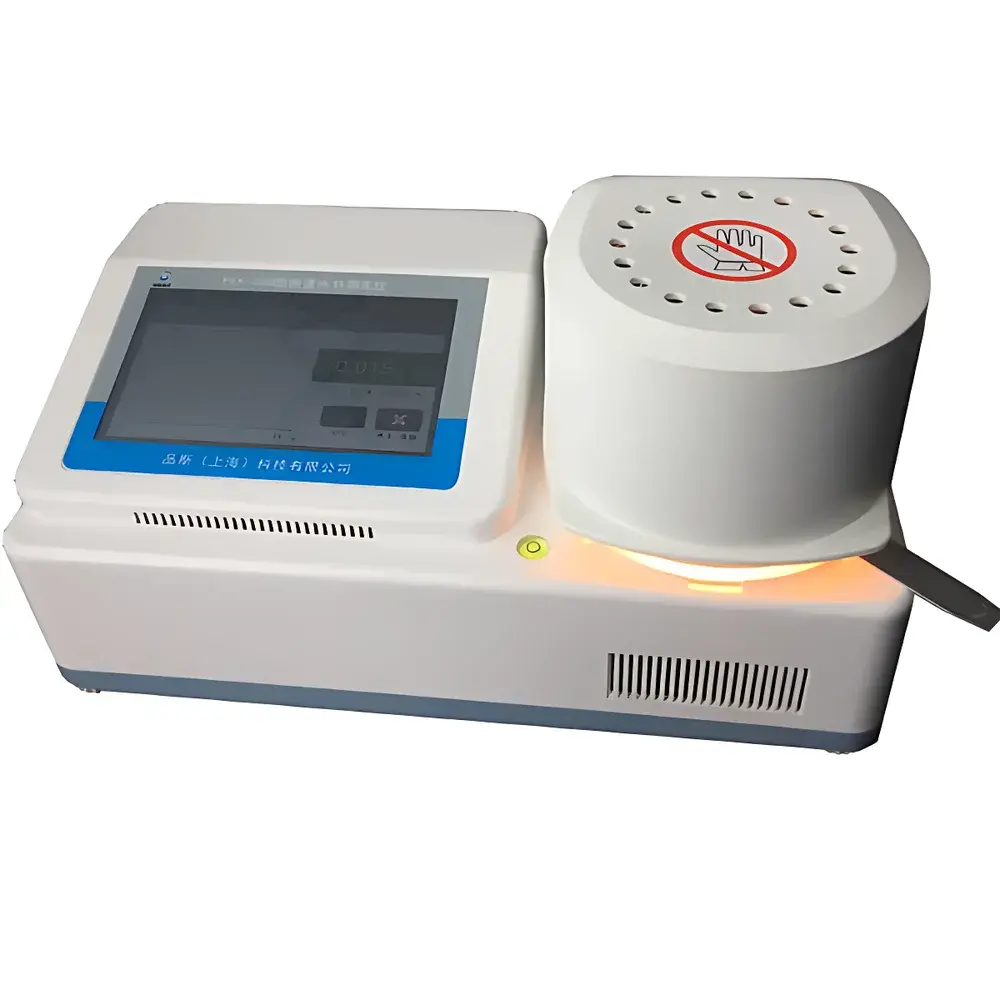
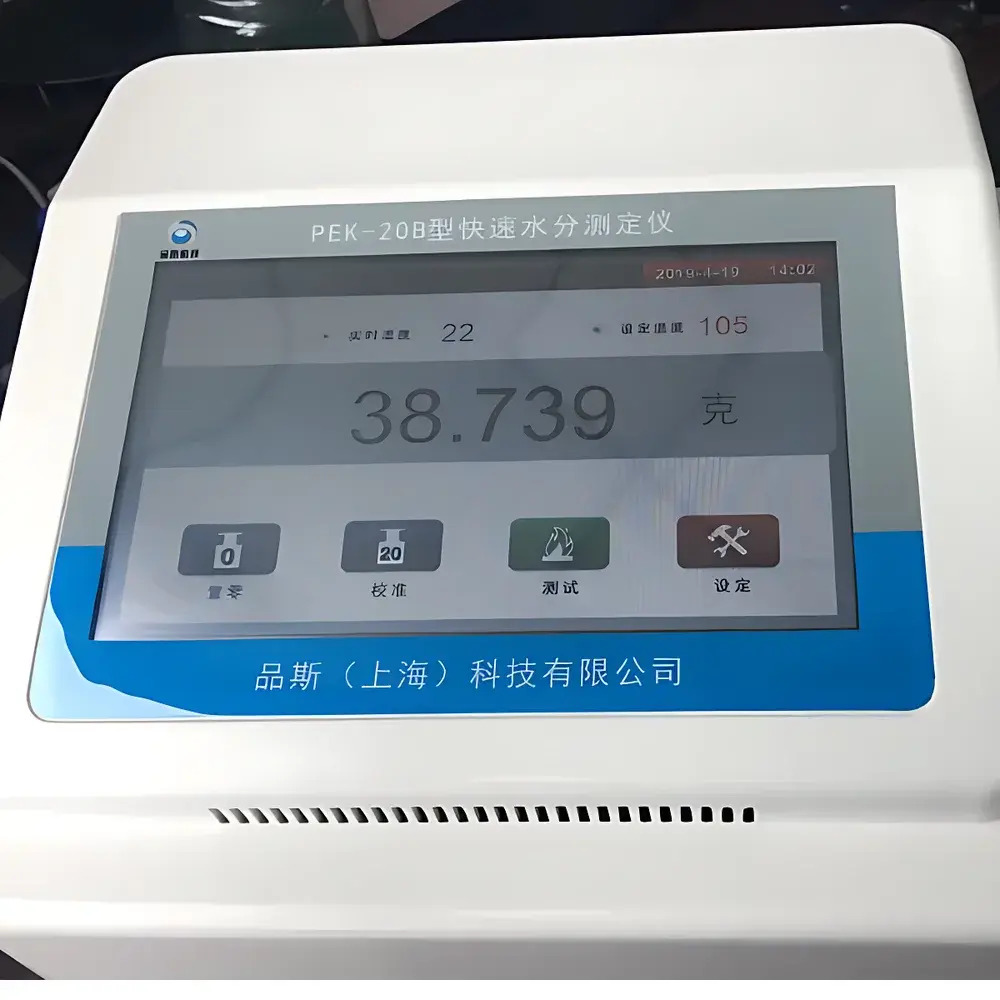
Qingji PEK-20B Halogen Moisture Analyzer
| Brand | Qingji |
|---|---|
| Origin | Shanghai, China |
| Model | PEK-20B |
| Heating Source | Halogen Lamp |
| Maximum Sample Capacity | 200 g |
| Temperature Range | Ambient to 230 °C |
| Moisture Resolution | 0.001 g |
| Temperature Control Accuracy | ±0.01 °C |
| Automatic Endpoint Detection | Mass Change ≤ 0.005 g over Adjustable Time (Default: 40 s) |
| Display | Full-Color Touchscreen Interface |
| Communication | RS232/USB for PC Connectivity |
| Language Options | English / Chinese Switchable |
| Compliance | Designed for GLP-compliant workflows with audit-ready data export (CSV, Excel), timestamped measurement logs, and full traceability of weight loss vs. time and temperature profiles |
Overview
The Qingji PEK-20B Halogen Moisture Analyzer is a precision laboratory instrument engineered for rapid, gravimetric determination of moisture content in solid and semi-solid samples. It operates on the principle of thermogravimetric analysis (TGA): sample mass is continuously monitored during controlled halogen lamp heating, and moisture content (%) is calculated in real time as the percentage loss of initial mass upon complete drying. Unlike conventional oven-drying methods governed by ASTM D4457 or ISO 16298, the PEK-20B achieves thermal equilibrium within seconds due to the high-intensity, uniform irradiance of its halogen heating element—enabling reproducible drying cycles in under 5 minutes for most routine matrices. Its architecture complies with fundamental requirements for analytical balance integration, thermal stability, and environmental isolation—making it suitable for regulated environments where method validation, instrument qualification (IQ/OQ), and data integrity are essential.
Key Features
- Halogen lamp heating system delivering rapid, uniform thermal energy across the sample surface—minimizing thermal gradients and charring risk compared to infrared quartz or convection ovens.
- High-resolution electromagnetic force compensation balance with 0.001 g readability and automatic drift compensation, ensuring consistent mass tracking throughout dynamic drying phases.
- Programmable endpoint detection based on mass change threshold (adjustable from 0.000–0.009 g) and stabilization duration (user-defined, default 40 s), supporting both fixed-time and dynamic drying protocols.
- Full-color capacitive touchscreen interface with dual-language support (English/Chinese), intuitive navigation, and real-time graphical display of three synchronized curves: mass loss (%), sample weight (g), and chamber temperature (°C).
- Integrated temperature control with ±0.01 °C accuracy and auto-compensation across ambient to 230 °C range—critical for method transfer between labs and compliance with USP <921> moisture determination guidelines.
- RS232 and USB interfaces enabling bidirectional communication with Windows-based PCs for automated data capture, remote operation, and electronic record generation per FDA 21 CFR Part 11 requirements (when paired with compliant LIMS or ELN software).
Sample Compatibility & Compliance
The PEK-20B accommodates samples up to 200 g, optimized for particulate, granular, or powdered materials—including pharmaceutical excipients, ground cereals, tea leaves, tobacco lamina, polymer pellets, and dried botanicals. It excludes volatile organic compounds (VOCs), reactive hydrides, or thermally unstable substances that decompose below 230 °C or emit hazardous fumes upon heating. The instrument supports method development aligned with ISO 11875 (moisture in plastics), AOAC 950.46 (food moisture), and EP 2.2.32 (pharmaceutical water content). Its data export functionality (CSV, Excel, PDF reports) includes timestamps, operator ID fields, calibration history references, and full metadata—facilitating audit readiness under GLP and GMP frameworks.
Software & Data Management
PC connectivity enables comprehensive data management via Qingji’s proprietary Moisture Analysis Suite (v3.x), compatible with Windows 10/11. The software captures raw time-series datasets—including instantaneous mass, moisture %, and temperature—at user-configurable intervals (1–10 s). All curves are overlay-capable for comparative analysis across batches or formulations. Reports include statistical summaries (mean, SD, RSD), pass/fail flags against user-defined specification limits, and digital signatures for authorized review. Exported files retain embedded metadata required for 21 CFR Part 11 compliance when used with validated IT infrastructure and access controls.
Applications
This analyzer serves quality control laboratories in pharmaceutical manufacturing (raw material release, blend uniformity, lyophilized product verification), food processing (flour moisture specification, snack crispness control), agricultural commodity trading (grain moisture grading per USDA standards), and polymer production (resin drying validation prior to extrusion). It also supports R&D workflows requiring rapid screening of desiccant efficacy, coating solvent retention, or hygroscopicity profiling under accelerated humidity cycling.
FAQ
What regulatory standards does the PEK-20B support for moisture testing?
It aligns with core principles of USP <921>, EP 2.2.32, ISO 11875, and AOAC 950.46—though final method validation remains the user’s responsibility per ICH Q2(R2).
Can the PEK-20B be integrated into an existing LIMS or ELN platform?
Yes—via ASCII-based RS232 or USB CDC protocols; custom drivers and API documentation are available upon request for validated integrations.
Is calibration traceable to national standards?
Internal calibration uses certified weights (Class M2, NIST-traceable); external verification requires third-party accredited service providers per ISO/IEC 17025.
Does the instrument meet requirements for electronic records and signatures?
Hardware and firmware support ALCOA+ data integrity principles; full 21 CFR Part 11 compliance depends on site-specific procedural controls and software validation.
How is sample heterogeneity addressed during testing?
Users must homogenize representative sub-samples per ISO 6497; the 200 g capacity allows replication across multiple aliquots to assess variability statistically.





