
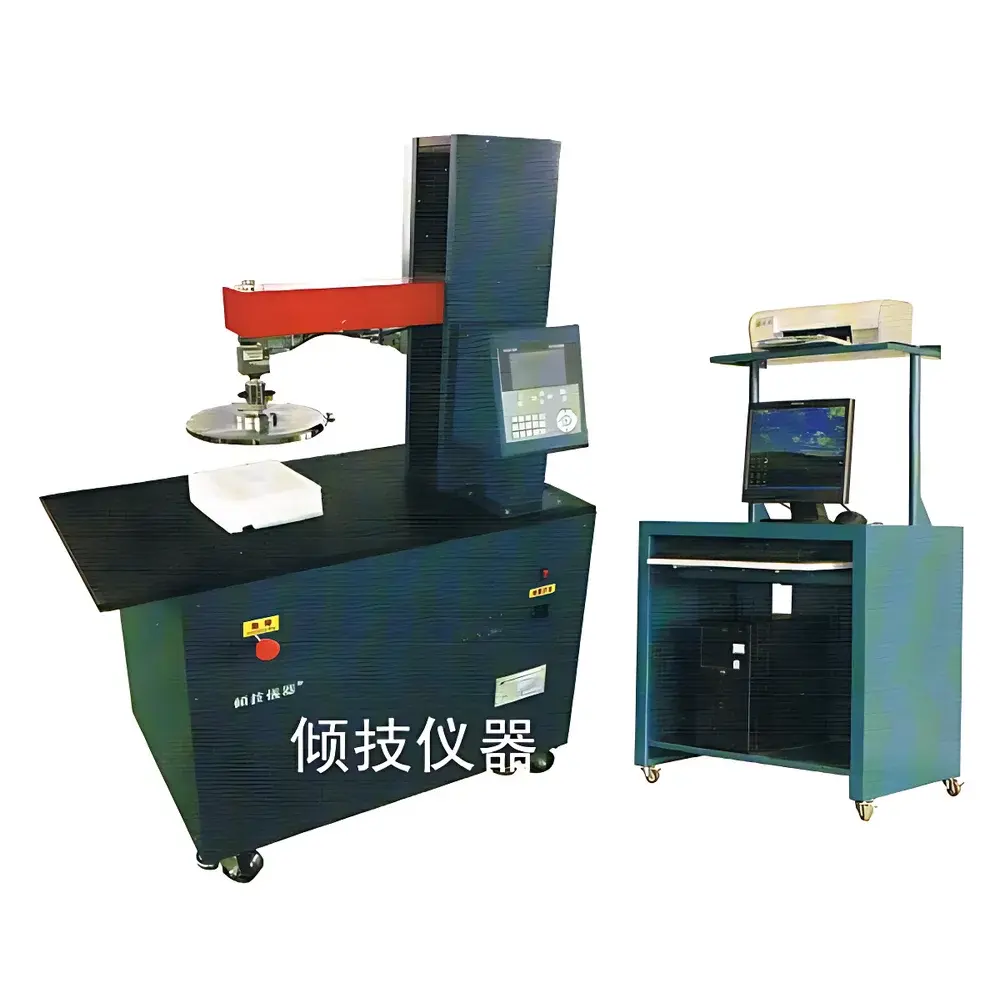
Qingji QJ210K Foam Indentation Load Tester
| Brand | Qingji |
|---|---|
| Origin | Shanghai, China |
| Model | QJ210K |
| Maximum Load Capacity | 2000 N |
| Force Sensor Accuracy | ±0.01% FS |
| Test Accuracy | Class 0.5 |
| Repeatability | ≤0.5% |
| Displacement Accuracy | ≤0.2% |
| Deformation Accuracy | ≤0.2% |
| Test Speed Range | 0.01–300 mm/min |
| Compliance | GB/T 6344–1996, GB/T 10807–2006, GB/T 20467–2006 |
Overview
The Qingji QJ210K Foam Indentation Load Tester is a precision electromechanical compression testing system engineered for standardized mechanical characterization of flexible polymeric foam materials. It operates on the principle of controlled quasi-static indentation under defined boundary conditions—specifically implementing the constant-rate displacement method per ISO 2439 and ASTM D3574 protocols—to quantify indentation load (IL), indentation force deflection (IFD), and progressive compression set behavior. Designed for laboratory- and production-floor environments, the system integrates a high-stiffness dual-column frame, servo-controlled actuation, and a tri-closed-loop control architecture (force, displacement, and strain) to ensure metrological integrity across low-force regimes typical of soft cellular materials. Its modular architecture supports both standalone operation via integrated LCD interface and synchronized PC-based control, enabling traceable, auditable test execution aligned with GLP and GMP documentation requirements.
Key Features
- Tri-closed-loop digital control system ensuring simultaneous regulation of load, displacement, and deformation signals for high reproducibility in low-force (<2000 N) compression events
- High-resolution force transducer with ±0.01% full-scale accuracy and thermal drift compensation, calibrated to national metrological standards
- Adjustable crosshead speed range from 0.01 to 300 mm/min, programmable in 0.01 mm/min increments for precise compliance with IFD-25/40/60 and IL-10/25/40 test sequences
- Integrated 7-inch industrial-grade LCD touchscreen HMI supporting real-time curve display, parameter configuration, and local data storage (up to 1000 test records)
- Rigid dual-column steel frame with preloaded ball screws and anti-backlash gear train to minimize parasitic deflection and maintain axial alignment during indentation
- Compliance with international test standards including ISO 2439 (foam hardness by indentation), ASTM D3574 (flexible cellular materials), and GB/T 10807–2006 (Chinese national standard for indentation hardness of soft foam)
Sample Compatibility & Compliance
The QJ210K accommodates standard foam specimens measuring 380 mm × 380 mm × 50 mm (L × W × H), with optional fixtures for smaller cut samples or cylindrical cores. It supports both single-cycle and multi-cycle indentation protocols—including static hold periods for creep analysis and stepwise loading for stress relaxation profiling. All test routines are structured to meet regulatory expectations for method validation: force and displacement channels are independently validated per ISO/IEC 17025 calibration guidelines; software audit trails record operator ID, timestamp, test parameters, and raw sensor outputs. The system is compatible with FDA 21 CFR Part 11-compliant software modules (optional upgrade), providing electronic signatures, role-based access control, and immutable data archiving for pharmaceutical packaging or medical device foam qualification.
Software & Data Management
The proprietary QingjiTest v4.2 software suite provides comprehensive test sequence definition, real-time visualization of load–displacement curves, and automated calculation of key metrics: indentation load at specified deflections (e.g., IFD-25), residual deformation after unloading, and hysteresis area. Data export conforms to ASTM E1434 and ISO 10360-5 formats—CSV, XML, and PDF reports include metadata such as environmental conditions (temperature/humidity), calibration certificate IDs, and instrument serial numbers. Raw time-series data (1 kHz sampling) is stored in binary format with embedded CRC checksums to prevent corruption. For enterprise integration, OPC UA and Modbus TCP interfaces enable bidirectional communication with LIMS and MES platforms.
Applications
- Quality control of automotive seat foams per SAE J2717 and OEM-specific IFD specifications
- Compression performance evaluation of medical mattress overlays and wound care cushioning materials
- R&D of viscoelastic polyurethane and latex foams for furniture and bedding applications
- Validation of compressive resilience in packaging foams used for electronics and aerospace components
- Regulatory submission support for Class I/II medical devices requiring ISO 10993-10 biocompatibility-related mechanical characterization
- Accelerated aging studies involving cyclic compression to assess long-term structural degradation
FAQ
What standards does the QJ210K directly support out-of-the-box?
GB/T 10807–2006, GB/T 6344–1996, GB/T 20467–2006, ISO 2439, and ASTM D3574 test methods are preloaded in the firmware and software.
Is the system suitable for fatigue testing?
Yes—the controller supports programmable multi-cycle loading with variable dwell times, frequency ranges up to 5 Hz, and automatic failure detection based on load decay thresholds.
Can test data be exported to third-party statistical analysis tools?
All numerical outputs are exportable in CSV and XML formats; curve data is available in ASCII-compatible XY format for direct import into MATLAB, Python (NumPy/Pandas), or Minitab.
Does the system include calibration certification?
Each unit ships with a factory-issued calibration certificate traceable to CNAS-accredited reference standards, valid for 12 months from date of shipment.
What maintenance intervals are recommended?
Preventive maintenance is advised every 12 months or after 10,000 test cycles, including transducer recalibration, lubrication of lead screws, and verification of encoder linearity per ISO 7500-1.



