
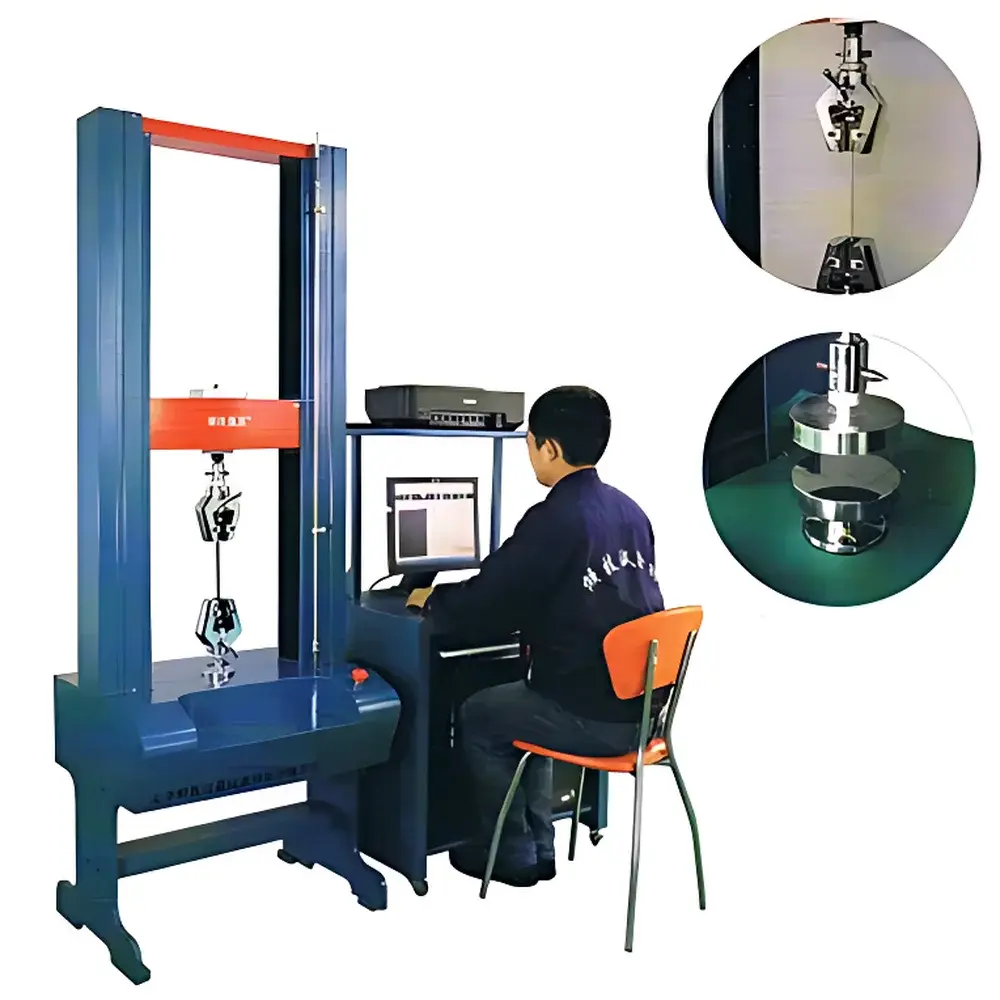
Qingji QJ211 Advanced Tensile Testing Machine
| Brand | Qingji |
|---|---|
| Origin | Shanghai, China |
| Model | QJ211 |
| Max. Test Load | 30 kN |
| Load Range | 0–30 kN |
| Load Accuracy | ±0.5% FS |
| Stroke | 800 mm |
| Displacement Resolution | 0.001 mm |
| Effective Width | 420 mm |
| Speed Range | 0.01–500 mm/min |
| Speed Accuracy | ±0.5% |
| Displacement Accuracy | ±0.5% |
| Deformation Measurement Accuracy | ±0.5% |
| Safety Features | Electronic stroke limit protection, emergency stop button |
| Unit Weight | ~2650 kg |
Overview
The Qingji QJ211 Advanced Tensile Testing Machine is a floor-standing electromechanical universal testing system engineered for high-reproducibility mechanical property evaluation of metallic, polymeric, composite, ceramic, and elastomeric materials. It operates on the principle of controlled uniaxial force application via a precision ball-screw-driven crosshead, with load measurement performed through calibrated S-type or cantilever load cells compliant with ISO 7500-1 Class 0.5. The machine supports static tensile, compression, flexural (3-point & 4-point), peel, tear, shear, and puncture testing in accordance with internationally harmonized test protocols—including ASTM E8/E9/E21/E292, ISO 6892-1, ISO 178, ISO 527-1, JIS Z2241, and DIN 53455. Its rigid dual-column frame and reinforced base provide minimal deflection under full-load conditions, ensuring traceable force transmission and long-term dimensional stability required for GLP-compliant laboratory environments.
Key Features
- High-stiffness dual-column structural architecture with vibration-damped cast-iron base and hardened steel guide columns
- Microprocessor-controlled servo motor drive system delivering precise speed regulation across 0.01–500 mm/min, maintaining ±0.5% speed accuracy throughout the full range
- Integrated digital load cell with 0.5% full-scale accuracy per ISO 7500-1, factory-calibrated and NIST-traceable
- Real-time dynamic display of load, displacement, strain, and time-based curves via embedded 7-inch TFT LCD interface
- Automatic calculation of standard mechanical parameters: ultimate tensile strength (UTS), yield strength (Rp0.2), elongation at break (%), modulus of elasticity, bending strength, and fracture energy
- Dual safety redundancy: programmable electronic stroke limits plus hardware-based emergency stop circuit meeting IEC 60204-1 requirements
- Modular grip interface supporting wedge-action, pneumatic, hydraulic, and custom fixtures (e.g., thread inserts, dog-bone holders, compression platens)
Sample Compatibility & Compliance
The QJ211 accommodates specimens up to 420 mm wide and 800 mm effective travel length, enabling standardized testing of ASTM E8 dog-bone coupons, ISO 527-2 Type 1B bars, and non-standard components such as medical tubing, geotextiles, adhesives, and battery electrode laminates. All firmware and control logic comply with ISO 17025 technical requirements for testing laboratories. Data acquisition meets audit-trail prerequisites for FDA 21 CFR Part 11 when paired with optional PC-based software (Qingji TestSuite v4.x). Mechanical design adheres to CE Machinery Directive 2006/42/EC and conforms to EN ISO 12100 for risk assessment and protective measures.
Software & Data Management
While the QJ211 operates autonomously via its onboard controller, optional Qingji TestSuite software provides extended functionality including multi-curve overlay, statistical batch reporting (mean, SD, CV%), automated report generation in PDF/Excel formats, and raw data export in CSV/ASCII. The software implements role-based user access control, electronic signatures, and immutable audit logs—supporting regulatory readiness for ISO 9001, ISO 13485, and GMP environments. Calibration certificates include uncertainty budgets aligned with ISO/IEC 17025:2017 Annex A.
Applications
- Mechanical validation of aerospace fasteners and composite layups per ASTM D3039/D6641
- Quality control of automotive thermoplastics and rubber compounds (ISO 37, ISO 62)
- R&D characterization of biodegradable films and hydrogels under wet/dry conditions
- Pharmaceutical tablet hardness and capsule shell tensile integrity per USP
- Construction material certification for rebar, grout, and fiber-reinforced cementitious composites
- Electronics manufacturing: bond strength testing of wire bonds, solder joints, and flexible PCB substrates
FAQ
What international standards does the QJ211 support out-of-the-box?
It natively executes test routines aligned with ASTM E8, ISO 6892-1, ISO 178, and JIS Z2241; additional method templates can be loaded via USB or Ethernet.
Is third-party calibration certification available?
Yes—factory calibration includes a NIST-traceable certificate; accredited external calibration services (ISO/IEC 17025) are available upon request.
Can the system be integrated into an existing LIMS or MES environment?
Via optional OPC UA or Modbus TCP gateway module, enabling bidirectional data exchange with laboratory information management systems.
What maintenance intervals are recommended for long-term accuracy retention?
Load cell verification every 12 months; mechanical inspection (lubrication, belt tension, alignment) every 6 months; full system recalibration recommended after 2000 test cycles or major component replacement.
Does the machine support extensometer integration?
Yes—the QJ211 features analog and digital inputs compatible with contact and non-contact extensometers (e.g., video-based DIC systems) for high-fidelity strain measurement per ISO 9513.



