
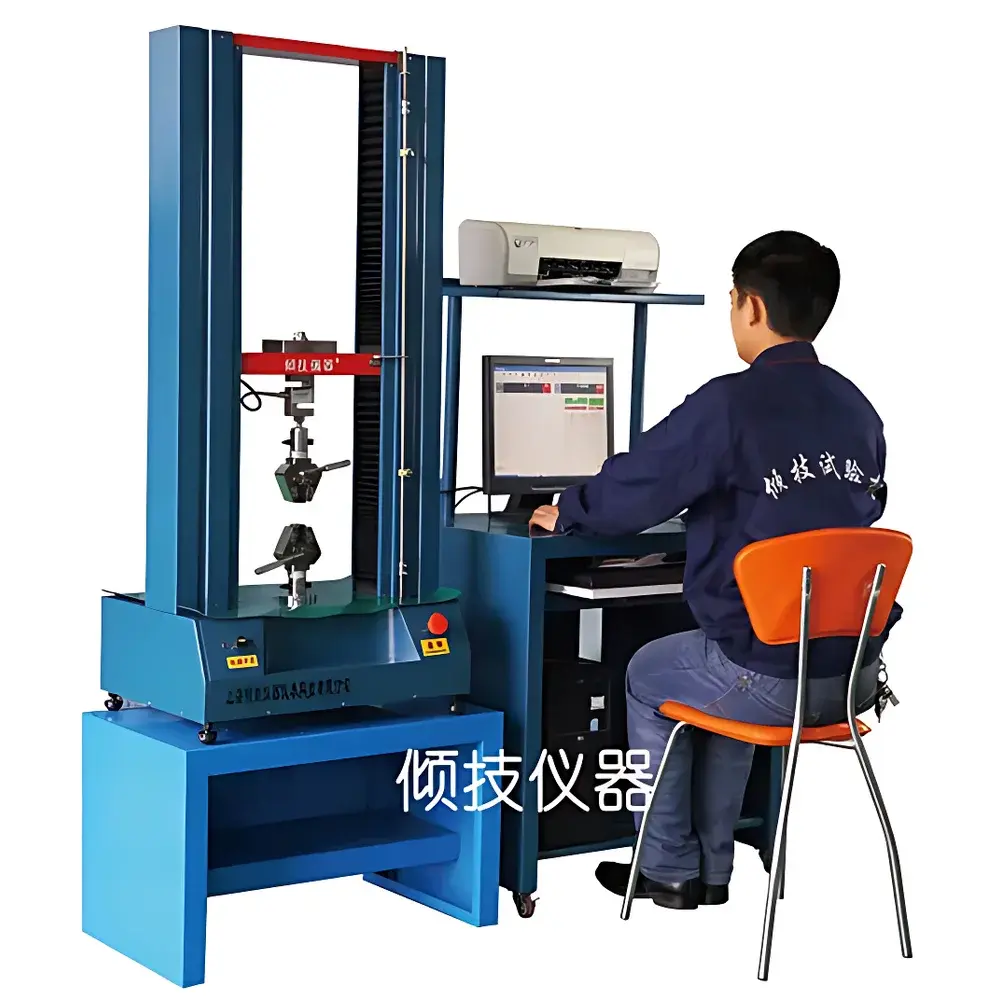
Qingji QJ211S Electronic Universal Testing Machine for Rubber and Elastomer Mechanical Characterization
| Brand | Qingji |
|---|---|
| Origin | Shanghai, China |
| Model | QJ211S |
| Type | Electronic Universal Testing Machine |
| Maximum Load Capacity | 10 kN |
| Load Accuracy Class | 0.5 |
| Effective Test Width | 320 mm |
| Effective Tensile Stroke | 500 mm (optional 800 mm) |
| Test Speed Range | 0.01–300 mm/min |
| Speed Accuracy | ±0.5% of indicated value |
| Load Resolution | 500,000 counts (full-scale, no range switching) |
| Displacement & Strain Measurement Accuracy | ±0.5% of indicated value |
| Force Sensing | High-precision U.S.-sourced load cell |
| Control System | Panasonic full-digital AC servo controller |
| Software Architecture | Full-digital closed-loop control supporting constant stress, constant strain, and constant displacement modes |
| Safety Protection | Electronic limit switches, software-based overload diagnosis (110% F.S.), automatic return post-test |
| Weight | ~145 kg |
| Power Requirement | 2–5 kW |
Overview
The Qingji QJ211S Electronic Universal Testing Machine is an ISO/IEC 17025-aligned static mechanical testing system engineered for precise tensile, tear, puncture, peel, and elongation characterization of elastomeric materials—particularly vulcanized rubber compounds, thermoplastic elastomers (TPE), silicone rubbers, and rubber-to-metal bonded assemblies. Operating on the principle of controlled uniaxial force application via a high-stiffness dual-column frame and precision ball-screw actuation, the system complies with ASTM D412 (rubber tensile properties), ASTM D624 (tear resistance), ASTM D3787 (burst strength), ISO 37, ISO 34-1, and GB/T 528–2009. Its 10 kN load capacity, combined with 0.5-class accuracy per ISO 7500-1 and EN 10002-2, ensures traceable force measurement across the full dynamic range—from low-force elastomer extension (9 kN). The machine’s modular design supports both horizontal and vertical test configurations, enabling seamless integration into QC laboratories operating under GLP or ISO 9001 quality management frameworks.
Key Features
- High-fidelity load measurement using a calibrated U.S.-manufactured load cell with 500,000-count resolution, eliminating range-switching artifacts and ensuring consistent sensitivity from 0.02% to 100% of full scale.
- Panasonic full-digital AC servo motor and drive system delivering stable, low-noise motion control across the full speed range (0.01–300 mm/min), with speed accuracy maintained within ±0.5% of setpoint per ISO 5893.
- Rigid dual-column steel frame with preloaded ball screws and anti-backlash nuts, minimizing frame deflection and ensuring axial alignment repeatability ≤0.02 mm over 500 mm stroke.
- Integrated safety architecture: real-time software diagnostics, programmable electronic travel limits, hardware-based overload cutoff at 110% F.S., and dual-mode return (manual rapid or automated post-test).
- Modular fixture interface compliant with ISO 26203-1 mounting standards, supporting standardized grips (pneumatic, wedge, roller), custom tooling for dumbbell, ring, and trouser specimens, and optional environmental chamber adapters.
Sample Compatibility & Compliance
The QJ211S accommodates standardized test specimens per ASTM D412 Type A/C, ISO 37 Type 1/2, and GB/T 528 dumbbell geometries (width: 6 mm, thickness: 2 mm), as well as non-standard geometries including O-rings, extruded profiles, and molded gaskets. It supports multi-step protocols required for stress relaxation, creep compliance (per ISO 899-1), and cyclic loading (hysteresis loop analysis). All force, displacement, and time data are timestamped and logged in accordance with FDA 21 CFR Part 11 requirements when paired with validated software and audit-trail-enabled user accounts. Calibration certificates conform to ISO/IEC 17025 and include uncertainty budgets traceable to NIM (China National Institute of Metrology).
Software & Data Management
The proprietary closed-loop test control software provides real-time visualization of stress–strain curves, modulus calculation (100%, 200%, 300% modulus per ASTM D412), elongation at break, tear strength (kN/m), and permanent set. Raw data export is supported in CSV, Excel (.xlsx), and universal .tdms formats for third-party statistical analysis (e.g., JMP, Minitab). The system maintains full audit trails—including operator ID, calibration history, method version, and parameter change logs—enabling full compliance with GLP, GMP, and ISO 17025 documentation requirements. Optional integration with LIMS platforms via OPC UA or RESTful API is available upon request.
Applications
- Quality control of raw compound batches: tensile strength, elongation, and hardness correlation studies.
- Development of high-performance elastomers for automotive seals, vibration isolators, and aerospace O-rings.
- Adhesion testing of rubber-to-substrate bonds (e.g., rubber-to-steel, rubber-to-fabric) per ASTM D429.
- Mechanical validation of recycled rubber content in sustainable tire treads and conveyor belts.
- Creep and stress relaxation behavior assessment for medical-grade silicone tubing under physiological loading conditions.
FAQ
What international standards does the QJ211S support out-of-the-box?
ASTM D412, D624, D3787, ISO 37, ISO 34-1, ISO 899-1, GB/T 528–2009, and EN 15306 for rubber and polymer mechanical testing.
Is the system compatible with environmental chambers?
Yes—the machine features standardized mounting interfaces and signal pass-through ports for integration with temperature/humidity chambers (-70°C to +250°C) and dynamic mechanical thermal analysis (DMTA) accessories.
Can test methods be password-protected and version-controlled?
Yes—software supports role-based access control, method locking, digital signatures, and revision history tracking aligned with 21 CFR Part 11 Annex 11 requirements.
What is included in the standard warranty and service coverage?
A 12-month comprehensive parts-and-labor warranty, lifetime technical support, remote diagnostics, and annual calibration verification services (traceable to national metrology institutes).
Are custom fixtures supplied with validation documentation?
Custom grips and holders are provided with dimensional inspection reports and grip force uniformity test records; full IQ/OQ documentation packages are available upon request.



