
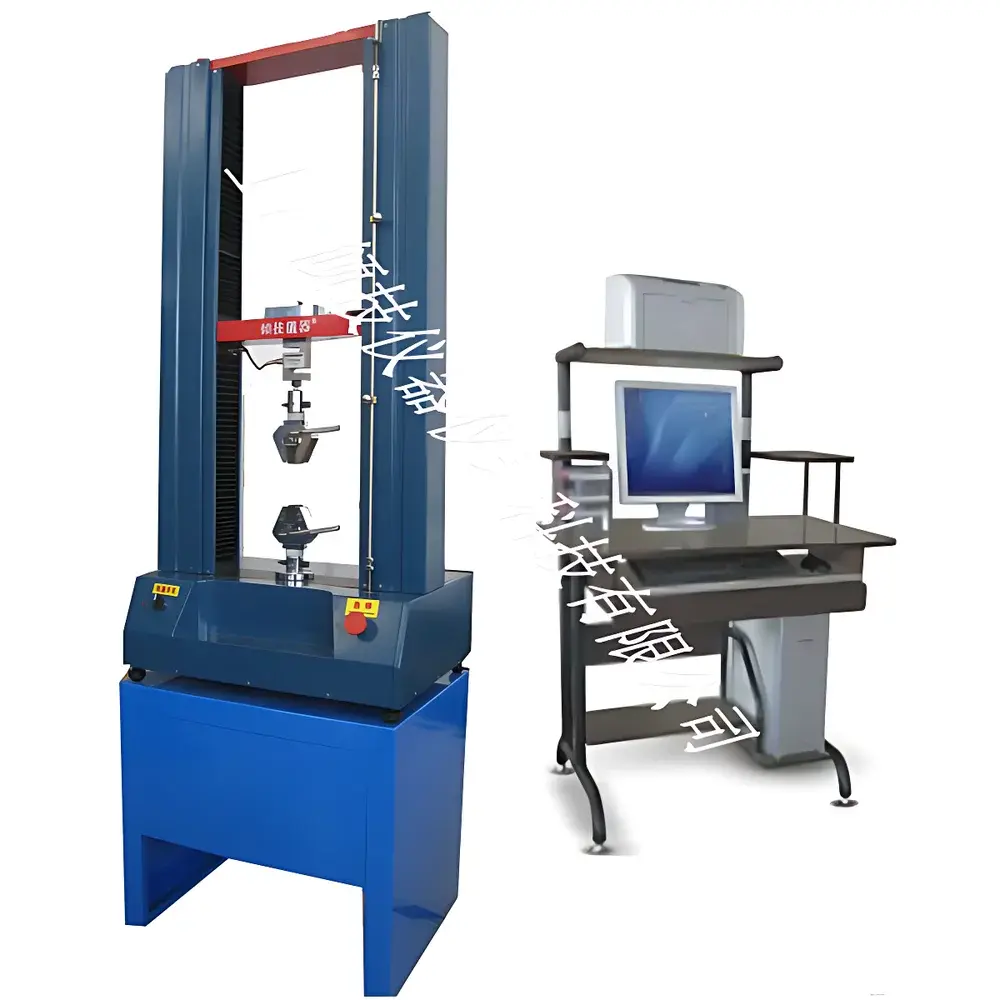
Qingji QJ211S2 Universal Testing Machine for Wood and Structural Materials
| Origin | Shanghai, China |
|---|---|
| Manufacturer Type | Authorized Distributor |
| Origin Category | Domestic (PRC) |
| Model | QJ211S2 |
| Price | USD 3,950 (FOB Shanghai) |
| Max Load Capacity | 10 kN |
| Accuracy Class | 0.5 |
| Effective Test Width | 320 mm |
| Vertical Test Space | 500 mm |
| Speed Range | 0.01–500 mm/min (standard configuration: 300 mm/min) |
| Speed Accuracy | ±0.5% of indicated value |
| Displacement Measurement Accuracy | ≤0.2% of reading |
| Strain/Deformation Measurement Accuracy | ≤0.2% of reading |
| Force Resolution | 500,000 counts (full-scale, single-range, no auto-ranging) |
| Load Cell Calibration Compliance | ISO 7500-1 Class 0.5 |
| Safety Features | Electronic travel limit protection, overload shutdown (>110% FS), manual/auto return, dual-speed crosshead control |
| Power Supply | 220 V AC, 50 Hz |
| Motor Output | 400 W |
| Net Weight | 145 kg |
Overview
The Qingji QJ211S2 Universal Testing Machine is a precision-engineered electromechanical system designed for static mechanical characterization of wood, engineered timber products (e.g., LVL, glulam, CLT), bamboo composites, and related structural biomaterials — as well as metals, polymers, and fasteners used in timber construction systems. It operates on the principle of controlled displacement or load-controlled actuation via a servo-motor-driven ball-screw crosshead, enabling standardized quasi-static tensile, compression, flexural, shear, and peel testing per ASTM D143, ISO 3133, EN 338, ASTM D1037, and GB/T 1936–2009. The machine integrates a high-stiffness dual-column frame with a rigid loading train, ensuring minimal deflection under load and high reproducibility across repeated tests. Its modular grip interface supports interchangeable fixtures—including wedge-action tensile grips, four-point bending assemblies, double-shear test jigs, and custom-designed wood-specific clamping systems—enabling compliance with both international standards and application-specific protocols for structural timber evaluation.
Key Features
- Class 0.5 force measurement accuracy per ISO 7500-1, validated with traceable dead-weight calibration kits
- Full-scale force resolution of 500,000 digital counts without range switching, eliminating step errors during low-load or high-sensitivity measurements (e.g., early-stage wood fiber deformation)
- Adjustable crosshead speed from 0.01 to 500 mm/min, programmable in 0.01 mm/min increments; standard factory configuration set at 300 mm/min for routine ASTM D143 tension tests
- Dual-mode operation: closed-loop load control (for creep or stress-relaxation studies) and closed-loop displacement control (for modulus determination and failure envelope mapping)
- Integrated electronic travel limits and hardware-based overload cutoff (>110% of 10 kN full scale), independent of software logic, for fail-safe operation
- Motorized crosshead with selectable fast/slow modes and jog functionality for precise specimen alignment prior to test initiation
- Robust cast-iron base and reinforced steel columns ensure long-term dimensional stability under cyclic loading conditions typical in quality assurance labs
Sample Compatibility & Compliance
The QJ211S2 accommodates specimens up to 320 mm wide and 500 mm tall, supporting standard-sized wood specimens per ASTM D143 (e.g., 20 × 20 × 300 mm clear wood samples) and EN 408 (bending specimens up to 150 × 150 × 1200 mm when used with auxiliary support fixtures). Its open-frame architecture allows direct integration with environmental chambers (optional) for humidity- and temperature-controlled testing per ISO 22087. All firmware and controller firmware comply with IEC 61508 SIL1 for functional safety in industrial lab environments. Data acquisition meets GLP audit requirements, with timestamped raw channel logging (load, displacement, extensometer input) stored in vendor-neutral CSV format. System validation documentation includes IQ/OQ templates aligned with ISO/IEC 17025 laboratory accreditation criteria.
Software & Data Management
The machine is supplied with Qingji TestMaster v4.2 — a Windows-based control and analysis suite supporting multi-channel synchronous acquisition at 100 Hz sampling rate. Software features include real-time curve overlay (force vs. displacement, stress vs. strain), automatic yield point detection per ASTM E8/E8M, secant modulus calculation, and fracture energy integration. Reports are exportable in PDF, Excel, and XML formats, with embedded digital signatures and full audit trail (user login, parameter changes, calibration events) compliant with FDA 21 CFR Part 11 Annex 11 requirements. Raw data files retain native 24-bit ADC resolution and are compatible with third-party post-processing tools including MATLAB, Python (via Pandas), and Minitab for statistical process control in timber product certification workflows.
Applications
- Tensile strength and modulus of elasticity (MOE) determination in solid-sawn lumber and cross-laminated timber (CLT) lamellas
- Compression parallel-to-grain testing per ISO 3347 for structural grade verification
- Four-point bending evaluation of bending strength (MOR) and modulus of rupture in glued laminated timber (glulam)
- Shear strength assessment of adhesive bonds in finger-jointed wood and plywood core layers
- Fastener withdrawal and embedment resistance testing for timber connectors (per ASTM D1761)
- Quality control screening of bamboo scrimber and hempcrete composites during pilot-scale manufacturing
FAQ
Does the QJ211S2 meet ISO/IEC 17025 requirements for accredited testing laboratories?
Yes — the system includes documented metrological traceability to NIM (National Institute of Metrology, China), factory calibration certificates per ISO/IEC 17025 Clause 6.4, and software validation packages supporting laboratory accreditation audits.
Can the machine be integrated into an existing LIMS or MES environment?
Yes — TestMaster supports OPC UA and TCP/IP socket communication protocols, enabling bidirectional data exchange with common laboratory information management systems (e.g., LabWare, STARLIMS) and enterprise resource planning platforms.
Is third-party calibration support available outside mainland China?
Yes — Qingji maintains authorized service partners in Germany, Singapore, and Canada offering on-site recalibration, uncertainty budgeting, and ISO 17025-compliant certificate issuance.
What is the recommended maintenance schedule for long-term reliability?
We recommend biannual lubrication of the ball screw assembly, quarterly verification of load cell linearity using certified reference loads, and annual full-system performance verification including displacement encoder drift check and crosshead alignment assessment.



