
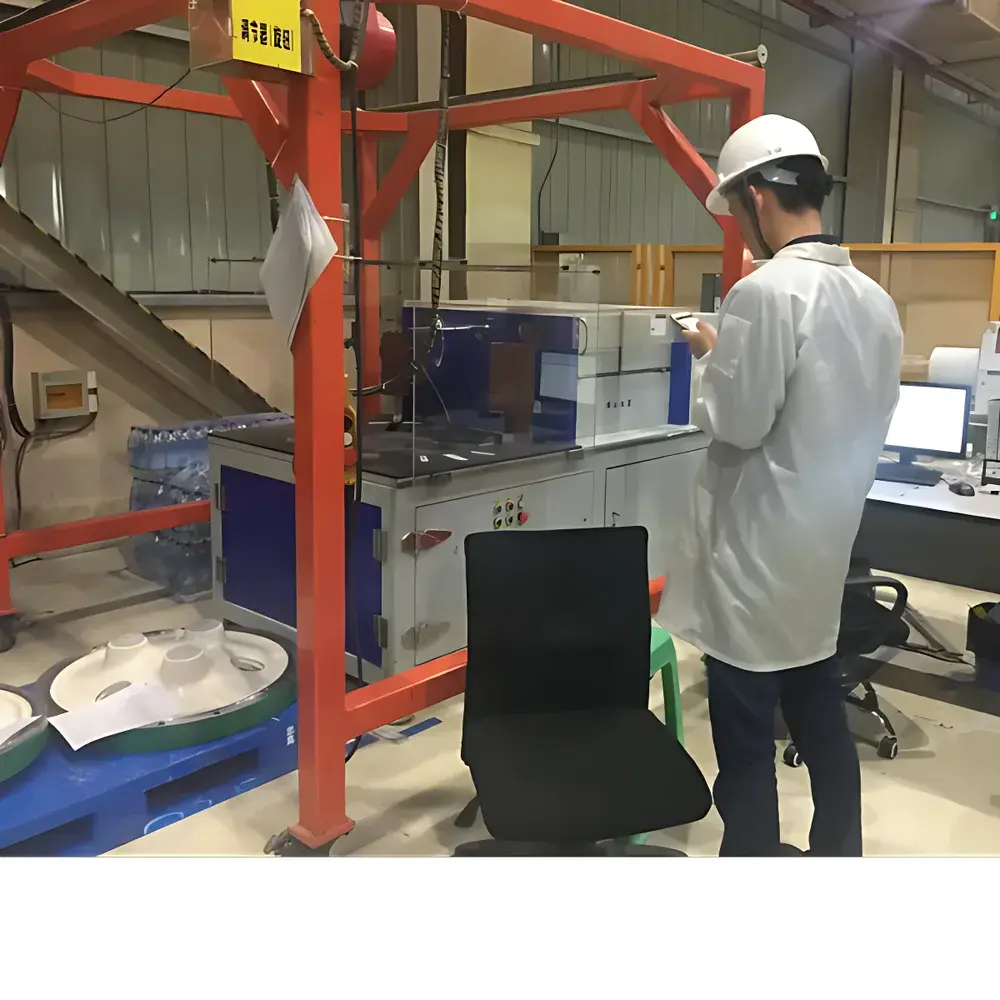
Qingji QJ211WS-50KN Microcomputer-Controlled Insulator Bending Test Machine
| Brand | Qingji |
|---|---|
| Origin | Shanghai, China |
| Model | QJ211WS-50KN |
| Maximum Load Capacity | 50 kN |
| Accuracy Class | 0.5 |
| Effective Force Measurement Range | 0.2–100% FS |
| Force Resolution | 500,000 counts (full-scale, unsegmented) |
| Bending Moment Capacity | ≥10,000 N·m |
| Horizontal Load Capacity | ≥40,000 N |
| Lifting Capacity | ≥100 kg |
| Horizontal Travel (4-directional) | ≥1.5 m |
| Vertical Travel | ≥1.6 m |
| Loading Stroke | ≥400 mm |
| Software Platform | Windows-based real-time data acquisition and curve analysis |
Overview
The Qingji QJ211WS-50KN Microcomputer-Controlled Insulator Bending Test Machine is a purpose-built electromechanical testing system engineered for the static mechanical evaluation of high-voltage insulators—particularly epoxy-resin composite insulators, porcelain suspension units, and GIS enclosure support insulators—under controlled bending load conditions. It operates on the principle of quasi-static three-point or four-point bending, applying precisely regulated transverse force via a servo-controlled actuator while simultaneously measuring load, displacement, and strain response in real time. Designed to meet the structural integrity verification requirements specified in IEC 60383-1, GB/T 775.3, DL/T 864, and ANSI C29.1, this system delivers traceable, repeatable mechanical performance data essential for type testing, routine quality control, and failure mode analysis in power transmission infrastructure manufacturing and grid maintenance laboratories.
Key Features
- High-stiffness dual-column frame with reinforced base plate and adjustable support fixtures optimized for insulator geometry (e.g., cylindrical, hollow-core, flanged-end configurations)
- 50 kN capacity electro-hydraulic or electromechanical actuation system with closed-loop PID control and ≤0.5% indication error across full range (per ISO 7500-1 Class 0.5)
- Integrated moment-resisting fixture assembly capable of sustaining ≥10,000 N·m bending moment and ≥40,000 N lateral reaction forces without frame deformation or slippage
- Motorized 4-axis positioning stage enabling precise alignment of test specimens: ±1.5 m horizontal travel (X/Y), ±1.6 m vertical lift (Z), and rotational adjustment (θ) for angular loading simulation
- Force transducer with 500,000-count resolution, no internal range switching, and temperature-compensated output ensuring consistent sensitivity from 0.2% to 100% of full scale (FS)
- Real-time synchronized acquisition of load, crosshead displacement, and optional extensometer/strain gauge signals at up to 1 kHz sampling rate
Sample Compatibility & Compliance
The QJ211WS-50KN accommodates insulator specimens ranging from 300 mm to 3,000 mm in length and up to 400 mm in diameter. Standard test configurations include cantilever bending (for post-type insulators), center-loaded three-point bending (for line post and station post units), and eccentrically loaded four-point bending (for stress distribution mapping). All mechanical calibrations are traceable to national metrology institutes (e.g., NIM China), and system validation conforms to ISO 17025 requirements for testing laboratories. The machine supports compliance documentation generation for audits under GB/T 19001 (ISO 9001), DL/T 573 (Power Grid Equipment Quality Supervision), and IEC 61400-23 (wind turbine insulator certification).
Software & Data Management
The embedded Windows-based control software provides ISO/IEC 17025-compliant data handling: automatic calibration certificate logging, electronic signature support, audit trail recording (per FDA 21 CFR Part 11 principles), and GLP/GMP-aligned report templates. Users may perform dynamic curve overlay, differential strain analysis, yield point detection via tangent modulus method, and fracture energy integration (area under load-deflection curve). Export formats include CSV, XML, PDF (with embedded digital signatures), and ASTM E122-22 compliant summary reports. Raw data files are stored with metadata tags including operator ID, environmental conditions (optional sensor input), and calibration validity dates.
Applications
- Type approval testing of composite polymer insulators per IEC 61109 and GB/T 19519
- Routine mechanical strength verification of porcelain and glass insulators during batch release (DL/T 620)
- Root cause analysis of insulator fractures observed in service—correlating bending stiffness degradation with aging, moisture ingress, or partial discharge damage
- Development validation of new insulator geometries, core materials (e.g., FRP rods), and housing formulations under combined mechanical–electrical stress protocols
- Research-grade characterization of creep behavior under sustained bending loads (up to 1,000 hours) with automated hold-step sequencing
FAQ
What standards does this system comply with for insulator bending tests?
It supports test execution and reporting aligned with IEC 60383-1, GB/T 775.3, DL/T 864, ANSI C29.1, and ISO 7500-1 Class 0.5 force measurement accuracy requirements.
Can the system accommodate non-standard insulator mounting configurations?
Yes—the modular fixture interface allows custom adapter plates, articulated support arms, and auxiliary clamping mechanisms for irregular geometries or field-sampled specimens.
Is third-party calibration and certification available?
Qingji provides factory calibration certificates traceable to NIM; accredited third-party calibration (e.g., CNAS-certified labs) can be arranged upon request with documented uncertainty budgets.
Does the software support multi-user role-based access control?
Yes—administrator, technician, and reviewer roles are configurable with password protection, session timeout, and operation-level audit logging.
What is the typical lead time for installation and on-site validation?
Standard delivery includes pre-shipped mechanical commissioning kits; on-site IQ/OQ validation with witness testing typically completes within 5 working days after equipment arrival.



