
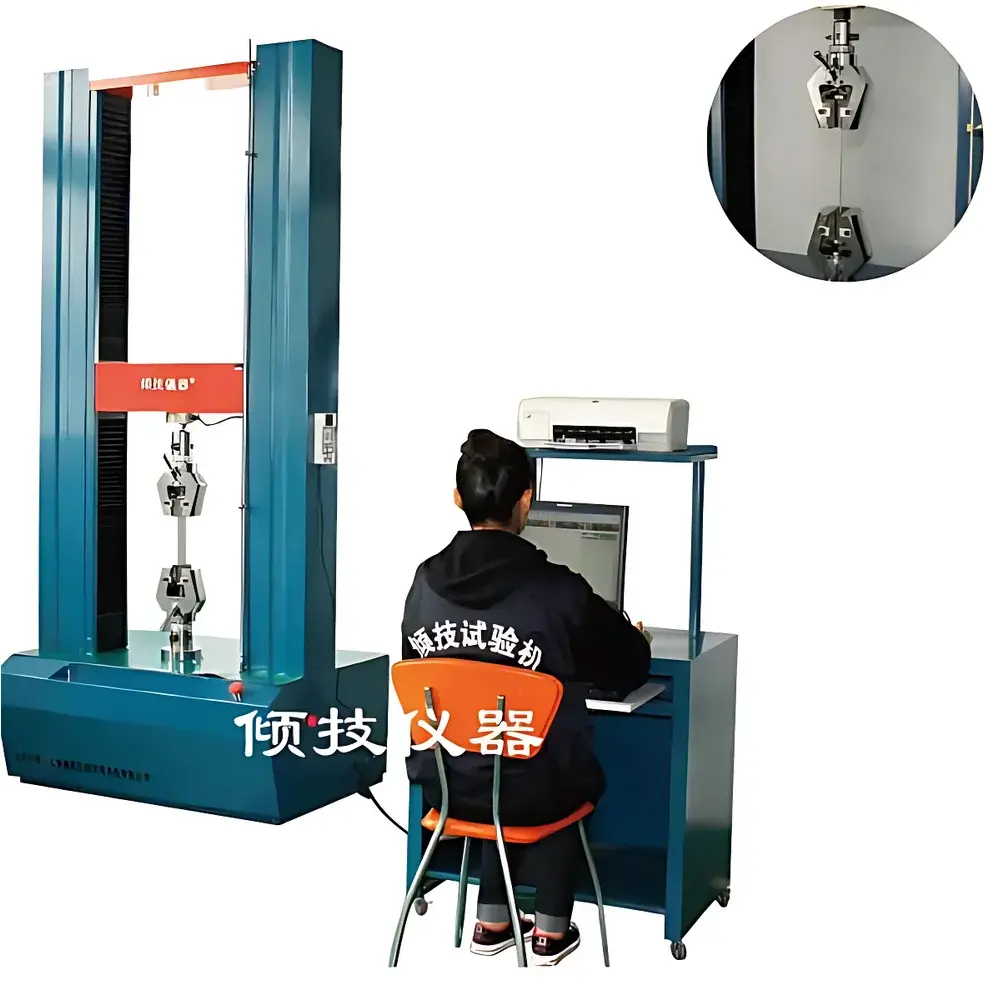
Qingji QJ212 Universal Tensile Testing Machine
| Brand | Qingji |
|---|---|
| Origin | Shanghai, China |
| Model | QJ212 |
| Type | Electromechanical Universal Testing Machine |
| Max Load Capacity | 10–500 kN (configurable) |
| Load Resolution | ±1/250,000 full scale |
| Effective Test Width | 500 mm |
| Effective Stroke | 600 or 800 mm |
| Test Speed Range | 0.001–1000 mm/min |
| Speed Accuracy | ±1% of indicated value |
| Displacement Accuracy | ±0.5% of indicated value |
| Strain Measurement Accuracy | ±0.5% of indicated value |
| Safety Protection | Electronic limit switches, overload protection (110% F.S.), emergency stop |
| Power Supply | 1.5 kW |
| Dimensions (W×D×H) | 960 × 650 × 2000 mm |
| Weight | 1200 kg |
| Compliance | ISO 6892-1, ASTM E4, ASTM E8, ASTM D638, ISO 527, DIN 53455, JIS Z2241 |
Overview
The Qingji QJ212 Universal Tensile Testing Machine is an electromechanical static testing system engineered for precision mechanical property characterization of metallic, polymeric, composite, and elastomeric materials under uniaxial loading conditions. Based on servo-controlled ball-screw actuation and high-stability load cell feedback, the system implements closed-loop force, displacement, and strain control in accordance with fundamental principles of Hooke’s law and stress–strain continuum mechanics. Designed to meet the functional requirements of ISO 6892-1 (metallic materials – tensile testing), ASTM E8/E4 (tension tests of metallic materials and verification of testing machines), and ASTM D638 (tensile properties of plastics), the QJ212 supports standardized test protocols across R&D laboratories, quality control departments, and third-party certification facilities. Its Windows-based control interface enables real-time acquisition and visualization of load–displacement, stress–strain, and cyclic fatigue curves, facilitating immediate interpretation of yield strength, ultimate tensile strength, elongation at break, modulus of elasticity, and Poisson’s ratio.
Key Features
- Configurable load capacity ranging from 10 kN to 500 kN, allowing adaptation to diverse material classes—from thin films and biomedical sutures to structural steel specimens.
- High-fidelity load measurement with ±1/250,000 full-scale resolution and consistent linearity across the entire force range—no auto-ranging or calibration step changes required.
- Precision crosshead movement driven by a low-backlash ball-screw assembly and AC servo motor, delivering smooth, repeatable motion from 0.001 mm/min (creep-sensitive testing) to 1000 mm/min (high-speed rupture analysis).
- Dual-mode crosshead positioning: manual jog control for rapid specimen alignment and programmable automatic return to home position post-test.
- Integrated electronic limit switches and hardware-based overload cutoff (triggered at 110% of selected full-scale load) ensure operator safety and load cell integrity.
- Robust cast-iron frame with reinforced column structure provides torsional rigidity and minimizes deflection-induced measurement error during high-load compression or bending tests.
- Modular extensometer interface supporting clip-on, video, or non-contact strain measurement accessories for ASTM E83-compliant strain data acquisition.
Sample Compatibility & Compliance
The QJ212 accommodates standard tensile specimens per ISO 6892-1 (Type 2, 5, or 8), ASTM E8 (flat or round bars), ASTM D638 (Type I–V plastics), and ISO 527 (polymer strips). Grip options include wedge-action pneumatic, hydraulic, or mechanical vise systems rated for respective load classes. Compression platens (up to 300 mm diameter), three-point/four-point bending fixtures, peel test jigs, and shear adapters are available as optional accessories. All test methods and reporting outputs comply with GLP documentation standards. Data audit trails—including user ID, timestamp, parameter settings, raw channel values, and curve metadata—are retained for FDA 21 CFR Part 11–aligned environments when paired with validated software configurations.
Software & Data Management
Control and analysis are executed via Qingji’s proprietary Windows-native software platform, compatible with Windows 10/11 (64-bit). The application supports multi-curve overlay, dynamic scaling, point-and-click event marking (yield point, necking onset), derivative-based modulus calculation, and automated report generation in PDF or Excel format. Raw data exports include CSV files with synchronized time-stamped channels: load (N), displacement (mm), extension (mm), calculated stress (MPa), and strain (%). All modifications to test parameters or post-acquisition curve edits are logged with user attribution and timestamp. Software validation documentation, IQ/OQ protocols, and electronic signature modules are available upon request for regulated industries.
Applications
- Mechanical validation of aerospace aluminum alloys and titanium sheet stock per AMS and NADCAP requirements.
- Quality assurance of medical device polymers (e.g., PEEK, UHMWPE) per ISO 5833 and ASTM F2026.
- Tensile and peel strength evaluation of pressure-sensitive adhesives and laminated packaging per FINAT and ASTM D3330.
- Compression testing of concrete cores, foam cushions, and battery electrode coatings.
- Low-cycle fatigue profiling of elastomeric seals and O-rings under controlled strain amplitude.
- Educational use in materials science curricula for hands-on stress–strain curve derivation and failure mode analysis.
FAQ
What international standards does the QJ212 support out of the box?
The system includes preloaded test templates for ISO 6892-1, ASTM E8, ASTM D638, ISO 527, and JIS Z2241, with configurable pass/fail criteria and reporting fields aligned to each standard’s annexes.
Can the QJ212 be integrated into an existing LIMS or MES environment?
Yes—via TCP/IP or RS232 communication protocols, the controller supports ASCII-based command sets for remote start/stop, parameter upload, and result retrieval; custom API integration is supported through DLL libraries provided under NDA.
Is third-party calibration certification available?
Qingji partners with ISO/IEC 17025-accredited calibration laboratories to provide traceable force (Class 1 per ISO 376) and displacement (Class 0.5 per ISO 9513) certificates, valid for 12 months.
What maintenance is required during the first year of operation?
No scheduled maintenance is required; however, biannual visual inspection of grip surfaces, lubrication of ball screws (with ISO VG 68 oil), and verification of emergency stop functionality are recommended per the operator manual.



