
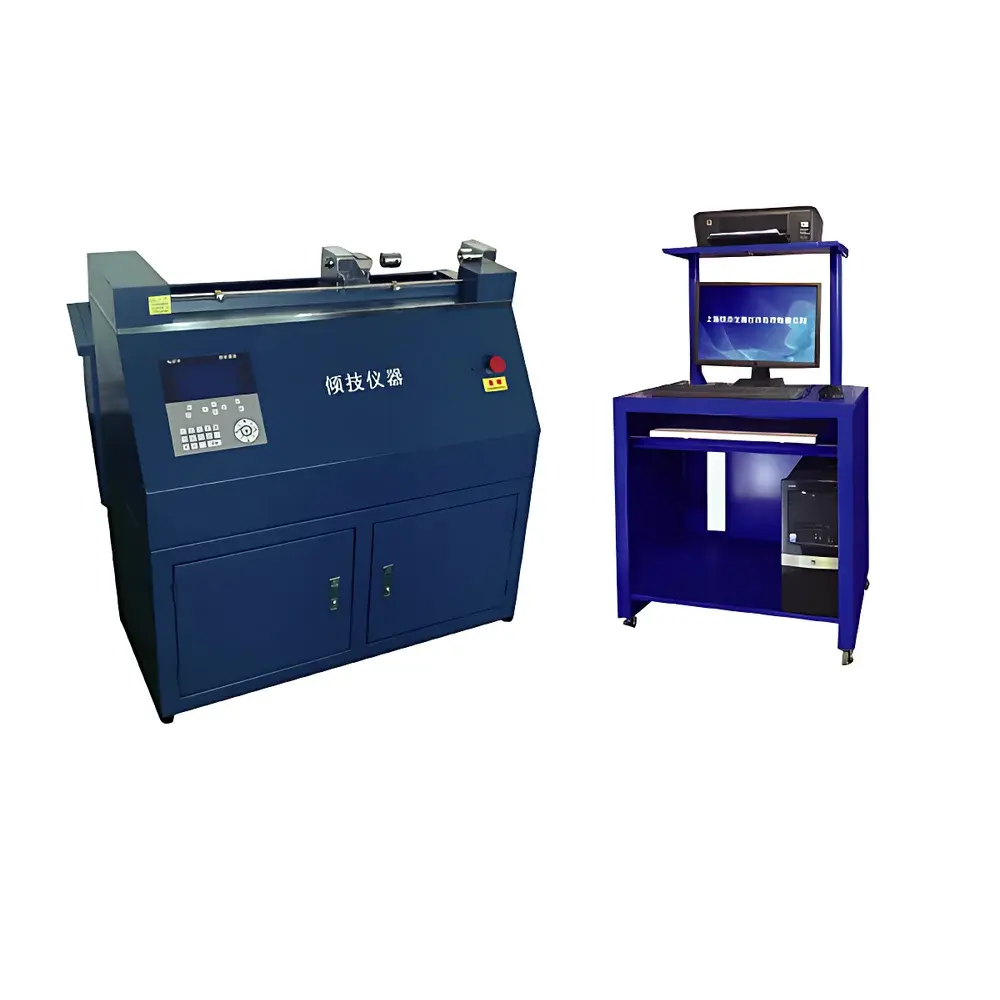
Qingji QJ310 Horizontal Wire Harness Terminal Tensile Tester
| Brand | Qingji |
|---|---|
| Origin | Shanghai, China |
| Model | QJ310 |
| Instrument Type | Electronic Tensile Testing Machine |
| Maximum Test Load | 5 kN |
| Load Range | 0–5000 N |
| Load Accuracy | ±0.5% of full scale |
| Test Stroke | 500 mm |
| Displacement Resolution | 0.001 mm |
| Load Cell Accuracy | 0.01% |
| Speed Range | 0.001–300 mm/min |
| Test Space (Min.) | 200 mm |
| Power Supply | AC 220 V, 50/60 Hz |
| Dimensions (W×D×H) | 600 × 300 × 300 mm |
| Weight | ~85 kg |
Overview
The Qingji QJ310 Horizontal Wire Harness Terminal Tensile Tester is an engineered solution for quantitative mechanical evaluation of crimped wire harness terminals, electrical connectors, plugs, sockets, adhesive bonds, lamp holders, and miniature electronic assemblies. Designed specifically for horizontal-axis tensile detachment and peel testing, this system adheres to fundamental principles of uniaxial force application under controlled displacement—enabling precise measurement of pull-out force, crimp retention strength, interfacial adhesion, and structural integrity at the terminal-to-wire interface. Its rigid horizontal configuration minimizes gravitational influence on specimen alignment and eliminates vertical load-path eccentricity, thereby improving repeatability in low-force, high-precision applications typical of automotive, aerospace, and consumer electronics manufacturing QA/QC labs.
Key Features
- Horizontal load frame architecture optimized for wire harness terminal pull tests—reducing bending moments and ensuring axial force transmission
- High-precision ball screw drive system with backlash-free motion control and smooth velocity regulation across the full speed range (0.001–300 mm/min)
- Integrated high-resolution LCD controller with real-time dynamic display of load (N), displacement (mm), and stress–strain curves
- Calibrated load cell with 0.01% internal resolution and verified accuracy of ±0.5% FS per ASTM E4 and ISO 7500-1 Class 0.5 requirements
- Displacement encoder delivering 0.001 mm resolution, traceable to national metrological standards
- Robust powder-coated steel frame with CNC-machined mounting surfaces and modular fixture interface for rapid setup of DIN 46228, USCAR-21, and JASO D001-compliant test fixtures
- Standard RS-232 and USB interfaces for bidirectional communication with Windows-based control software
Sample Compatibility & Compliance
The QJ310 accommodates a broad spectrum of small-form-factor specimens including insulated and non-insulated crimped terminals (e.g., FAKRA, USCAR, TYCO-style), PCB-mounted connectors, soldered joints, heat-shrink splices, and pressure-sensitive adhesive assemblies. Fixture adaptability supports standardized test geometries defined in SAE J1798, IEC 60512-2-1 (contact retention), and ISO/IEC 17025-accredited laboratories’ internal validation protocols. The system meets mechanical safety requirements per EN 61000-6-2 (EMC) and EN 61000-6-4, and its force calibration methodology aligns with ISO/IEC 17025 clause 6.5.2 for measurement traceability.
Software & Data Management
The bundled PC software enables full test sequence programming—including multi-step ramp-hold-relax profiles, automatic peak detection, yield point identification, and modulus calculation via tangent or secant methods. All raw data are stored with embedded metadata (operator ID, timestamp, environmental conditions, calibration certificate ID). Audit trails comply with FDA 21 CFR Part 11 requirements when configured with user authentication, electronic signatures, and immutable data archiving. Export formats include CSV, PDF (with embedded signature fields), and XML for LIMS integration. Calibration records and verification reports are auto-generated and version-controlled within the software’s secure database.
Applications
- Quantitative verification of crimp joint strength per USCAR-21 Rev. 5 section 5.3.1 (pull-out force acceptance criteria)
- Comparative analysis of terminal plating durability under cyclic loading (e.g., Au vs. Sn finishes)
- Adhesive bond strength assessment for LED module wire attachments in automotive lighting systems
- Validation of automated crimping process capability (Cpk ≥ 1.33) through statistical analysis of batch test results
- Root cause investigation of field failures involving connector disengagement or insulation rupture
- Supporting PPAP submissions with documented test method validation per AIAG APQP guidelines
FAQ
What standards does the QJ310 support for terminal pull testing?
It supports test execution per USCAR-21, SAE J1798, ISO 6892-1 (for metallic terminal substrates), and customer-specific OEM specifications requiring horizontal-axis loading.
Can the system be integrated into an automated production line?
Yes—via digital I/O signals and Modbus TCP protocol, enabling synchronization with PLC-controlled feeders and pass/fail sorting mechanisms.
Is third-party calibration certification available?
Yes—factory-calibrated units ship with NIST-traceable certificates; optional UKAS or DAkkS accredited calibration services are available upon request.
How is data integrity ensured during long-term deployment?
All firmware and software updates undergo regression testing; data files include SHA-256 checksums, and the system logs all operator actions with timestamps and IP addresses in encrypted audit logs.
What maintenance intervals are recommended?
Ball screw lubrication every 6 months; load cell verification every 12 months or after 10,000 cycles—whichever occurs first—per ISO 7500-1 Annex B guidance.



