
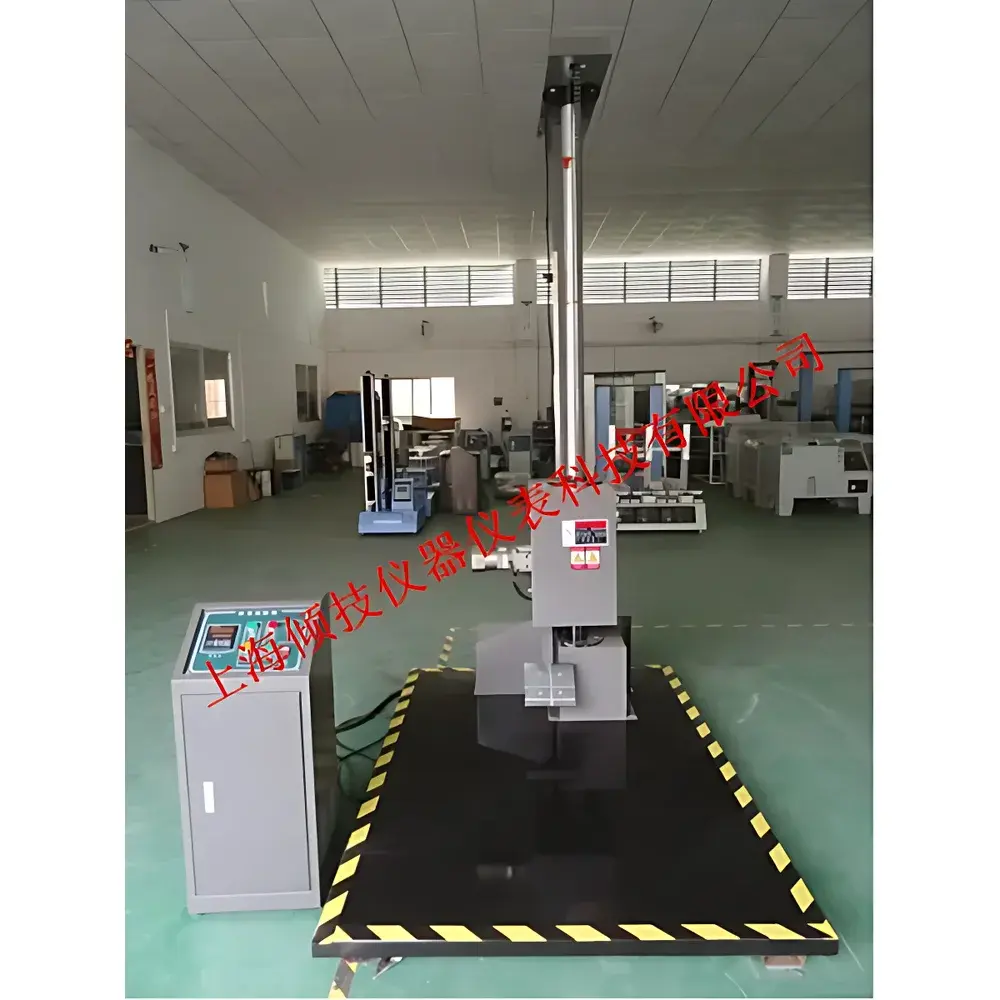
Qingji QJBLC-73 Single-Arm Drop Testing Machine
| Brand | Qingji |
|---|---|
| Origin | Shanghai, China |
| Model | QJBLC-73 |
| Drop Height Range | 300–2000 mm |
| Max. Specimen Weight | 435 kg |
| Max. Specimen Dimensions | 1000 × 800 × 800 mm |
| Drop Surface Dimensions | 1000 × 800 × 800 mm |
| Height Display Accuracy | ≤ ±2% of set value |
| Drop Angle Tolerance | ≤ ±5° |
| Motor Power | 0.5 HP |
| Power Supply | AC 380 V, 50 Hz, 10 A |
| Overall Dimensions (L×W×H) | ≈ 1700 × 1200 × 3015 mm |
| Machine Weight | 435 kg |
| Compliance | ISO 2248, JIS Z 0202-87, GB/T 4857.5–1992 |
| Accuracy Class | Grade 1 or higher |
Overview
The Qingji QJBLC-73 Single-Arm Drop Testing Machine is an electromechanically actuated impact testing system engineered for standardized evaluation of packaging integrity and product resilience under free-fall conditions. It operates on the principle of controlled gravitational acceleration, enabling repeatable drop events from precisely defined heights onto a rigid, horizontally aligned impact surface. Designed in accordance with internationally recognized transport simulation standards—including ISO 2248 (packaging — vertical impact tests), JIS Z 0202-87 (Japanese Industrial Standard for drop testing of packaged goods), and GB/T 4857.5–1992 (Chinese national standard equivalent to ISO 2248)—the QJBLC-73 supports face, edge, and corner drop configurations to replicate real-world handling stresses during logistics, warehousing, and distribution. Its single-arm lifting mechanism ensures stable specimen suspension and minimizes lateral deviation prior to release, contributing to high reproducibility across sequential test cycles.
Key Features
- Single-arm electro-mechanical lifting structure with dual-point support for enhanced stability during specimen elevation and release
- LED digital height indicator with resolution sufficient to meet ≤ ±2% accuracy relative to programmed drop height
- Adjustable drop platform accommodating specimens up to 1000 × 800 × 800 mm in footprint and 435 kg in mass
- Fixed horizontal impact surface engineered to ASTM E1050-compliant rigidity specifications (minimum dynamic stiffness > 10⁸ N/m)
- Drop angle control mechanism ensuring angular deviation ≤ ±5° for edge and corner impact orientations
- Industrial-grade 0.5 HP motor driving synchronized lifting motion with overload protection and emergency stop integration
- Robust steel frame construction with powder-coated finish, designed for long-term operational reliability in QC laboratories and production environments
Sample Compatibility & Compliance
The QJBLC-73 accommodates a broad range of packaged unit loads—from consumer electronics enclosures and pharmaceutical secondary packaging to industrial component crates and e-commerce fulfillment parcels. Its open-frame architecture allows unobstructed access for manual placement and orientation of irregularly shaped specimens. All mechanical tolerances, height repeatability, and angular alignment conform to Grade 1 accuracy requirements per GB/T 4857.5–1992 and ISO 2248 Annex A. The machine’s structural design permits direct integration into GLP-compliant quality assurance workflows, supporting documented test execution, operator identification, and environmental condition logging when paired with external data acquisition systems.
Software & Data Management
While the QJBLC-73 operates as a standalone hardware platform without embedded PC-based control software, its LED interface provides real-time height feedback and manual parameter lock functionality. For traceable test recordkeeping, users may integrate external USB or RS-232 enabled data loggers to capture timestamped event sequences—including lift initiation, release confirmation, and cycle completion. Such configurations support compliance with FDA 21 CFR Part 11 when combined with electronic signature-capable laboratory information management systems (LIMS). Calibration certificates and metrological verification reports are provided upon commissioning, with annual recalibration recommended to maintain conformance to ISO/IEC 17025-accredited measurement uncertainty thresholds.
Applications
- Validation of corrugated box compression strength and edge crush resistance under simulated palletized drop scenarios
- Verification of cushioning material performance (e.g., foam inserts, molded pulp trays) in protecting fragile components during last-mile delivery
- Pre-shipment qualification testing for medical device packaging subject to MDR Annex I essential requirements
- Comparative analysis of alternative closure systems (e.g., tape vs. staples vs. adhesive seals) under repeated drop exposure
- Root cause investigation of field failure reports linked to transit-related mechanical shock damage
- Internal audit readiness for ISO 9001:2015 Clause 8.5.4 (production and service provision – protection) and ISO 14001:2015 environmental packaging assessments
FAQ
What standards does the QJBLC-73 comply with?
It is fully aligned with ISO 2248, JIS Z 0202-87, and GB/T 4857.5–1992 for vertical impact testing of packaged products.
Can the machine perform corner drops on oversized packages?
Yes—its 1000 × 800 × 800 mm test chamber and adjustable arm geometry allow secure positioning and repeatable corner impact for packages up to the maximum specified dimensions.
Is calibration documentation included with delivery?
Yes—a factory calibration certificate traceable to CNAS-accredited reference standards is supplied, along with a detailed mechanical verification report covering height linearity, angle repeatability, and load-bearing integrity.
Does the system support automated test sequencing?
No—the QJBLC-73 is manually operated; however, it features standardized mounting points and electrical interfaces compatible with third-party programmable logic controllers (PLCs) or custom automation modules.
What maintenance intervals are recommended?
Monthly visual inspection of lifting cables, brake engagement, and guide rail lubrication is advised; annual full mechanical recalibration and motor performance verification are recommended to sustain Grade 1 accuracy classification.



