
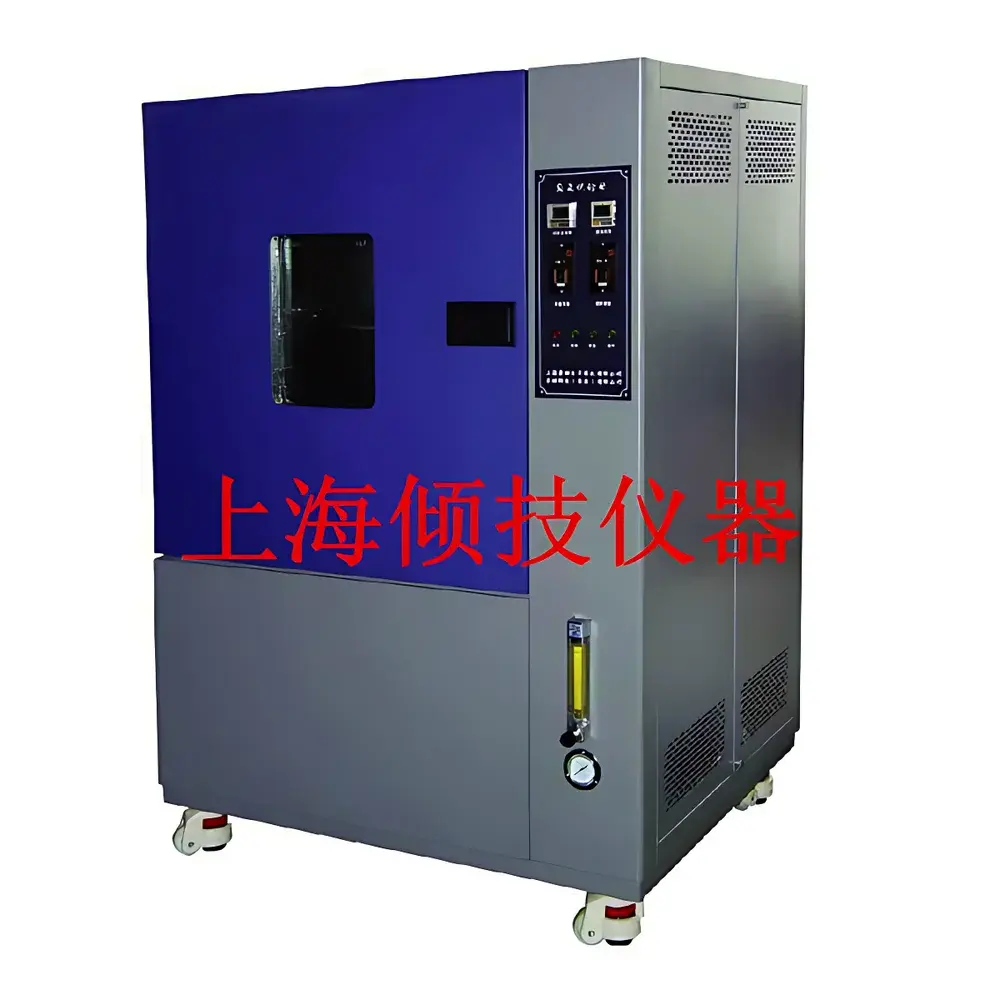
Qingji QJCYX-542 Programmable Ozone Aging Test Chamber
| Brand | Qingji |
|---|---|
| Origin | Shanghai, China |
| Manufacturer Type | Authorized Distributor |
| Origin Category | Domestic (China-made) |
| Model | QJCYX-542 |
| Price | USD 8,600 (FOB Shanghai) |
| Temperature Range | 0–60 °C |
| Humidity Range | 40–98% RH (at 30–60 °C) |
| Temp. Uniformity | ≤±2 °C |
| Temp. Stability | ≤±0.5 °C |
| Humidity Stability | +2/−3% RH |
| Heating Rate | 0.7–1.0 °C/min |
| Cooling Rate | ≤20 min (from ambient to 10 °C, uncontrolled ambient conditions) |
| Ozone Concentration Range | 10–1000 pphm |
| Gas Flow Velocity | 12–16 mm/s |
| Sample Mounting | Static Rack Only |
Overview
The Qingji QJCYX-542 Programmable Ozone Aging Test Chamber is an engineered environmental simulation system designed to evaluate the ozone resistance of elastomers, vulcanized rubber compounds, polymeric seals, cable sheaths, and other non-metallic materials subject to atmospheric exposure in service environments. It operates on the principle of controlled ozone generation and circulation within a sealed, recirculating gas loop—enabling precise, repeatable exposure conditions per ASTM D1149, ISO 1431-1, and GB/T 7762. Unlike open-air or static ozone exposure methods, this chamber maintains stable ozone concentration (10–1000 pphm), temperature (0–60 °C), relative humidity (40–98% RH at elevated temperatures), and laminar airflow (12–16 mm/s) across the test zone—critical parameters influencing crack initiation and propagation kinetics in ozone-sensitive polymers.
Key Features
- Integrated ozone generator with real-time feedback control, enabling programmable concentration setpoints from 10 to 1000 parts per hundred million (pphm) with typical stability ±5% of setpoint over 24 h.
- Microprocessor-based PID controller supporting multi-segment time-temperature-ozone-humidity profiles; up to 99 cycles with 99 steps per cycle, stored in non-volatile memory.
- Double-wall insulated stainless steel chamber (inner: SUS304, outer: powder-coated steel) with silicone-sealed observation window and ozone-resistant gasketing to prevent leakage and ensure operator safety.
- Independent refrigeration and heating systems with forced-air convection, achieving temperature uniformity ≤±2 °C and stability ≤±0.5 °C across the working volume.
- Humidity control via steam injection and precision dry-air mixing; humidity accuracy maintained at +2/−3% RH within the operational range (30–60 °C).
- Static sample rack configuration compliant with ASTM D1149 requirements—no mechanical flexing or dynamic strain applied during exposure, isolating ozone-specific degradation mechanisms.
Sample Compatibility & Compliance
The QJCYX-542 accommodates standard dumbbell-shaped specimens (e.g., ASTM D412 Type C), O-rings, hose sections, and flat sheet coupons up to 200 mm × 200 mm. All internal surfaces contacting the test atmosphere are constructed from ozone-inert materials—including fluorosilicone gaskets, electropolished stainless steel, and borosilicate glass—to eliminate catalytic decomposition or unintended surface reactions. The system meets essential design and operational criteria referenced in ISO/IEC 17025-accredited laboratories for material qualification testing. While not certified to IEC 61000-4-x EMC standards out-of-the-box, it complies with CE marking requirements for laboratory equipment under Directive 2014/30/EU (EMC) and 2014/35/EU (LVD) when installed per manufacturer instructions. Full traceability documentation—including calibration certificates for ozone sensor (electrochemical cell), PT100 temperature probes, and capacitive RH sensors—is provided upon request for GLP/GMP-regulated environments.
Software & Data Management
The embedded controller supports RS485 Modbus RTU communication for integration into centralized lab monitoring networks. Optional PC-based software (Qingji LabLink v3.2) enables remote parameter programming, real-time graphing of ozone concentration, temperature, and humidity trends, automatic report generation in PDF/CSV formats, and audit-trail logging compliant with FDA 21 CFR Part 11 requirements—including user authentication, electronic signatures, and immutable event timestamps. Data logs are timestamped with millisecond resolution and stored internally for ≥30 days; external USB export preserves raw datasets for third-party statistical analysis (e.g., Weibull modeling of crack onset time).
Applications
- Evaluation of antioxidant package efficacy in natural rubber (NR), styrene-butadiene rubber (SBR), nitrile rubber (NBR), and ethylene propylene diene monomer (EPDM) formulations.
- Qualification of automotive weatherstrips, brake hoses, and engine mounts under simulated urban ozone exposure scenarios.
- Validation of polymer coatings and encapsulants used in outdoor electrical insulation applications per IEC 60587.
- Supporting failure analysis investigations where surface cracking correlates with ozone-rich ambient conditions (e.g., coastal or high-altitude installations).
- Research-grade aging studies requiring correlation between ozone dose (pphm·h), temperature history, and microstructural evolution observed via SEM or FTIR-ATR.
FAQ
What ozone concentration range is validated and traceably calibrated?
The chamber delivers and maintains 10–1000 pphm ozone with NIST-traceable electrochemical sensor calibration performed at three points (50, 500, and 1000 pphm) prior to shipment.
Is dynamic (flexing) sample testing supported?
No—the QJCYX-542 is configured exclusively for static exposure per ASTM D1149. Dynamic testing requires separate equipment with motorized specimen racks.
Can the system operate continuously for extended durations (e.g., 1000+ hours)?
Yes—designed for unattended operation with thermal overload protection, ozone sensor auto-zeroing cycles, and alarm-triggered shutdown on critical fault detection (e.g., chamber overtemperature, ozone generator failure).
Does the unit include ozone destruction capability for exhaust gas?
An optional catalytic ozone destruct module (QJ-ODM-1) is available as an add-on, converting residual ozone to oxygen prior to venting—recommended for indoor installation without dedicated fume hood infrastructure.
What maintenance intervals are recommended for long-term reliability?
Ozone generator electrodes require cleaning every 500 operational hours; humidity sensor recalibration every 6 months; and full system performance verification annually using certified reference standards.
Related Products



