
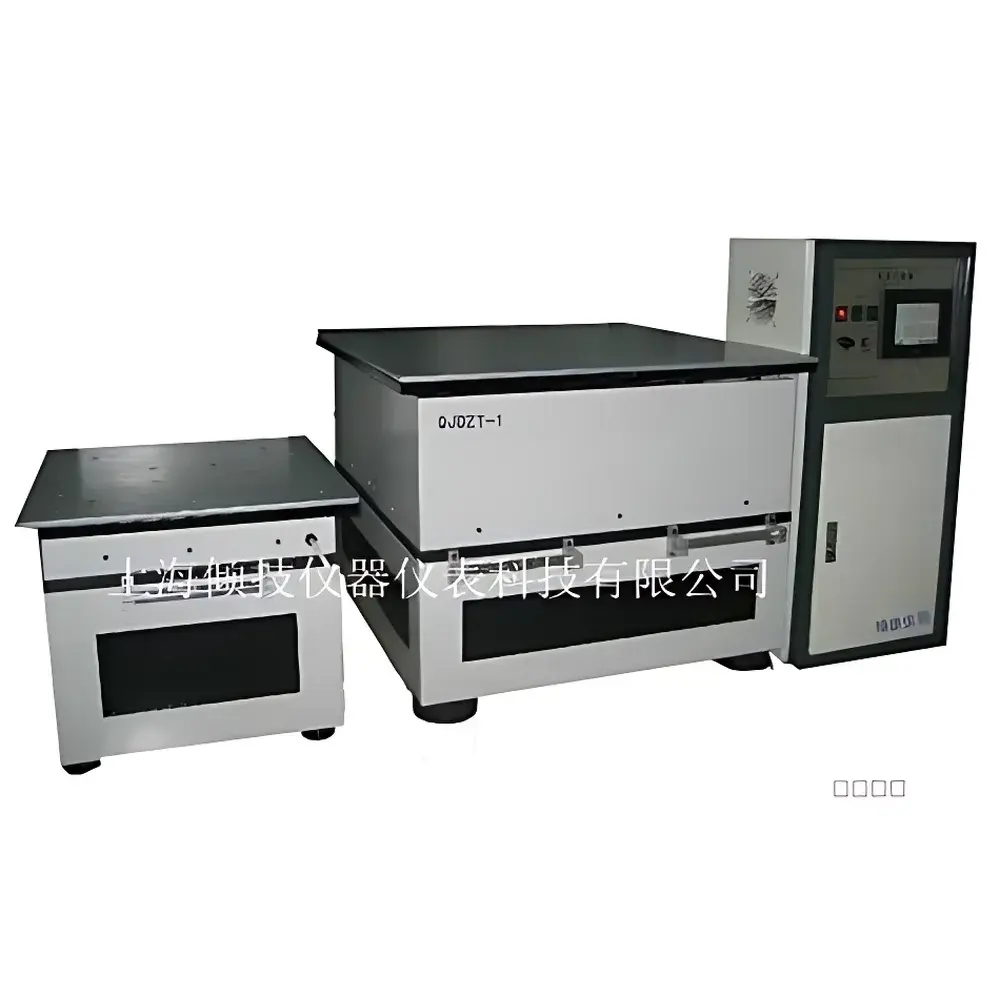
Qingji QJDZT-1 Vertical Electromagnetic Vibration Test System
| Brand | Qingji |
|---|---|
| Origin | Shanghai, China |
| Manufacturer Type | Authorized Distributor |
| Country of Origin | China |
| Model | QJDZT-1 |
| Pricing | Available Upon Request |
| Frequency Range | 0.5–600 Hz (±0.1% accuracy) |
| Vibration Axis | Vertical (Y-axis, up/down) |
| Control Modes | Standard Programmable Control (P-series, W-series, T-series) |
| Waveform Options | Sine wave (full-cycle or half-cycle selectable) |
| Output Channels | Dual independent vertical excitation channels — configurable for simultaneous, synchronized, or isolated operation |
Overview
The Qingji QJDZT-1 Vertical Electromagnetic Vibration Test System is an engineered solution for simulating controlled mechanical vibration environments in laboratory and industrial qualification settings. Based on electromagnetic shaker technology, it generates calibrated sinusoidal acceleration profiles along a single vertical (Y-axis) degree of freedom, enabling precise replication of transport, handling, and operational vibration spectra encountered during product life cycles. This system adheres to fundamental principles of forced harmonic excitation, where the shaker armature—driven by a voice-coil actuator within a permanent magnetic field—converts electrical input signals into reproducible mechanical displacement, velocity, and acceleration outputs. Its design supports both functional verification and structural integrity assessment, making it suitable for early-life failure detection, design validation, and compliance screening per international environmental testing standards.
Key Features
- Electromagnetic shaker architecture with high-force-to-mass ratio and low harmonic distortion (<3% THD at rated load)
- Dual-channel vertical excitation capability: channels may operate independently, in phase-synchronized mode, or as separate test zones—enabling comparative or multi-point stress evaluation
- Frequency sweep and dwell functionality across 0.5–600 Hz range with ±0.1% frequency stability under closed-loop control
- Programmable waveform selection: full-cycle sine (symmetric bipolar) or half-cycle sine (unipolar pulse), supporting both fatigue and shock-like loading profiles
- Standardized control architecture compliant with P-series (programmed step sweeps), W-series (random vibration synthesis via power spectral density shaping), and T-series (transient event simulation) protocols
- Integrated thermal management and over-travel protection to ensure long-term operational reliability under sustained duty cycles
Sample Compatibility & Compliance
The QJDZT-1 accommodates test specimens up to 50 kg (subject to fixture rigidity and center-of-gravity alignment), with mounting interface conforming to ISO 5344 and ASTM D999 standard plate dimensions. It supports rigid and semi-rigid fixtures fabricated from aluminum or steel alloys, and is compatible with industry-standard accelerometers (IEPE and charge-type) for real-time response monitoring. The system facilitates test execution aligned with key environmental qualification standards including MIL-STD-810H Method 514.8 (Vibration), IEC 60068-2-6 (Sinusoidal vibration), and GB/T 2423.10 (Chinese national standard equivalent). While not certified for FDA-regulated validation out-of-the-box, its deterministic control architecture and traceable calibration path support integration into GLP/GMP-aligned test workflows when paired with documented procedures and third-party sensor calibration.
Software & Data Management
Control and data acquisition are managed through Qingji’s proprietary VTS-Link software suite, running on Windows-based host PCs. The software provides real-time spectrum display, time-history logging (sample rate up to 50 kHz), and post-test FFT analysis. All test configurations—including sweep rates, dwell times, amplitude profiles, and waveform parameters—are stored in XML-based project files with embedded metadata (operator ID, timestamp, revision history). Audit trails record all parameter changes and start/stop events, satisfying basic requirements for 21 CFR Part 11-compliant environments when deployed with appropriate system access controls and electronic signature modules. Export formats include CSV, MATLAB .mat, and universal UFF 58b for interoperability with third-party analysis platforms such as MATLAB, Python (SciPy), and LMS Test.Lab.
Applications
- Structural resonance mapping of PCB assemblies, enclosures, and chassis components in electronics manufacturing
- Vibration endurance validation of avionics modules prior to flight certification (per DO-160 Section 7)
- Transport simulation for automotive ECUs, sensors, and infotainment units subjected to road-induced excitations
- Early defect screening in electromechanical relays, connectors, and solder joints using resonant dwell techniques
- Material bond integrity assessment in adhesive-bonded aerospace subassemblies
- Calibration reference support for in-house metrology labs performing vibration sensor sensitivity verification
FAQ
What is the maximum payload capacity for the QJDZT-1 system?
The system is rated for a nominal 50 kg test specimen mass under full-frequency-range operation; derating applies above 200 Hz depending on required acceleration amplitude and fixture mass.
Does the system support random vibration testing?
Yes—via W-series control mode, which implements power spectral density (PSD) profile generation and closed-loop random control per IEC 60068-2-64.
Can the dual output channels be used for multi-axis simulation?
No—the QJDZT-1 is strictly uniaxial (Y-axis only); simultaneous use of both channels remains co-directional and does not constitute multi-axis motion.
Is third-party calibration documentation provided with shipment?
A factory calibration certificate (traceable to CNAS-accredited reference standards) is included; annual recalibration is recommended and supported through Qingji’s authorized service network.
How is system synchronization achieved between the two vertical channels?
Phase-locking is maintained via shared master clock signal and digital delay compensation, ensuring sub-millisecond timing alignment across both outputs.
Related Products



