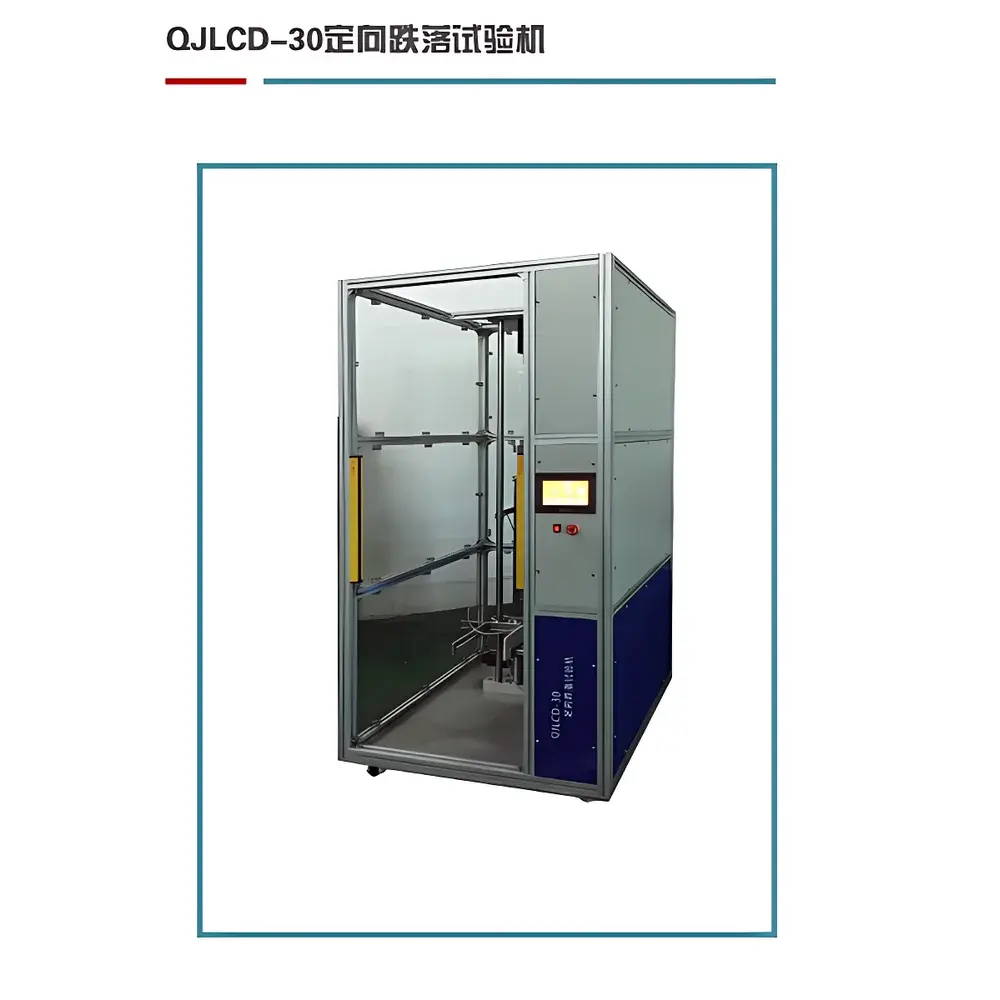
Qingji QJLCD-30 Touchscreen Controlled Directional Drop Tester
| Brand | Qingji |
|---|---|
| Origin | Shanghai, China |
| Manufacturer Type | Authorized Distributor |
| Country of Origin | China |
| Model | QJLCD-30 |
| Price | USD 8,400 (FOB Shanghai) |
| Drop Height Range | 400–1800 mm (±0.5 mm positioning accuracy) |
| Adjustable Drop Angles | 0°, 45°, 90° (supports face, edge, and corner impacts per IEC 60068-2-32) |
| Vacuum Suction Cups | Six Ø16 mm industrial-grade cups |
| Max Test Specimen Mass | 700 g |
| Drop Surface Dimensions | 350 × 350 × 50 mm |
| Drop Surface Options | Polished marble (Ra = 0.59 µm) or cured cement board (Ra = 1.29 µm), customizable |
| Drive System | Servo motor + timing belt |
| Control System | Industrial touchscreen HMI + PLC |
| Air Supply Requirement | ≥0.6 MPa clean compressed air |
| Power Supply | AC 220 V ±10%, 50 Hz |
| Rated Power | 400 W |
| Overall Dimensions | 800 × 900 × 2400 mm |
| Net Weight | 270 kg |
Overview
The Qingji QJLCD-30 Touchscreen Controlled Directional Drop Tester is an electromechanical impact testing system engineered for precise, repeatable evaluation of product mechanical robustness under controlled free-fall conditions. It operates on the principle of gravity-driven impact with programmable orientation control, enabling standardized simulation of real-world drop events onto flat, rigid surfaces. Designed in accordance with the test methodology defined in IEC 60068-2-32 (Environmental testing – Part 2-32: Tests – Test Ed: Free fall), the instrument supports systematic assessment of packaging integrity, enclosure durability, and structural resilience for consumer electronics, medical devices, handheld instruments, and industrial components. Its servo-driven vertical carriage, coupled with vacuum-assisted specimen handling and angle-selective release mechanisms, ensures high reproducibility across face, edge, and corner impact configurations without manual repositioning.
Key Features
- Industrial-grade 7-inch capacitive touchscreen HMI integrated with a certified PLC controller for intuitive parameter setting, real-time status monitoring, and sequence execution.
- Precision servo motor and timing belt drive system delivering ±0.5 mm vertical positioning accuracy over the full 400–1800 mm drop height range.
- Triple-axis vacuum cup assembly (six Ø16 mm SMC pneumatic suction cups) enabling secure, non-damaging specimen fixation and orientation-independent release at pre-set angles (0°, 45°, 90°).
- Automated post-drop carriage return to preset height—eliminating manual reset and reducing cycle time between consecutive tests.
- Modular drop surface platform accommodating interchangeable impact plates: optically polished granite (Ra = 0.59 µm) and ASTM C109-compliant cured cement board (Ra = 1.29 µm), both compliant with IEC 60068-2-32 surface hardness and flatness requirements.
- High-reliability pneumatic subsystem using SMC (Japan) solenoid valves, vacuum generators, and pressure regulators—rated for >1 million operational cycles under continuous laboratory use.
- Integrated data logging of critical parameters per test event: drop height, nominal impact velocity, estimated peak deceleration (derived from height and mass), elapsed test duration, and cumulative cycle count.
Sample Compatibility & Compliance
The QJLCD-30 accommodates specimens up to 700 g mass and maximum envelope dimensions compatible with a 7.2-inch diagonal display device (e.g., tablets, portable monitors, diagnostic handsets). Its configurable orientation system permits standardized testing of all six faces, twelve edges, and eight vertices of rectangular prisms per IEC 60068-2-32 Clause 5. The drop surface meets ISO 11337-defined rigidity and surface finish criteria for impact testing fixtures. While not certified to UL 60950-1 or MIL-STD-810H by default, the system’s mechanical architecture and calibration traceability support validation protocols required for internal quality audits, ISO/IEC 17025-accredited lab workflows, and GLP-compliant reliability studies.
Software & Data Management
The embedded control firmware records timestamped test metadata—including height, angle, cycle number, and pass/fail flag—to internal flash memory. Data export is supported via USB 2.0 interface in CSV format for integration into LIMS or statistical process control (SPC) platforms. Optional RS-485 Modbus RTU communication enables remote supervision and automated reporting within factory MES environments. Audit trails are maintained per test session, satisfying basic traceability requirements aligned with ISO 9001:2015 Clause 8.5.2 and FDA 21 CFR Part 11 (when deployed with external electronic signature-capable software layers).
Applications
- Pre-shipment validation of smartphone, tablet, and wearable housing integrity.
- Design verification of medical handheld devices (e.g., ultrasound probes, glucose meters) per IEC 60601-1 mechanical safety clauses.
- Package drop performance testing for Class IIa/III medical devices undergoing MDR Annex I conformity assessment.
- Supplier qualification of plastic enclosures, battery casings, and PCB assemblies subjected to logistics-related mechanical stress.
- Internal QA/QC screening for automotive infotainment modules prior to environmental stress screening (ESS) campaigns.
FAQ
Does the QJLCD-30 comply with IEC 60068-2-32 out-of-the-box?
Yes—the mechanical configuration, drop surface specifications, and angular repeatability meet all normative requirements of IEC 60068-2-32 Ed. 3.0 (2021) for free-fall testing. Calibration certificates for height and angle actuators are provided upon shipment.
Can the system be validated for GMP-regulated environments?
While the base unit does not include 21 CFR Part 11-compliant user access controls or electronic signatures, its deterministic operation, data logging integrity, and hardware traceability enable IQ/OQ protocol development. Qingji provides URS support and factory-verified performance qualification documentation upon request.
What maintenance is required to sustain measurement accuracy?
Biannual verification of vertical rail alignment, vacuum cup seal integrity, and drop surface flatness (using Class 0 granite straightedge) is recommended. SMC pneumatic components require no scheduled lubrication; only periodic filter element replacement (every 12 months under standard lab air supply conditions).