
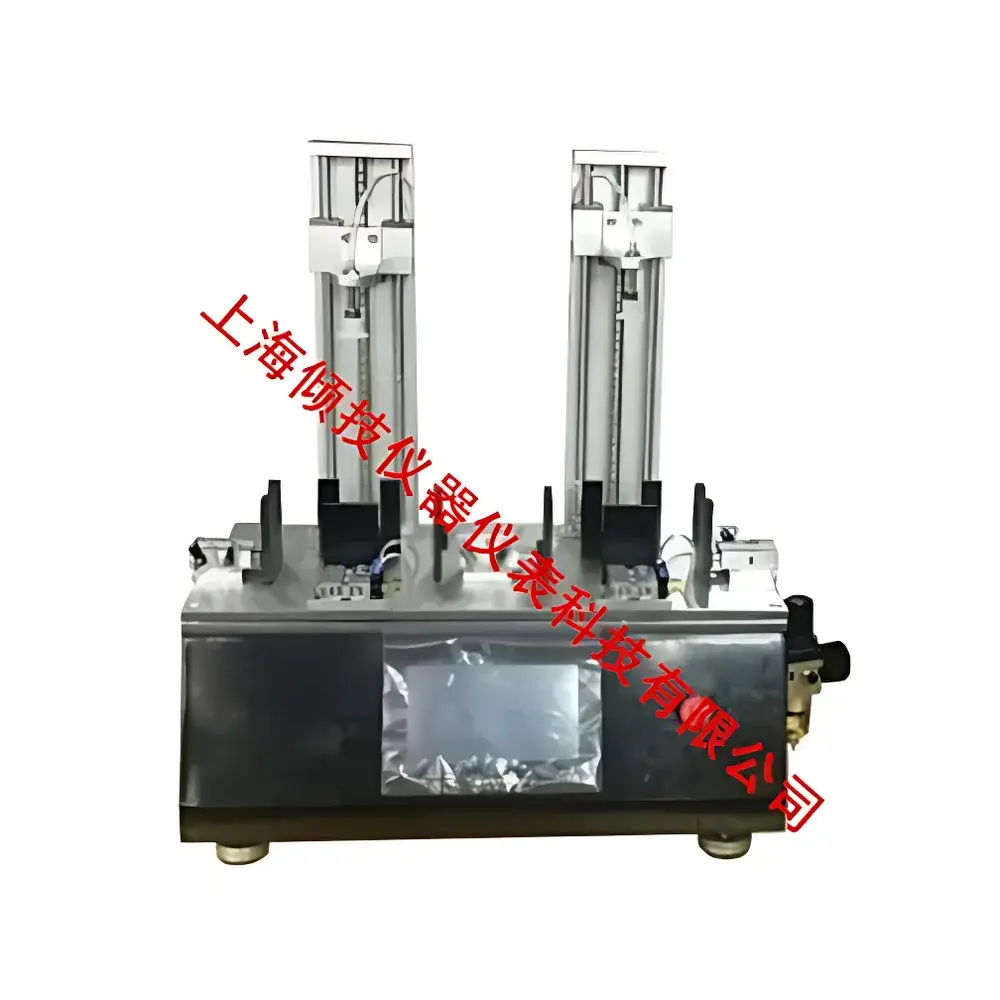
Qingji QJLCSW-86 Micro-Drop Lifetime Tester for Smartphones
| Brand | Qingji |
|---|---|
| Origin | Shanghai, China |
| Manufacturer Type | Authorized Distributor |
| Country of Origin | China |
| Model | QJLCSW-86 |
| Price | USD 7,800 (FOB Shanghai) |
| Drop Height Range | 10–200 mm |
| Maximum Specimen Weight | 2 kg |
| Maximum Specimen Dimensions | 80 × 140 mm |
| Drop Surface Dimensions | W550 × H750 × D650 mm |
| Test Speed | 6–20 cycles/min |
| Control System | PLC + 7-inch HMI touchscreen |
| Power Supply | AC 220 V, 50/60 Hz |
| Pneumatic Source Requirement | ≥0.5 MPa |
| Machine Weight | ~40 kg |
Overview
The Qingji QJLCSW-86 Micro-Drop Lifetime Tester is an electromechanical precision testing system engineered for accelerated mechanical durability evaluation of compact consumer electronics. It operates on a controlled pneumatic drop principle—where specimens are lifted vertically via linear actuators and released onto a rigid, calibrated impact surface under programmable height and repetition parameters. Unlike conventional free-fall drop testers designed for packaging or large devices, the QJLCSW-86 specializes in micro-scale, high-frequency repetitive impact testing (6–20 drops per minute), simulating real-world pocket-to-surface, hand-to-table, or belt-clip release events experienced by smartphones, touchscreens, earpieces, handheld radios, portable audio players, and electronic dictionaries. Its design adheres to fundamental principles of impact dynamics and fatigue life modeling, enabling correlation between controlled drop cycles and field failure modes such as glass microcracking, solder joint fatigue, housing deformation, and display delamination.
Key Features
- Programmable drop height range from 10 mm to 200 mm in 1-mm increments, supporting both low-energy shock simulation (e.g., desk-level slips) and higher-energy impacts (e.g., seated-height drops).
- Dual independent test stations accommodate two specimens simultaneously (max 80 × 140 mm each), increasing throughput without compromising positional repeatability.
- Integrated PLC-based control architecture with a 7-inch industrial touchscreen HMI enables intuitive cycle configuration, real-time status monitoring, and event logging—including drop count, elapsed time, and fault alerts.
- Robust aluminum-alloy frame with vibration-damped base minimizes energy dissipation outside the specimen–impact interface, ensuring consistent kinetic energy transfer across test runs.
- Pneumatically actuated lift-and-release mechanism delivers high timing accuracy (< ±10 ms cycle jitter) and eliminates motor-induced torque variability inherent in servo-driven systems.
- Modular impact surface assembly allows quick replacement of standardized anvil materials (e.g., stainless steel, tempered glass, or polymer composites) to emulate different receiving surfaces per ASTM D5276 and IEC 60068-2-32 requirements.
Sample Compatibility & Compliance
The QJLCSW-86 accepts flat or low-profile rectangular specimens up to 80 mm × 140 mm in footprint and 2 kg in mass—covering the vast majority of modern smartphones (including foldables in unfolded configuration), mid-sized tablets, wearables, and handheld communication devices. Fixturing utilizes non-marring vacuum chucks or adjustable edge clamps, preserving surface integrity during repeated cycling. The system supports test protocols aligned with key international standards including IEC 60068-2-32 (drop test), MIL-STD-810H Method 516.8 (transit drop), and GB/T 2423.8–2022 (Chinese national standard for environmental testing). While not certified for GLP/GMP production release, its deterministic control logic and audit-ready cycle logs meet preliminary R&D validation and internal quality assurance requirements.
Software & Data Management
The embedded controller records all operational parameters—including total drop count, cumulative runtime, height setting, cycle rate, and pneumatic pressure stability—in non-volatile memory. Data export is supported via USB flash drive in CSV format for traceability and post-processing in Excel or statistical analysis platforms (e.g., Minitab, JMP). Optional RS-485 or Ethernet MODBUS TCP interfaces enable integration into factory MES or LabVantage environments. All firmware updates are delivered via signed binary packages; version history and calibration timestamps are retained in device metadata. No cloud connectivity or remote access capabilities are included—ensuring full data sovereignty and compliance with corporate IT security policies.
Applications
- Pre-production durability screening of smartphone chassis, OLED/LCD modules, and camera lens assemblies.
- Comparative assessment of protective film adhesion strength and screen protector fracture resistance.
- Validation of adhesive bond integrity in multi-layer display stacks under cyclic impact loading.
- Accelerated life testing of flex-circuit interconnects and battery mounting brackets.
- Supplier qualification testing for contract manufacturers requiring repeatable, documented mechanical stress exposure.
- Root cause analysis support when correlating lab-induced micro-damage (via SEM or acoustic emission) with field return failure patterns.
FAQ
What is the minimum recommended drop height for statistically meaningful fatigue data?
A minimum of 50 mm is advised for reliable detection of early-stage microstructural damage; lower heights (10–30 mm) are suitable only for functional verification or pass/fail go/no-go screening.
Can the tester accommodate curved or irregularly shaped devices?
Only flat-bottomed or near-planar specimens within the defined footprint and weight limits are supported; custom fixturing may be developed separately but falls outside standard scope.
Is calibration certification provided with shipment?
Yes—a factory calibration report verifying height repeatability (±0.3 mm), cycle timing accuracy (±0.5 s over 100 cycles), and pneumatic pressure regulation (±0.02 MPa) is included.
What maintenance intervals are recommended?
Pneumatic filter elements should be replaced every 6 months; linear guide rails require light lubrication every 1,000 cycles; annual verification of PLC firmware integrity and HMI touchscreen responsiveness is advised.
Does the system comply with ISO/IEC 17025 requirements?
While the instrument itself is not accredited, its measurement traceability chain—linked to NIM (National Institute of Metrology, China)-certified height gauges and timer standards—supports laboratory accreditation efforts when operated under documented SOPs.
Related Products



