
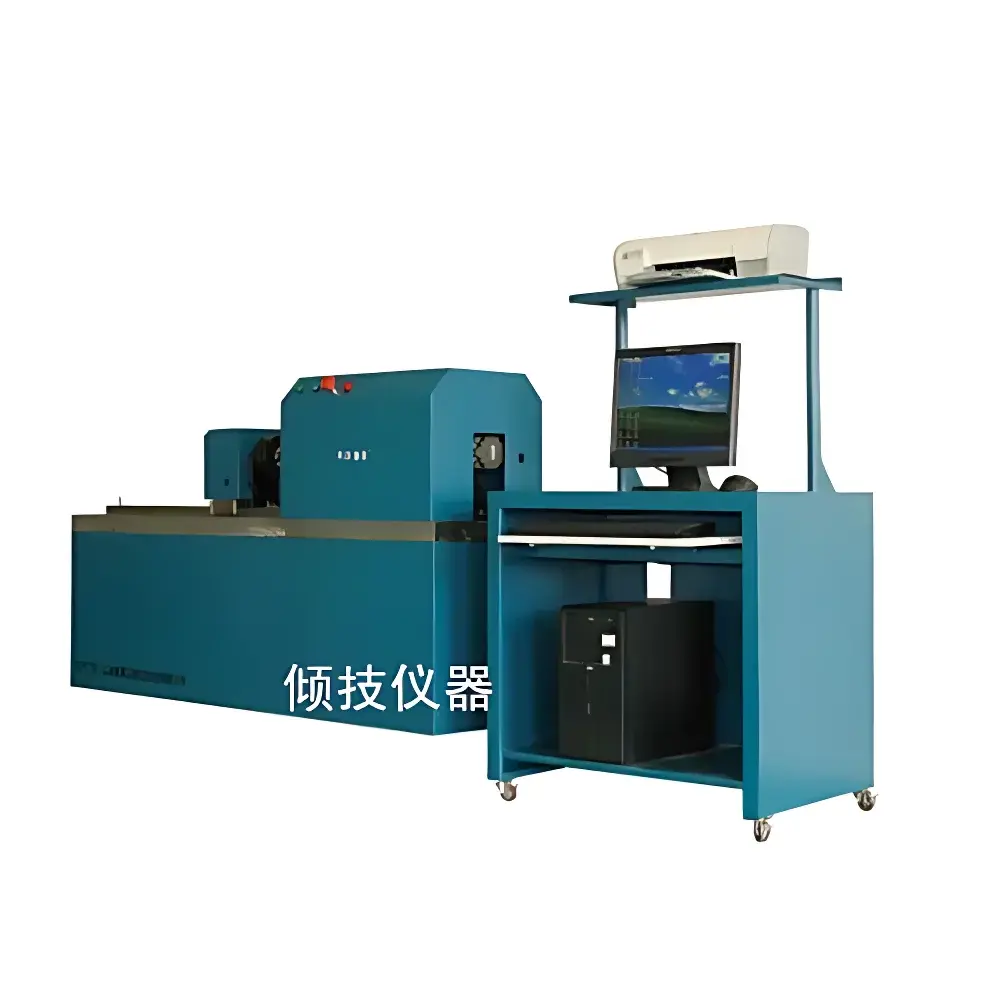
Qingji QJNZ-1 Automotive Component Torsion Strength Testing Machine
| Brand | Qingji |
|---|---|
| Origin | Shanghai, China |
| Model | QJNZ-1 |
| Max Torque | 0–10,000 N·m |
| Torque Measurement Range | 0–10,000 N·m |
| Torque Resolution | ±0.001° |
| Torsion Angle Range | 0–±100,000° (4-digit display) |
| Torsion Speed | 0.01–1,000 °/min (infinitely variable) |
| Angular Accuracy | ±0.5% of reading |
| Torque Accuracy | ±0.5% of reading |
| Angular Resolution | ±0.001° |
| Torsion Angle Precision | 0.009° |
| Speed Accuracy | ±0.2% of indicated value |
| Torque Resolution (full scale) | 1/350,000 (no range switching, constant resolution) |
| Maximum Distance Between Grips | 1500 mm |
| Specimen Clamping Diameter | Φ8–Φ40 mm (extendable) |
| Dimensions (L×W×H) | 2800 × 4700 × 1250 mm |
| Weight | 1500 kg |
Overview
The Qingji QJNZ-1 Automotive Component Torsion Strength Testing Machine is a high-capacity, precision-engineered torsion testing system designed for static and quasi-static mechanical characterization of structural components under pure torsional loading. Based on the principle of controlled angular displacement and real-time torque reaction measurement, the system employs a robust servo-motor-driven actuation architecture coupled with high-fidelity torque transducers and optical angular encoders to deliver traceable, repeatable torsional data. It is specifically engineered for evaluating torsional yield strength, ultimate torsional strength, torsional stiffness, and plastic deformation behavior of axles, drive shafts, steering columns, suspension links, and other safety-critical automotive subassemblies. The machine complies with core international torsion testing standards including ISO 7800:2015 (Metallic materials — Determination of torsional strength), ASTM E143-22 (Standard Test Method for Shear Modulus at Room Temperature), and GB/T 9370–1999 (Torsion testing methods for metallic materials), ensuring compatibility with global quality assurance workflows in Tier-1 suppliers and OEM validation labs.
Key Features
- High-torque capacity up to 10,000 N·m with full-scale resolution of 1/350,000—enabling precise detection of micro-yield phenomena and low-level torsional hysteresis.
- Infinitely variable torsion speed control from 0.01 to 1,000 °/min, supporting both slow-rate compliance testing and rapid qualification cycles.
- Dual-axis high-precision angular encoder system delivering ±0.001° resolution and 0.009° absolute angular accuracy across the full ±100,000° range.
- Fixed-distance dual-grip configuration with 1500 mm maximum separation and adjustable clamping jaws accommodating specimens from Φ8 mm to Φ40 mm (customizable for larger diameters).
- Integrated load frame with rigid welded steel construction and vibration-damped base—engineered for long-term dimensional stability under cyclic torsional loads.
- Real-time torque and angle synchronization at ≥1 kHz sampling rate, supporting dynamic torsion curve reconstruction and derivative-based event detection (e.g., yield onset, necking initiation).
Sample Compatibility & Compliance
The QJNZ-1 accommodates cylindrical, tubular, and prismatic metallic and composite specimens used in chassis, powertrain, and body-in-white applications. Its modular fixture interface supports standardized test configurations per ISO 7800 Annex A (solid round bars), ASTM E143 Annex B (hollow shafts), and GB/T 239–1999 (wire torsion). Optional accessories include hydraulic wedge grips for high-friction interfaces, temperature-controlled environmental chambers (−40°C to +200°C), and extensometer-compatible angular strain adapters. All calibration procedures follow JJG 269–1981 (Verification Regulation for Torque Measuring Instruments) and are traceable to CNAS-accredited national metrology institutes. Data acquisition meets GLP/GMP audit requirements with configurable electronic signatures and 21 CFR Part 11-compliant software logs.
Software & Data Management
The system runs on a Windows-based virtual instrumentation platform compliant with IEC 61508 functional safety principles. The software provides closed-loop PID control of torsion rate or torque setpoint, automated test sequencing (predefined or user-scripted), real-time Lissajous plotting (torque vs. angle), and post-test calculation of shear modulus (G), non-proportional limit stress (τp), and torsional ductility (total angle at fracture). Reports export to PDF, Excel, and XML formats with embedded metadata (operator ID, calibration certificate IDs, environmental conditions). Audit trails record all parameter modifications, test starts/stops, and data exports with timestamped user attribution—fully supporting FDA and EU MDR regulatory submissions.
Applications
- Validation of torsional fatigue life of CV joint housings and half-shafts per SAE J2982.
- Characterization of cold-formed high-strength steel control arms under combined bending-torsion loading.
- Quality conformance testing of aluminum alloy steering knuckles per OEM-specific PV3901 specifications.
- Research-grade determination of G-modulus anisotropy in carbon-fiber-reinforced polymer (CFRP) drive shafts.
- Calibration verification of production-line torque sensors using reference-standard torsion transfer standards.
- Failure mode analysis of welded subframe joints via incremental torque-angle mapping and acoustic emission correlation.
FAQ
What standards does the QJNZ-1 comply with for torque calibration and test methodology?
It conforms to JJG 269–1981 (national torque instrument verification regulation), GB/T 9370–1999 (metal torsion testing), GB/T 239–1999 (wire torsion), ISO 7800:2015, and ASTM E143–22.
Can the system perform torsional modulus (G) calculations automatically?
Yes—the software computes shear modulus (G) from the linear region of the torque–angle curve, optionally incorporating axial extension compensation when paired with axial extensometry.
Is remote diagnostics and firmware updates supported?
Yes—via secure TLS-encrypted Ethernet connection; diagnostic logs and calibration history are remotely accessible with role-based authentication.
What maintenance intervals are recommended for long-term accuracy retention?
Torque transducer recalibration every 12 months; angular encoder alignment check every 6 months; mechanical preload verification before each daily shift.
Does the system support integration into factory MES or LIMS platforms?
Yes—through OPC UA server interface and configurable RESTful API endpoints for bidirectional data exchange with LabWare LIMS, Siemens Opcenter, or custom MES environments.



