
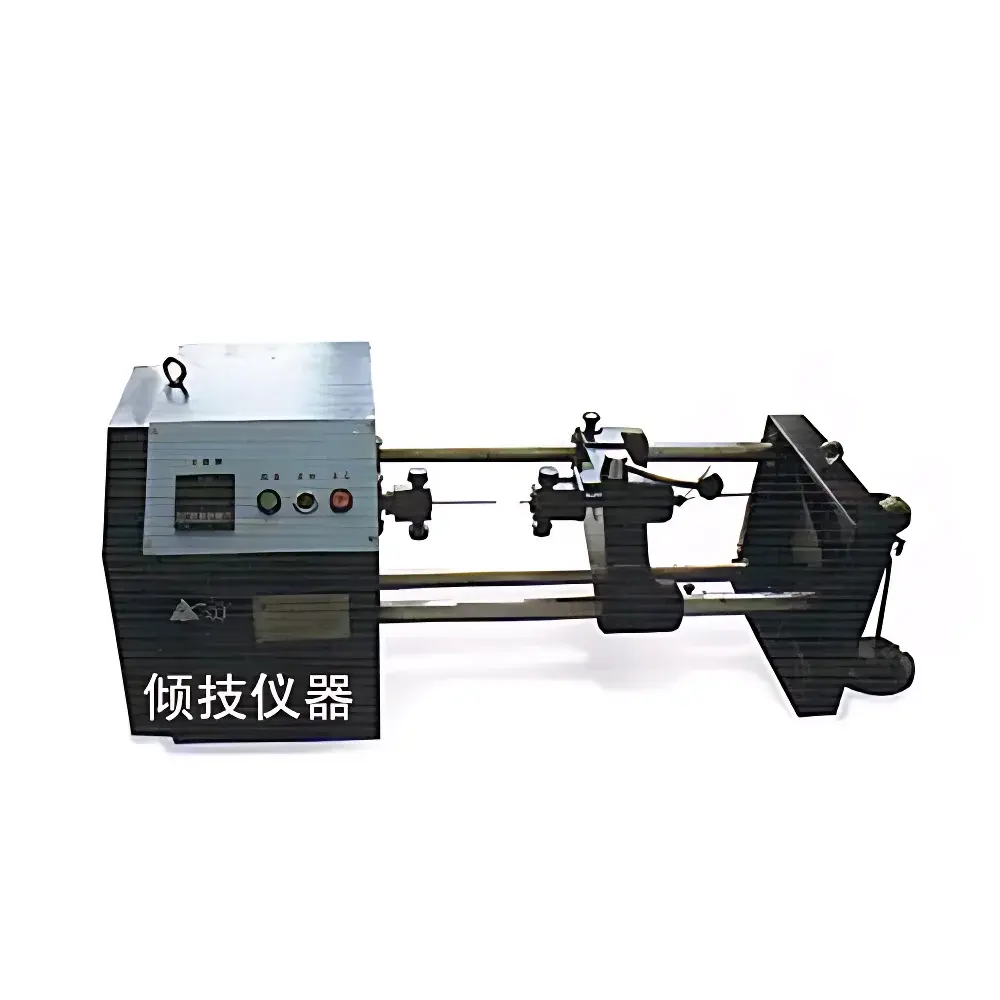
Qingji QJNZ-3(6) Wire Torsion and Coiling Testing Machine
| Brand | Qingji |
|---|---|
| Origin | Shanghai, China |
| Model | QJNZ-3(6) |
| Sample Diameter Range | Ø0.1–Ø3 mm |
| Gauge Length | 0–300 mm |
| Pre-tension Force Range | 0.2–350 N |
| Rotational Speeds | 60, 90, 120, 180, 300 rpm |
| Counting Method & Capacity | Electronic digital display, max 9999 revolutions |
| Torsion Modes | Unidirectional, bidirectional (single-cycle programmable) |
| Motor Power & Voltage | 250 W, 380 V AC |
| Dimensions (L×W×H) | 1150 × 410 × 460 mm |
| Net Weight | ~200 kg |
Overview
The Qingji QJNZ-3(6) Wire Torsion and Coiling Testing Machine is a precision-engineered mechanical testing system designed for quantitative evaluation of torsional ductility, work hardening behavior, and surface integrity in metallic wire materials. Based on the principles of controlled angular displacement under axial pre-tension, the instrument subjects wire specimens to defined rotational stress cycles while maintaining constant tensile loading—mimicking real-world service conditions such as spooling, cabling, and spring forming. Compliant with GB/T 239–1999 (equivalent to ISO 7800:2012 for metallic wire torsion testing), the system measures critical failure indicators including total twist count to fracture, onset of surface cracking, and torque decay profile. Its dual-mode operation—continuous unidirectional twisting and programmable bidirectional reversal—enables both standard ductility assessment and advanced fatigue simulation for quality control laboratories, wire manufacturers, and R&D centers engaged in metallurgical process validation.
Key Features
- Programmable torsion control: Supports single-direction rotation or fully configurable bidirectional cycling with user-defined reversal count and dwell time per cycle.
- Adjustable axial pre-tension: Precision load cell–based tensioning system delivers stable, repeatable pre-load from 0.2 N to 350 N across the full specimen diameter range (Ø0.1–Ø3 mm).
- Five discrete rotational speed settings (60, 90, 120, 180, 300 rpm) ensure compatibility with varying material response times and test protocol requirements—including ASTM A938 for steel wire torsion.
- Digital revolution counter with 4-digit LED display (0–9999 rev) provides high-resolution, non-volatile counting with automatic stop-on-fracture logic.
- Modular clamping assembly accommodates both straight wire specimens and stranded constructions, with dedicated fixtures enabling strand-unlay (de-lay) testing per ISO 22325 for steel rope analysis.
- Robust cast-iron base frame and reinforced linear guide system minimize vibration-induced measurement drift, ensuring long-term repeatability in production-floor environments.
Sample Compatibility & Compliance
The QJNZ-3(6) accepts round metallic wires—including copper, aluminum, stainless steel, piano wire, and galvanized steel—with diameters spanning 0.1 mm to 3.0 mm. Specimen gauge length is adjustable between 0 mm and 300 mm via calibrated sliding jaw positioning. The system meets national and international regulatory frameworks for mechanical testing instrumentation, including GB/T 239–1999, ISO 7800:2012, and ASTM E1823 (Standard Terminology Relating to Fatigue and Fracture Testing). While not inherently 21 CFR Part 11–compliant, its mechanical-only architecture supports integration into GLP/GMP workflows when paired with validated external data logging systems and audit-trail documentation procedures.
Software & Data Management
The QJNZ-3(6) operates as a standalone electromechanical tester without embedded software or network connectivity. All operational parameters—including selected speed, direction mode, pre-tension setpoint, and real-time revolution count—are configured manually via front-panel controls. Test results are recorded manually or via external timestamped observation logs. For laboratories requiring electronic data capture, optional analog output (0–5 V DC proportional to motor shaft position) enables connection to third-party DAQ systems (e.g., National Instruments CompactDAQ or Keysight DAQ970A) for synchronized torque-angle profiling and automated report generation. Raw data export formats (CSV, TXT) are supported through compatible acquisition platforms.
Applications
- Quality assurance of drawn copper wire used in magnet winding and automotive harnesses.
- Evaluation of cold-drawn stainless steel wire for surgical suture and orthodontic applications.
- Process validation of galvannealed steel wire prior to cable armoring.
- Comparative ductility screening during alloy development for high-strength low-alloy (HSLA) wire grades.
- Strand-unlay testing of 7×19 and 1×19 steel ropes to assess core integrity and inter-strand slippage resistance.
- Teaching laboratory use in materials science curricula for hands-on demonstration of torsional plasticity and necking phenomena.
FAQ
What standards does the QJNZ-3(6) comply with?
It conforms to GB/T 239–1999, which aligns technically with ISO 7800:2012 and references ASTM A938 for torsion testing of steel wire.
Can the machine test stranded wire or cables?
Yes—it includes specialized fixtures for strand-unlay (de-lay) testing of multi-wire constructions, supporting ISO 22325-compliant rope analysis.
Is calibration certification included with delivery?
Factory calibration verification is provided; users must perform periodic traceable recalibration using NIST-traceable torque and force standards per ISO/IEC 17025 requirements.
What maintenance is required for long-term accuracy?
Routine inspection of chuck jaw surfaces, lubrication of lead screws every 500 operating hours, and annual verification of pre-tension load cell linearity are recommended.
Does the system support custom test sequences beyond bidirectional cycling?
No—the control logic is fixed-function; complex waveform programming (e.g., variable-speed ramps or stepwise torque profiles) requires external motion controllers interfaced via analog I/O.



