
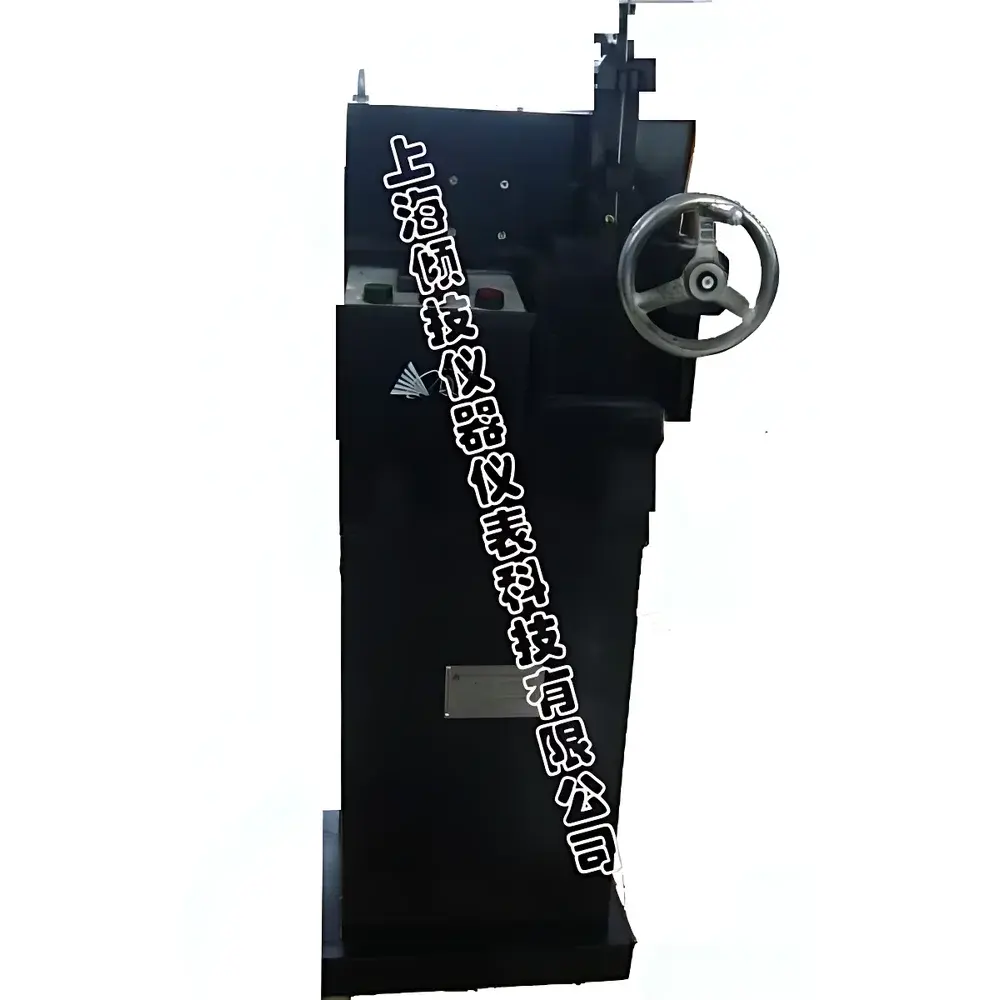
Qingji QJWQ-6(10) Repeated Bending Tester for Metal Sheets and Wires
| Brand | Qingji |
|---|---|
| Origin | Shanghai, China |
| Manufacturer Type | Authorized Distributor |
| Country of Origin | China |
| Model | QJWQ-6(10) |
| Price | USD 9,200 (FOB Shanghai) |
| Wire Diameter Range | 0.3–3 mm (optional up to 6 mm) |
| Sheet Thickness Capacity | 3 mm |
| Bend Cycle Counter Range | 0–9999 |
| Bending Rate | 60 cycles/min |
| Bend Angle per Cycle | ±90° (total 180° reversal) |
| Specimen Length | 150–200 mm |
| Operating Ambient Temperature | 15–30 °C |
| Relative Humidity | ≤85 % RH |
| Dimensions (W×D×H) | 420 × 300 × 1320 mm |
| Net Weight | 350 kg |
Overview
The Qingji QJWQ-6(10) Repeated Bending Tester is a precision mechanical fatigue testing instrument engineered to evaluate the ductility, plastic deformation resistance, and structural integrity of metallic flat products—including thin sheets, strips, and wires—under controlled cyclic bending stress. It operates on the principle of uniaxial alternating flexural loading, where a fixed-length specimen is clamped at one end while the free end undergoes repetitive 90° clockwise and counterclockwise rotations about a defined mandrel axis. This simulates real-world service conditions involving repeated flexing, such as in electrical contacts, spring components, flexible printed circuit interconnects, and automotive trim elements. The system strictly complies with the test methodology specified in GB/T 238–2002 (“Metallic Materials — Wire — Repeated Bending Test”), which defines procedural requirements for specimen preparation, mandrel diameter selection, bending frequency, and failure criteria (i.e., crack initiation or complete fracture observed under magnification). Its robust architecture ensures high reproducibility across laboratories and supports routine quality control in metallurgical production, incoming material inspection, and R&D validation workflows.
Key Features
- Motor-driven cam mechanism delivering consistent 60 bending cycles per minute, with adjustable dwell time at extremities to minimize inertial overshoot
- Dual-mode operation: configurable for wire testing (0.3–3 mm nominal diameter; optional extension to 6 mm) and sheet testing (up to 3 mm thickness), each with dedicated clamping fixtures and mandrel sets
- High-resolution electromechanical cycle counter (0–9999) with non-volatile memory retention and manual reset function
- Fixed-axis bending geometry ensuring precise ±90° angular displacement per half-cycle, verified via optical encoder feedback
- Stainless-steel mandrels available in standardized diameters per GB/T 238–2002 Annex A, supporting traceable calibration against reference gage blocks
- Heavy-duty cast-iron base and reinforced upright column (350 kg total mass) providing vibration damping and long-term dimensional stability
- Front-access specimen chamber with transparent polycarbonate guard panel meeting EN ISO 13857 safety clearance requirements
Sample Compatibility & Compliance
The QJWQ-6(10) accommodates flat specimens measuring 150–200 mm in length and up to 3 mm in thickness, as well as round wires within the 0.3–6 mm diameter range. Specimen cross-sections must be uniform along the gauge length; edge burrs or surface defects are excluded per GB/T 238–2002 Section 6. Mandrel selection follows mandatory ratios relative to specimen thickness/diameter (e.g., 1×, 2×, or 3×), documented in test reports. While GB/T 238–2002 is the primary compliance standard, the instrument’s kinematic repeatability and force profile align with functional equivalents in ASTM E2128 (Standard Guide for Evaluating Flexural Fatigue of Metallic Foils) and ISO 7438 (Metallic materials — Bend test). It supports GLP-compliant documentation when integrated with external lab management systems.
Software & Data Management
The QJWQ-6(10) operates as a standalone electromechanical tester without embedded microprocessor control or digital interface. All operational parameters—including cycle count, bending rate, and specimen identification—are manually recorded by the operator. For auditability, users may integrate the device into LIMS or ELN platforms via external barcode scanners or foot-switch-triggered timestamp loggers. Cycle completion signals can be exported as dry-contact TTL pulses (open-collector output, 5 V logic level) for synchronization with high-speed imaging systems or acoustic emission sensors used in advanced failure mode analysis. No proprietary software is supplied; however, raw count data is compatible with common spreadsheet and statistical process control (SPC) tools.
Applications
- Quality assurance of cold-rolled stainless steel strips for consumer electronics housings
- Evaluation of aluminum alloy sheet formability in aerospace bracket fabrication
- Validation of copper-nickel alloy wire ductility prior to crimp termination in automotive harnesses
- Comparative fatigue screening of coated vs. bare metal foils in battery current collector development
- Supplier qualification testing per OEM-specific material specifications referencing GB/T 238–2002 or internal bend-life thresholds
- Teaching laboratory use for undergraduate metallurgy courses demonstrating strain localization and necking behavior under cyclic bending
FAQ
Does the QJWQ-6(10) comply with international standards beyond GB/T 238–2002?
Yes—its mechanical design and test execution protocol are functionally compatible with ASTM E2128 and ISO 7438 for qualitative bend-fatigue assessment, though formal certification requires third-party verification per local regulatory frameworks.
Can the bending speed be adjusted below 60 cycles/min?
No—the drive mechanism is fixed-speed only; variable-rate operation is not supported. For lower-frequency fatigue studies, alternative servo-hydraulic or electromagnetic testers are recommended.
Is calibration documentation provided with shipment?
A factory calibration certificate verifying mandrel diameter tolerances (±0.02 mm) and cycle counter accuracy (±1 count over 1,000 cycles) is included. Annual recalibration is advised using NIST-traceable gage blocks and optical encoders.
What maintenance intervals are recommended for sustained accuracy?
Lubrication of cam follower bearings and inspection of clamp jaw wear are required every 5,000 cycles. Replacement mandrels and clamping inserts are stocked globally through Qingji’s authorized distributor network.



