
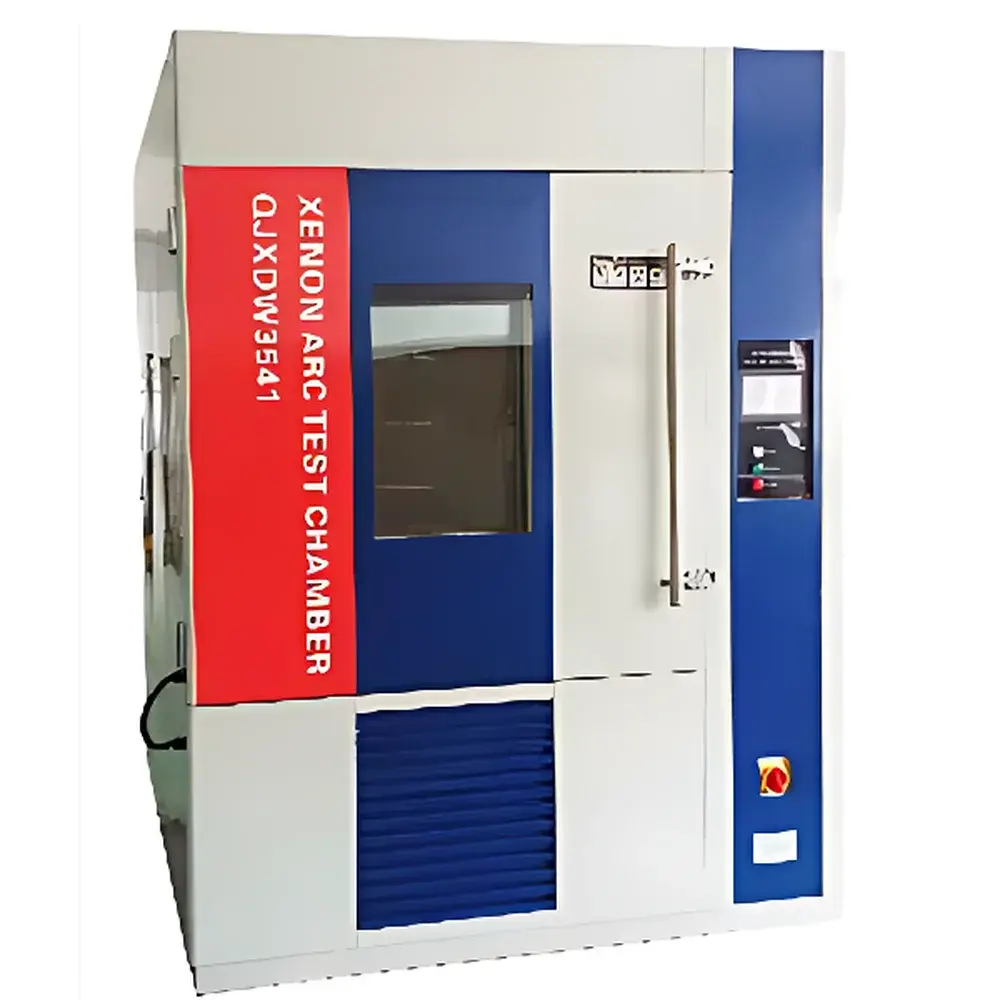
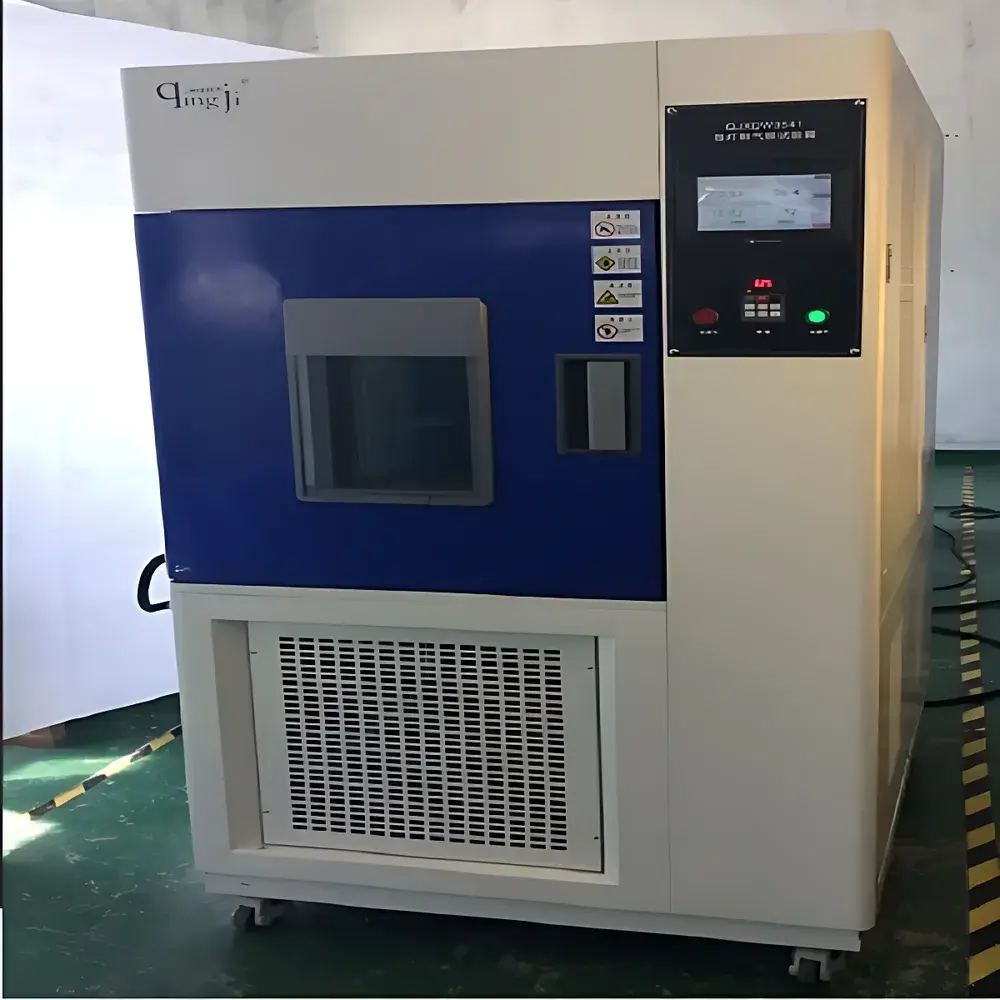
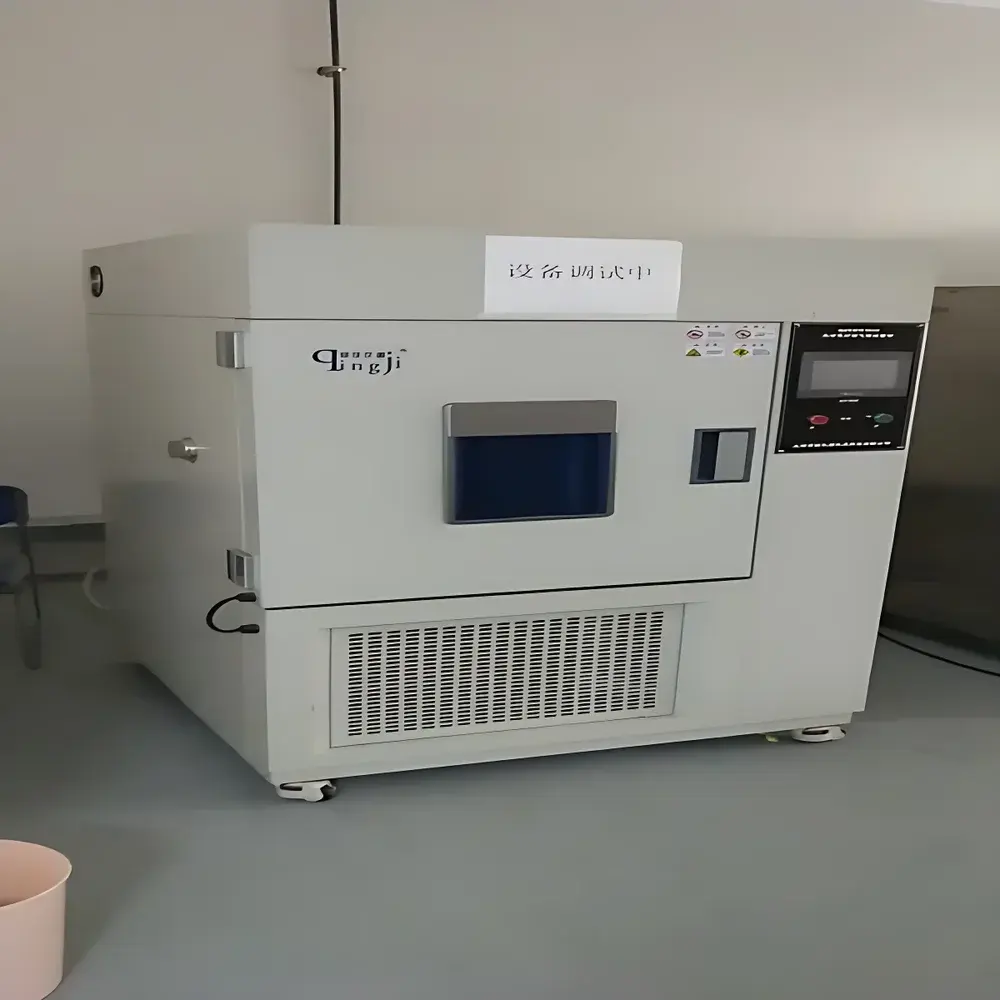
Qingji QJXDW3541 Xenon Arc Weathering Test Chamber
| Brand | Qingji |
|---|---|
| Origin | Shanghai, China |
| Manufacturer Type | Authorized Distributor |
| Country of Manufacture | China |
| Model | QJXDW3541 |
| Price Range | USD 5,600 – 28,000 (FOB Shanghai) |
| Light Source | 6 kW Air-Cooled or Water-Cooled Xenon Arc Lamp |
| Spectral Range | 290–800 nm |
| Irradiance Control | Adjustable, Displayed in Real Time (300–800 nm @ 550 W/m² nominal) |
| Temperature Range | RT+10°C to 80°C ±1°C |
| Temp Uniformity | ≤2°C |
| Sample Rotation | 5 rpm, Dual-Radial Fixture (Inner Ø100 mm / Outer Ø220 mm), Center Distance 165 mm, Height 420 mm |
| Chamber Dimensions (W×D×H) | 500×500×600 mm (standard) |
| Rainfall Duration | 0–9999 min (adjustable) |
| Rainfall Cycle Interval | 0–240 min (adjustable) |
| Cooling Method | Air-cooled (3 kW) or Water-cooled (4.5 kW) |
| Lamp Lifetime | Approx. 2000 h |
Overview
The Qingji QJXDW3541 Xenon Arc Weathering Test Chamber is an engineered environmental simulation system designed to replicate the photodegradative, thermal, and hygric stresses induced by natural outdoor exposure. It operates on the principle of xenon arc irradiation—utilizing a high-intensity 6 kW xenon lamp whose spectral output (290–800 nm) closely approximates terrestrial solar radiation when filtered through appropriate optical filters (e.g., borosilicate outer and quartz inner filters). This enables quantitative assessment of material degradation mechanisms including photooxidation, chalking, color shift, gloss loss, cracking, and embrittlement. The chamber integrates controlled irradiance, precise black-panel or black-standard temperature regulation (RT+10°C to 80°C ±1°C), programmable moisture cycles (condensation, spray, and humidity hold), and uniform sample rotation (5 rpm) to ensure reproducible, spatially consistent exposure across all test specimens. It conforms to core international weathering standards including ISO 4892-2, ASTM G155, SAE J2527, and GB/T 16422.2, supporting both R&D formulation screening and QC validation under GLP-aligned test protocols.
Key Features
- High-fidelity solar spectrum simulation via water-cooled or air-cooled 6 kW xenon arc lamp with real-time irradiance monitoring (300–800 nm band, nominal 550 W/m²)
- Precise temperature control using PID-regulated heating and refrigeration systems; black-standard temperature sensor integration ensures surface-relevant thermal profiling
- Programmable moisture delivery: independent control of spray duration (0–9999 min), interval timing (0–240 min), and condensation cycle sequencing
- Rotating dual-radius specimen holder (inner radius 100 mm, outer radius 220 mm) with center distance fixed at 165 mm and total height of 420 mm for optimal angular irradiance distribution
- Digital touchscreen controller with multi-segment programming capability, data logging (irradiance integral, temperature, spray status), and USB export functionality
- Robust stainless-steel interior construction with corrosion-resistant hardware and safety interlocks compliant with IEC 61000-6-3 EMC requirements
Sample Compatibility & Compliance
The QJXDW3541 accommodates flat-panel specimens up to 500×500×600 mm (chamber internal volume), with standard fixtures supporting ISO 4892-2-compliant specimen racks (e.g., 75×150 mm or 100×100 mm formats). It supports testing of organic coatings (automotive topcoats, architectural paints), polymeric films (PVC, PC, PET), composites (fiber-reinforced plastics), elastomers, and laminated safety glass per OEM specifications (e.g., Ford CETP, GMW14124, Toyota TSL). All operational parameters—including irradiance setpoint, temperature ramp rate, spray frequency, and dark-cycle duration—are fully traceable and auditable, enabling compliance with FDA 21 CFR Part 11 (when paired with validated software), ISO/IEC 17025 documentation requirements, and internal GLP/GMP quality systems.
Software & Data Management
The embedded controller provides non-volatile storage of up to 100 test programs and 30 days of continuous parameter logging (irradiance, chamber temperature, black-standard temperature, spray status). Exported CSV files include timestamped irradiance integrals (kJ/m²), cumulative thermal exposure (°C·h), and cycle event markers—structured for direct import into LIMS or statistical analysis platforms (e.g., JMP, Minitab). Optional Ethernet connectivity enables remote monitoring and alarm notification via SMTP or Modbus TCP. Audit trails record user login/logout, parameter modifications, and program execution history—supporting regulatory review under ISO 9001:2015 Clause 8.5.2 and ICH Q5C stability guidance.
Applications
- Accelerated aging of automotive exterior trim and headlamp lenses per SAE J2412 and ISO 11341
- UV stability qualification of medical device packaging materials (ISO 11607-1)
- Formulation optimization of UV-stabilized polyolefins and pigment-dispersed acrylics
- Correlation studies between laboratory xenon exposure and real-world field performance (e.g., Florida exposure racks, Arizona desert sites)
- Pre-qualification of aerospace sealants and radome coatings per MIL-STD-810H Method 505.6
- Regulatory submission support for FDA 510(k) and CE Marking dossiers requiring environmental durability evidence
FAQ
What spectral filters are included with the QJXDW3541, and how do they affect irradiance output?
The system ships with standard Daylight-Q/B (quartz/borosilicate) filter sets that replicate terrestrial AM1.5G solar irradiance. Optional extended-UV (Xenochrom) or window-glass (WG) filters are available for specialized applications.
Can the chamber operate unattended for extended cycles (e.g., 1,000 hours)?
Yes—continuous operation is supported with automatic lamp voltage compensation, thermal cut-off redundancy, and self-diagnostic firmware. Scheduled maintenance intervals (lamp replacement, filter cleaning) are logged and configurable.
Is calibration traceable to NIST or other national metrology institutes?
Irradiance sensors are factory-calibrated against NIST-traceable reference cells; optional annual recalibration services include certificate of conformance per ISO/IEC 17025.
How does the QJXDW3541 handle specimen temperature non-uniformity during high-irradiance exposure?
Black-standard thermometers mounted adjacent to each specimen position provide localized feedback; the controller dynamically adjusts heater power and airflow to maintain ≤2°C spatial uniformity across the full load plane.
Does the system support custom irradiance profiles (e.g., ramped intensity over time)?
Yes—the controller allows segmented irradiance programming (up to 10 steps per cycle), enabling simulation of diurnal intensity variation or seasonal spectral shifts.



