
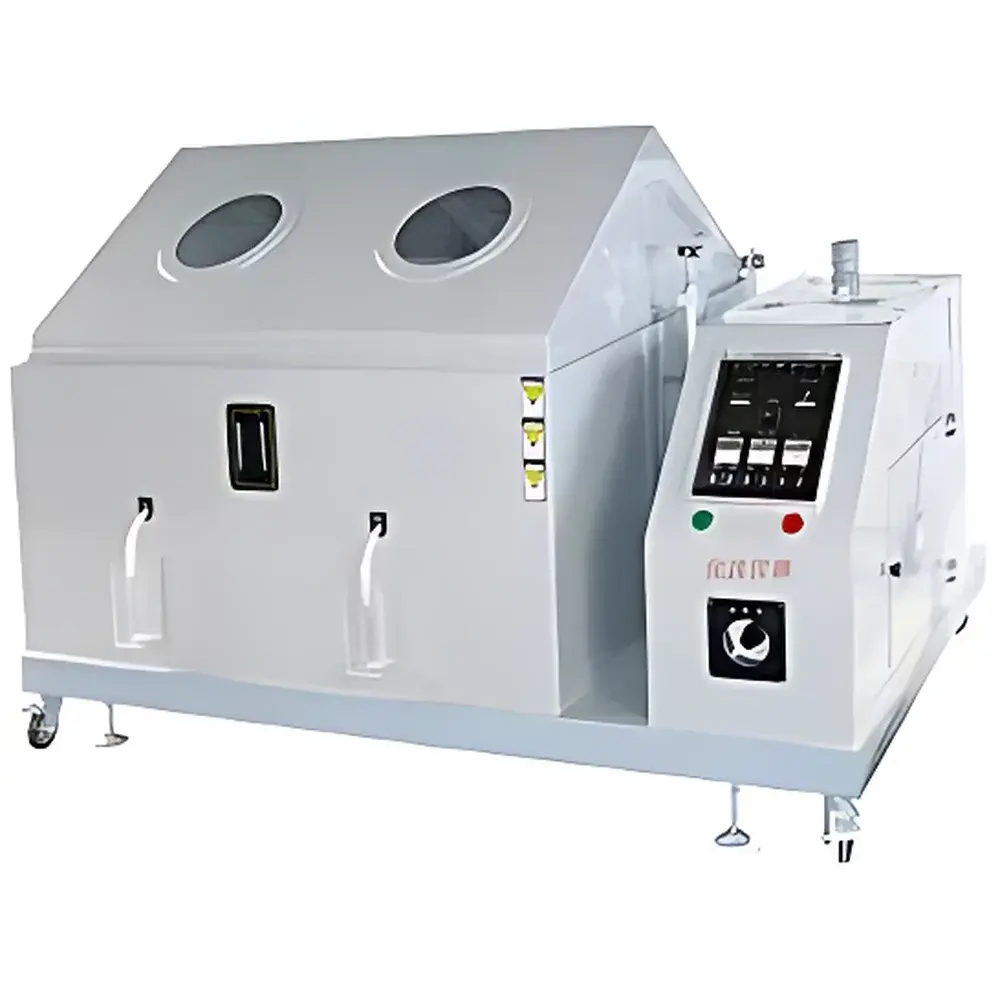
Qingji QJYS-70 Salt Spray Test Chamber
| Brand | Qingji |
|---|---|
| Origin | Shanghai, China |
| Manufacturer Type | Authorized Distributor |
| Country of Origin | China |
| Model | QJYS-70 |
| Price | USD 2,800 (FOB Shanghai) |
| Internal Chamber Dimensions (Min–Max) | 600 × 450 × 400 mm to 1600 × 1000 × 500 mm |
| External Dimensions (Min–Max) | 1075 × 630 × 1185 mm to 2300 × 1200 × 1485 mm |
| Chamber Volume (Min–Max) | 108 L to 800 L |
| Salt Solution Reservoir Capacity (Min–Max) | 15 L to 40 L |
| Test Standards Compliance | GB/T 2423.17 (Neutral Salt Spray), GB/T 2423.18 (Acetic Acid Salt Spray), ASTM B117, ISO 9227, JIS Z2371 |
Overview
The Qingji QJYS-70 Salt Spray Test Chamber is a precision-engineered environmental test system designed to evaluate the corrosion resistance of metallic materials, protective coatings, electroplated surfaces, and finished industrial components under accelerated saline atmospheric conditions. Operating on the principle of continuous or cyclic salt fog generation via compressed-air atomization of a standardized sodium chloride (NaCl) solution, the chamber simulates aggressive coastal or de-icing salt environments to quantify material degradation kinetics over controlled exposure durations. As a core tool in reliability engineering and quality assurance workflows, it supports both Neutral Salt Spray (NSS) testing per GB/T 2423.17 and Acetic Acid Salt Spray (AASS) per GB/T 2423.18 — fully aligned with internationally recognized protocols including ASTM B117, ISO 9227, and JIS Z2371. Its modular architecture accommodates seven distinct internal volume configurations (108–800 L), enabling scalability from R&D sample validation to full-scale production lot qualification.
Key Features
- Corrosion-resistant PVC-coated steel construction with double-wall insulation for thermal and chemical stability
- Precision-controlled saturated air heater and pre-heated salt solution reservoir to maintain consistent chamber temperature (35 ± 2°C for NSS; 50 ± 2°C for AASS) and humidity (≥95% RH)
- Adjustable nozzle-based spray system with calibrated flow rate (1.0–2.0 mL/80 cm²/h) and uniform fog distribution verified by ASTM B117 collection test
- Digital PID controller with real-time monitoring of chamber temperature, saturation temperature, and test duration
- Integrated overflow protection, low-level salt solution alarm, and automatic drain valve for operational safety and maintenance efficiency
- Compliance-ready design supporting audit trails for GLP/GMP environments when paired with optional data logging modules
Sample Compatibility & Compliance
The QJYS-70 accommodates a broad spectrum of test specimens — including automotive fasteners, aerospace alloy panels, printed circuit board assemblies, galvanized steel sheets, anodized aluminum extrusions, and polymer-coated structural components — without requiring custom fixturing for standard geometries. All chamber variants meet mechanical and dimensional requirements for specimen rack loading per ISO 9227 Annex A. Regulatory alignment extends beyond basic standards: the system’s repeatability and inter-laboratory reproducibility are validated against ISO/IEC 17025 calibration traceability frameworks. Optional accessories include polypropylene specimen racks, pH-adjusted solution preparation kits (for AASS), and NIST-traceable temperature/humidity sensors for accredited lab use.
Software & Data Management
While the base QJYS-70 operates via embedded digital controller with local display and manual data recording, optional RS-485/USB interface enables integration with third-party laboratory information management systems (LIMS) or custom SCADA platforms. Time-stamped test logs — including start/stop timestamps, setpoint deviations, and alarm events — can be exported as CSV files for long-term archival and statistical process control (SPC) analysis. For regulated industries, optional firmware upgrade supports 21 CFR Part 11-compliant electronic signatures, audit trail generation, and user access level management (Operator, Technician, Administrator), facilitating FDA-submission readiness and internal QA audits.
Applications
- Qualification of zinc-nickel and trivalent chromium electroplating processes in Tier-1 automotive suppliers
- Validation of powder coating adhesion and blistering resistance on outdoor HVAC enclosures
- Comparative evaluation of stainless steel grades (e.g., 304 vs. 316) for marine instrumentation housings
- Accelerated aging studies of solder mask integrity on high-reliability PCBs per IPC-J-STD-006
- Corrosion performance benchmarking of biodegradable metal implants under simulated physiological chloride exposure
- Supplier qualification testing for EN 13858-compliant architectural aluminum anodizing
FAQ
What standards does the QJYS-70 support out-of-the-box?
It natively supports GB/T 2423.17 (NSS), GB/T 2423.18 (AASS), ASTM B117, ISO 9227, and JIS Z2371. Custom test profiles (e.g., cyclic CASS or modified PROHIBIT protocols) require optional software configuration.
Is the chamber suitable for testing non-metallic materials?
Yes — while primarily used for metallic substrates and coatings, it is routinely applied to assess chloride-induced degradation of fiber-reinforced polymers, elastomeric seals, and conductive adhesives when combined with post-test visual/microscopic evaluation.
How is temperature and humidity uniformity verified?
Uniformity is confirmed during factory acceptance testing using nine-point thermocouple mapping per ISO 16750-4 Annex D, with ≤±2°C spatial deviation across the working volume.
Can the system be integrated into an automated test cell?
Yes — the standard RS-485 Modbus RTU interface allows bidirectional communication with PLCs or MES systems for batch-triggered test initiation and status reporting.
What maintenance intervals are recommended for sustained compliance?
Daily: rinse spray nozzles and inspect solution level. Quarterly: calibrate temperature sensors and verify saturation chamber water level. Annually: full system verification per ISO/IEC 17025 Clause 6.5, including fog deposition rate revalidation.



