
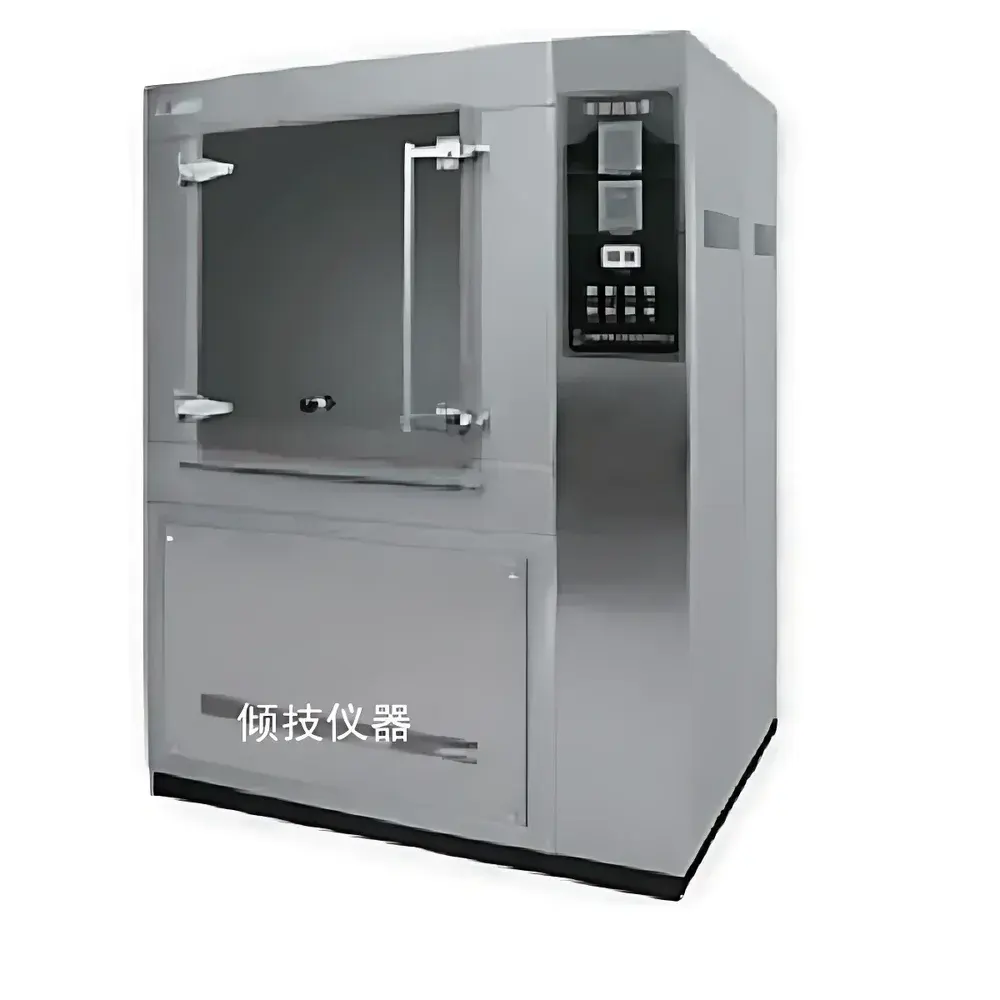
Qingji SCY-1215 IP Ingress Protection Rain Test Chamber
| Origin | Shanghai, China |
|---|---|
| Manufacturer Type | Authorized Distributor |
| Origin Category | Domestic (China) |
| Model | Qingji SCY-1215 |
| Price | USD 7,800 (FOB Shanghai) |
| Compliance | GB/T 4208–2017, GB/T 4942.1–1993, IEC 60529:2013 (equivalent) |
| Chamber Interior Dimensions | 800 × 800 × 800 mm (D×W×H) |
| External Dimensions | 1100 × 1300 × 1700 mm (D×W×H) |
| Oscillating Pipe Radius | 400 mm |
| Nozzle Quantity | 25 |
| Nozzle Diameter | Ø0.4 mm |
| Nozzle Spacing | 50 mm |
| Pipe Diameter | Ø16 mm |
| Water Flow Rate per Nozzle | 0.07 L/min |
| Total Flow Rate | ~1.8 L/min |
| Oscillation Angle | ±60° (120° total sweep) |
| Cycle Time per Full Oscillation | ~12 s |
| Timer Range | 00:00:00 to 99:59:59 (h:mm:ss) |
| Power Supply | AC 220 V ±10%, 50 Hz |
| Interior Material | SUS304 2B stainless steel |
| Exterior Enclosure | Cold-rolled steel with anti-rust pretreatment and electrostatic powder coating |
| Sample Tray | Custom stainless steel tray with precision-drilled drainage holes |
Overview
The Qingji SCY-1215 IP Ingress Protection Rain Test Chamber is an engineered environmental test system designed to evaluate the degree of protection provided by enclosures against water ingress under defined conditions—specifically in accordance with the international standard IEC 60529 and its national equivalents, including GB/T 4208–2017 and GB/T 4942.1–1993. This chamber implements the oscillating pipe (IPX3/IPX4) test method, where a calibrated array of nozzles mounted on a rotating arm delivers controlled water spray across the front-facing surface of a stationary sample at specified angles, flow rates, and durations. It is widely deployed for validation testing of outdoor lighting fixtures, automotive lamps, traffic signal housings, industrial control cabinets, and other electrotechnical equipment requiring certified IPX3 or IPX4 ratings. The system’s mechanical architecture ensures repeatable angular displacement, stable flow distribution, and long-term operational consistency under laboratory or production-line QA environments.
Key Features
- Oscillating pipe mechanism with ±60° swing range (120° total arc), driven by a precision stepper motor and gear-reduction assembly for low-vibration, high-repeatability motion
- 25 precisely drilled nozzles (Ø0.4 mm) arranged along a 400 mm radius pipe, spaced at uniform 50 mm intervals to ensure homogeneous spray coverage over the test zone
- Integrated digital flow control system featuring dual-stage regulation: primary metering via calibrated orifice plate, secondary monitoring via electromagnetic flowmeter (range: 0–3.0 L/min, accuracy ±1.5% FS)
- Programmable timer module supporting time-based test execution from 1 second to 99 hours, 59 minutes, 59 seconds—enabling full compliance with IPX3 (3 min minimum) and IPX4 (5 min minimum) protocols
- Robust chamber construction: interior lined with mirror-finished SUS304 2B stainless steel for corrosion resistance and ease of cleaning; exterior housing fabricated from cold-rolled steel with phosphating + epoxy-polyester powder coating (thickness ≥60 µm)
- Custom-engineered stainless steel sample support tray with laser-cut drainage apertures (Ø3 mm, pitch 15 mm) to prevent pooling and ensure unobstructed runoff during testing
- Dedicated water recirculation loop with integrated filtration (5 µm polypropylene cartridge) and temperature stabilization (ambient ±2 °C), minimizing consumable usage and enabling multi-cycle testing without manual refilling
Sample Compatibility & Compliance
The SCY-1215 accommodates samples up to 800 mm in height, width, and depth, making it suitable for luminaires (e.g., LED streetlights, headlamp assemblies), junction boxes, sensor housings, and small-to-medium industrial enclosures. Its test methodology aligns strictly with Clause 14.2.3 (IPX3) and Clause 14.2.4 (IPX4) of IEC 60529:2013. Validation documentation includes traceable calibration certificates for flowmeter and timer modules, issued by CNAS-accredited laboratories. The chamber supports audit-ready operation under GLP and ISO/IEC 17025 frameworks; optional data logging modules provide timestamped records compliant with FDA 21 CFR Part 11 requirements when paired with validated software.
Software & Data Management
While the base SCY-1215 operates via embedded microcontroller with tactile keypad interface, optional PC-based control software (Qingji TestSuite v3.2) enables remote parameter configuration, real-time flow rate visualization, automated test sequence scripting, and export of CSV-formatted test logs—including start/stop timestamps, cumulative runtime, and measured flow deviations. All digital records include operator ID, instrument serial number, and calibration expiry dates—supporting full traceability for internal quality audits or third-party certification submissions (e.g., CCC, CE, UL).
Applications
- Pre-certification verification of IPX3 (dripping water) and IPX4 (splashing water) ratings prior to formal IEC/GB testing
- Routine incoming inspection of lighting components in Tier-1 automotive suppliers
- Design validation of outdoor-rated power distribution units (PDUs) and telecom cabinets
- Failure mode analysis of gasket integrity and sealant performance under cyclic wetting stress
- Comparative evaluation of enclosure material hydrophobicity and surface geometry effects on water shedding behavior
FAQ
Does the SCY-1215 support IPX5 or IPX6 testing?
No—the SCY-1215 is configured exclusively for IPX3 and IPX4 oscillating pipe tests per IEC 60529. IPX5/IPX6 requires nozzle-based jet testing (12.5 mm or 6.3 mm diameter, 100 kPa pressure), which necessitates a separate high-pressure rain test system.
Can the chamber be integrated into an automated test line?
Yes—optional dry-contact I/O ports (2 × input, 2 × output) allow synchronization with PLC-controlled conveyors or robotic handlers for unattended batch testing.
What maintenance is required to sustain measurement accuracy?
Monthly inspection of nozzle orifices for mineral deposits (using 0.3 mm tungsten wire), quarterly recalibration of the electromagnetic flowmeter, and annual verification of oscillation angle repeatability using optical encoder feedback.
Is distilled water required for operation?
Deionized or softened water (conductivity <100 µS/cm) is strongly recommended to prevent scaling; tap water may be used only if hardness is <100 ppm CaCO₃ and filtered inline (5 µm).
Does Qingji provide installation and IQ/OQ documentation?
Yes—on-site commissioning, Factory Acceptance Testing (FAT), and full GMP-aligned Installation Qualification (IQ) and Operational Qualification (OQ) packages are available as value-added services.



