
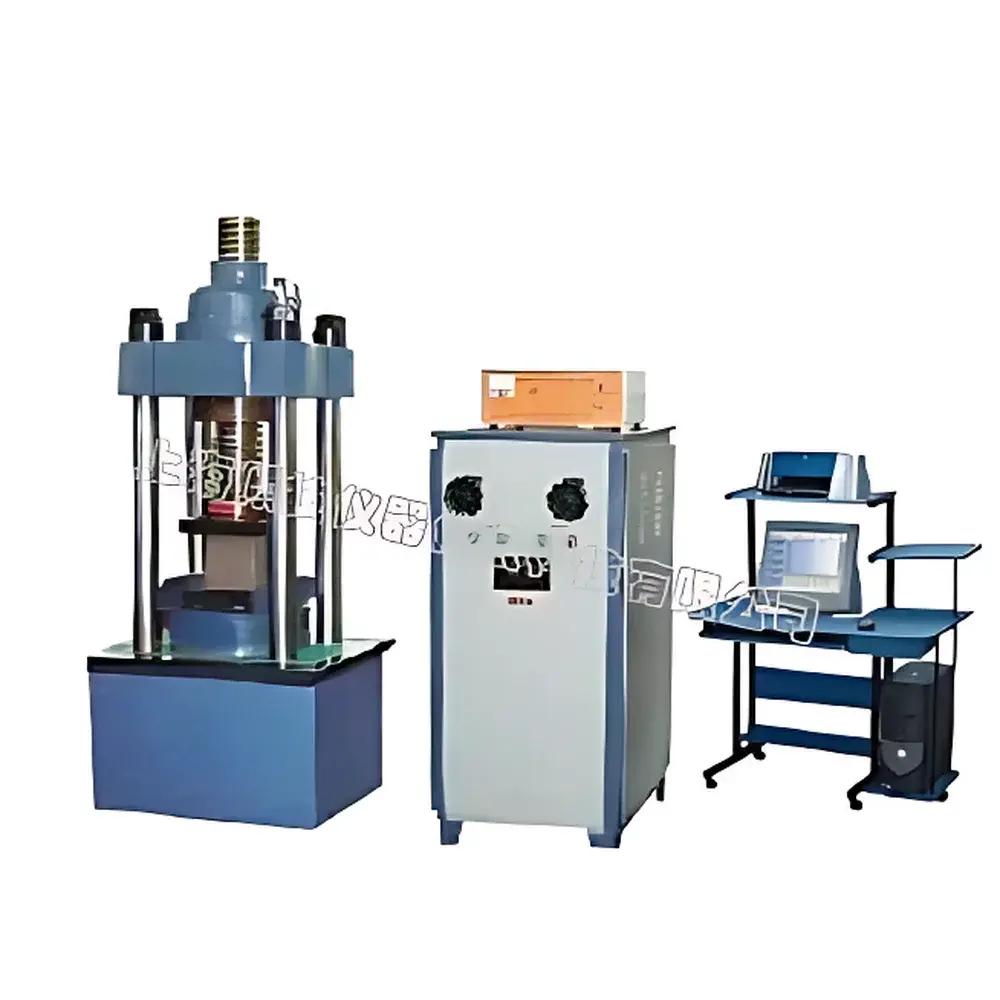
Qingji YL Series Road Construction Materials Strength Testing Machine
| Brand | Qingji |
|---|---|
| Origin | Shanghai, China |
| Model | Qingji YL-2000 / YL-3000 |
| Max Load Capacity | 2000 kN / 3000 kN |
| Accuracy Class | Class I (per ISO 7500-1 & ASTM E4) |
| Force Range | 10–2000 kN / 10–3000 kN |
| Loading Rate | 1–15 mm/s (adjustable, closed-loop servo-controlled) |
| Internal Clearance (between platens) | 320 mm |
| Platen Dimensions | 320 × 320 mm or 400 × 400 mm |
| Motor Power | 0.75 kW / 1.1 kW / 2.2 kW |
| Net Weight | 1000 kg / 1500 kg |
| Overall Dimensions (W×D×H) | ~520×450×1350 mm or ~700×540×1800 mm |
| Control System | PC-based servo-hydraulic or electromechanical closed-loop control with real-time data acquisition |
Overview
The Qingji YL Series Road Construction Materials Strength Testing Machine is a high-precision universal compression testing system engineered for mechanical characterization of rigid and semi-rigid construction materials under uniaxial compressive loading. Designed in accordance with ISO 7500-1 (static calibration of force-proving instruments), ASTM E4 (standard practices for force verification of testing machines), and EN 12390-4 (testing hardened concrete—compressive strength), this machine delivers traceable, repeatable, and auditable test results essential for quality assurance in highway engineering, civil infrastructure projects, and building material certification laboratories. It employs a closed-loop servo-controlled actuation system—either electromechanical or hydraulic depending on model configuration—to maintain precise stress, strain, or displacement trajectories during test execution. The system supports three primary control modes: constant stress rate, constant strain rate, and constant displacement rate—enabling compliance with standardized test protocols such as ASTM C39 (concrete cylinders), ASTM C67 (clay brick), ASTM C133 (refractory materials), and JTG E20-2011 (Chinese specification for asphalt mixture testing).
Key Features
- Class I accuracy certified per ISO 7500-1, ensuring measurement uncertainty ≤ ±0.5% of full scale across the validated force range.
- Dual-platen configuration with interchangeable 320 × 320 mm and 400 × 400 mm hardened steel platens, optimized for standard specimen geometries including Ø150 mm × 300 mm concrete cylinders, 240 × 115 × 53 mm clay bricks, and stabilized soil-cement cubes.
- Adjustable crosshead travel with 320 mm internal clearance accommodates specimens up to 300 mm in height while maintaining alignment tolerance ≤ 0.1 mm/m per ASTM E1012.
- Real-time PC-based control interface enabling programmable load–displacement profiles, multi-step ramp-hold sequences, and automatic termination upon peak load or preset deformation limits.
- Integrated high-resolution encoder and calibrated load cell with digital signal conditioning provide synchronized acquisition at ≥1 kHz sampling rate for dynamic response analysis.
- Rugged structural frame with reinforced base and guided column assembly ensures minimal deflection (<0.02 mm/kN) and long-term stability under cyclic loading conditions.
Sample Compatibility & Compliance
The Qingji YL series accommodates a broad spectrum of civil engineering specimens: Portland cement concrete (ASTM C39/C109), autoclaved aerated concrete (AAC), fired and unfired clay bricks (ASTM C67/GB/T 2542), asphalt-aggregate mixtures (ASTM D6927/JTG E20), stabilized subgrade soils (ASTM D1633/D559), and precast concrete elements. All test routines comply with international standards governing reporting integrity—including mandatory audit trails, electronic signatures, and data immutability features aligned with FDA 21 CFR Part 11 requirements when configured with optional GLP/GMP-compliant software modules. Calibration certificates are NIST-traceable and include as-found/as-left verification records.
Software & Data Management
The embedded Windows-based testing software provides ISO/IEC 17025-aligned data handling: raw sensor streams are timestamped and stored in encrypted binary archives (.qjd format), with export options to CSV, PDF, and XML for LIMS integration. Curve overlay, statistical batch reporting (mean, SD, CV%), outlier detection (Grubbs’ test), and pass/fail flagging against specification thresholds (e.g., minimum compressive strength per ACI 318 or EN 206) are natively supported. Audit logs record all user actions—including parameter changes, calibration events, and report generation—with immutable timestamps and operator IDs. Optional add-ons include automated report templates compliant with CNAS-CL01 and third-party accreditation body requirements.
Applications
- Quality control of ready-mix concrete batches in precast plants and batching facilities.
- Evaluation of compressive performance of recycled aggregate concrete and supplementary cementitious material (SCM) blends.
- Structural validation of pavement base layers (cement-treated, lime-fly ash stabilized) per AASHTO T135 and ASTM D559.
- Research-grade mechanical property mapping for novel geopolymer binders and fiber-reinforced concretes.
- Third-party certification testing for CE marking of masonry units under EN 771-1.
- Teaching laboratories for civil engineering curricula covering mechanics of materials and structural design fundamentals.
FAQ
What standards does the Qingji YL series comply with for calibration and operation?
It conforms to ISO 7500-1 (static calibration), ASTM E4 (force verification), ASTM E1012 (alignment verification), and EN ISO 7500-1 for metrological traceability.
Can the system perform split tensile strength tests on concrete cylinders?
Yes—when equipped with a Brazilian test fixture and appropriate software module, it executes ASTM C496-compliant diametral compression tests.
Is remote diagnostics and firmware updates supported?
Yes—via secure TLS-encrypted Ethernet connection; OEM technical support can initiate session-based troubleshooting with customer consent.
Does the machine support multi-specimen sequential testing without manual intervention?
Yes—through programmable test sequences with auto-unload, platen repositioning, and specimen ejection triggers.
What documentation is provided for regulatory audits?
Factory calibration certificate, ISO/IEC 17025-compliant user manual, software validation summary (IQ/OQ), and electronic audit trail export capability.



