
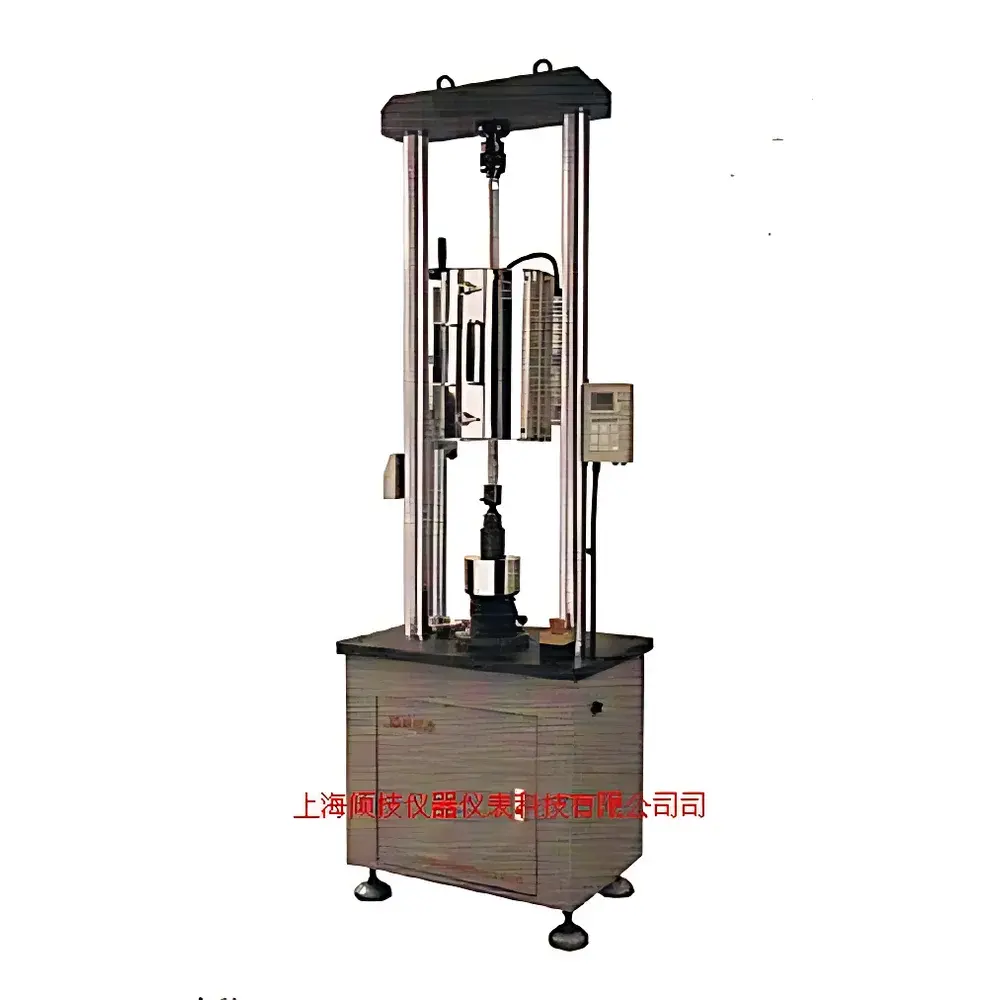
Qinji BV212F High-Temperature Creep and Stress Rupture Testing Machine
| Brand | Qinji |
|---|---|
| Origin | Shanghai, China |
| Model | BV212F |
| Instrument Type | Electromechanical |
| Max Test Load | 100 kN |
| Crosshead Travel | 200 mm |
| Furnace Dimensions | Ø50 mm × 450 mm (L) |
| Weight | 850 kg |
| Temperature Range | Ambient to 1200 °C |
| Temperature Control Accuracy | ±0.5 °C |
| Temperature Resolution | 0.1 °C |
| Uniform Temperature Zone Length | >150 mm |
| Load Measurement Accuracy | ±0.5% of reading (from 1% FS) |
| Load Control Stability | ±1% of setpoint |
| Load Resolution | 0.1 N |
| Deformation Measurement | High-precision linear encoder |
| Deformation Range | Up to 25 mm |
| Deformation Accuracy | ±0.5% |
| Drive Speed Range | 0.01–180 mm/min |
| Power Requirement | 3 kW |
Overview
The Qinji BV212F High-Temperature Creep and Stress Rupture Testing Machine is an electromechanical testing system engineered for precise, long-duration mechanical characterization of metallic and alloy materials under sustained uniaxial tensile loading at elevated temperatures. It operates on the fundamental principles of time-dependent viscoelastic deformation—specifically, primary (transient), secondary (steady-state), and tertiary (accelerated) creep regimes—as defined in ASTM E139, ISO 204, and GB/T 2039. Designed for compliance with national and international standards including JJG 276–1988, HB 5150–1996, and HB 5151–1996, the BV212F delivers traceable, reproducible data required for high-integrity structural assessment in mission-critical applications such as turbine blade qualification, pressure vessel design validation, and aerospace component life modeling.
Key Features
- Robust load frame with 850 kg mass and rigid structural architecture to minimize thermal drift and mechanical vibration during multi-day or multi-week tests.
- High-stability electromechanical actuation system featuring imported servo motor and precision ball-screw transmission, enabling continuous load control from 0.1 N to full-scale 100 kN with ±1% accuracy and 0.1 N resolution.
- Integrated high-temperature furnace with cylindrical hot zone (Ø50 mm × 450 mm L), capable of stable operation from ambient to 1200 °C; uniform temperature zone exceeds 150 mm in length, ensuring consistent thermal exposure across the gauge section of specimens.
- Dual-channel high-fidelity measurement: load acquisition via calibrated load cell (±0.5% error from 1% FS), and axial deformation via imported linear encoder (±0.5% error over 25 mm range).
- Programmable crosshead speed from 0.01 to 180 mm/min, supporting both creep rate profiling and stress rupture ramp-to-failure protocols.
- Thermal management system with optimized insulation and cooling ducts to protect load train components and extend service life of critical sensors and actuators.
Sample Compatibility & Compliance
The BV212F accommodates standard round and flat tensile specimens per ASTM E139, ISO 204, and GB/T 2039 geometries, including those with reduced sections up to Ø10 mm or equivalent cross-sectional area. Specimen holders are fabricated from high-temperature alloys (e.g., Inconel 718) and feature water-cooled grips to maintain mechanical integrity below 200 °C while isolating the furnace zone. All test procedures align with regulatory expectations for GLP-compliant laboratories: audit trails for load/temperature setpoints, calibration records, and environmental monitoring logs can be exported in CSV or XML format. The system supports documentation workflows compatible with FDA 21 CFR Part 11 requirements when integrated with validated third-party LIMS or ELN platforms.
Software & Data Management
The BV212F is supplied with dedicated Windows-based control and analysis software supporting real-time synchronization of load, displacement, temperature, and elapsed time. Users define multi-step test profiles—including hold periods, ramped stress increments, and automatic termination upon rupture—with configurable sampling intervals down to 1 second. Raw data files include embedded metadata (operator ID, specimen ID, calibration certificate IDs, furnace thermocouple positions). Post-test analysis modules compute minimum creep rate, time to specific strain thresholds (e.g., 1% total strain), time to rupture, and Larson–Miller parameter derivations. Export formats include ASCII, Excel-compatible .xlsx, and PDF reports compliant with internal QA review templates.
Applications
- Creep property mapping of Ni-based superalloys used in gas turbine disks and blades.
- Stress rupture life prediction for stainless steels and titanium alloys in nuclear reactor piping systems.
- Validation of constitutive models (e.g., Norton–Bailey power law, Garofalo hyperbolic sine law) under isothermal and thermomechanical cycling conditions.
- Quality assurance testing of weldments and heat-affected zones (HAZ) in high-temperature pressure vessels per ASME BPVC Section II and Section VIII.
- Research into microstructural evolution mechanisms—including dislocation climb, grain boundary sliding, and cavity nucleation—via post-test metallography correlation.
- Support for ISO 15614-4 and AWS D17.1 qualification of joining processes for aerospace structural components.
FAQ
What temperature uniformity is guaranteed within the furnace hot zone?
The furnace maintains a temperature gradient ≤±1.5 °C over a minimum 150 mm axial length at any setpoint between 600 °C and 1200 °C, verified by three-point thermocouple mapping prior to shipment.
Can the system perform constant-load creep tests and step-stress rupture tests simultaneously?
No—each test channel executes one protocol at a time; however, sequential automated test sequences (e.g., creep hold → ramp → rupture) are fully programmable within a single job file.
Is the load cell calibrated traceable to national metrology institutes?
Yes—factory calibration certificates reference CNAS-accredited laboratories (ISO/IEC 17025) with direct traceability to SIM/NIM standards; recalibration services are available with documented uncertainty budgets.
What specimen extensometer options are supported?
The system natively interfaces with clip-on high-temperature extensometers (up to 1200 °C) and non-contact laser extensometers; encoder-based deformation remains the default primary measurement per GB/T 2039.
Does the software support automated pass/fail evaluation against acceptance criteria?
Yes—user-defined limit checks (e.g., “rupture time ≥ 10,000 h at 700 °C / 150 MPa”) trigger visual alerts and generate summary flags in report exports.
Related Products



